
How Long Does It Take to Replace a Dental Crown?
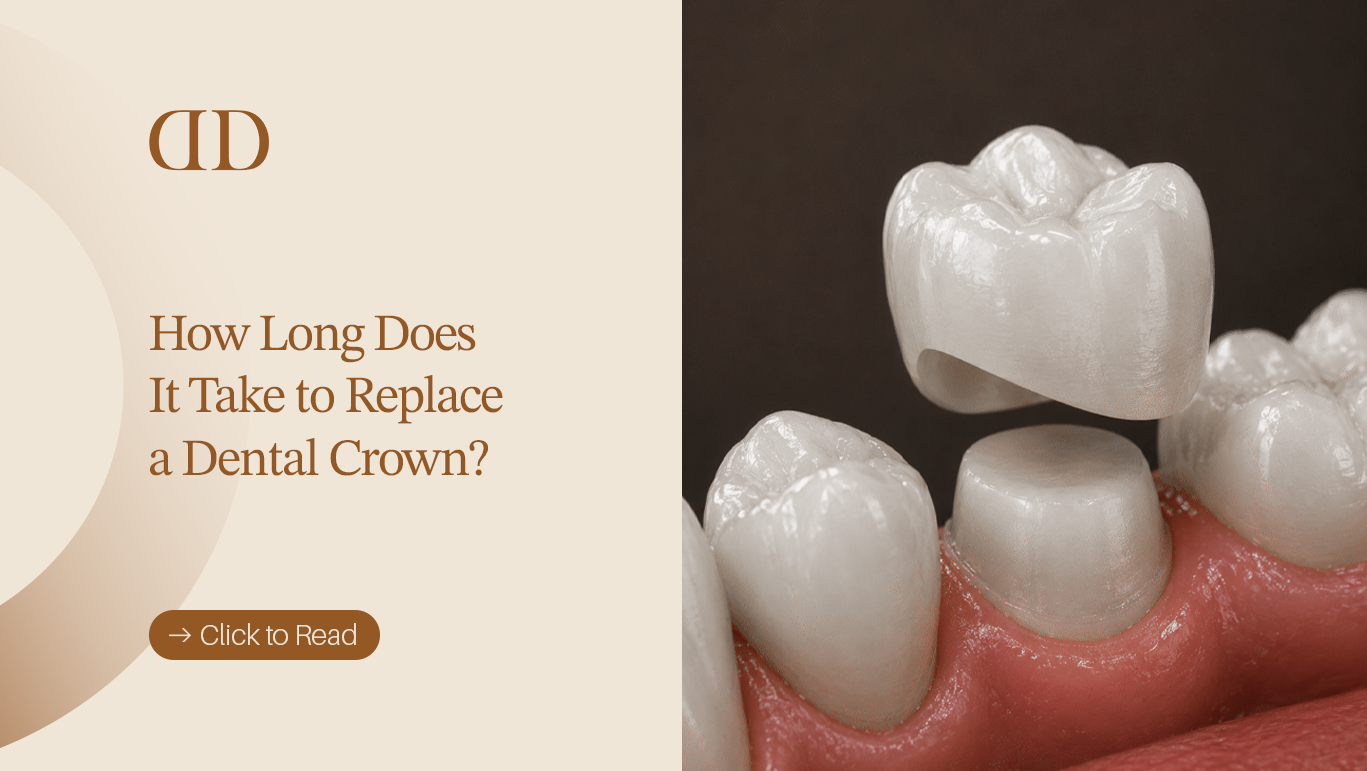

If you are wondering how long does it take to replace a dental crown, the answer depends mainly on the condition of the tooth underneath the existing crown and how the new crown is made. A straightforward replacement often involves two appointments, with a temporary crown used while the permanent restoration is prepared. In selected cases, a same-day workflow may be possible, while decay, infection, a fracture or additional treatment can make the process longer.
How Long Does Dental Crown Replacement Usually Take?
There is no single crown replacement time that applies to every patient. Before a new crown is fitted, the dentist needs to assess the existing restoration and the tooth beneath it. If the tooth is suitable for another crown, the replacement can generally follow a conventional crown workflow. If an underlying problem is found, that issue may need to be treated first.
For many patients, the process follows this general structure:
| Situation | Typical appointment structure | What affects the timing? |
| Standard dental crown replacement | Usually two appointments | Removal, tooth assessment, preparation and laboratory fabrication |
| Same-day crown replacement | One visit may be possible in selected cases | Availability of suitable CAD/CAM technology and clinical suitability |
| Replacement with additional treatment | More than two appointments may be needed | Decay, infection, fracture or insufficient tooth structure |
| Multiple crown replacements | May require several treatment stages | Number of teeth, laboratory work and complexity of the case |
A conventional crown procedure commonly involves an initial appointment followed by a second appointment when the permanent crown is ready. Cleveland Clinic notes that laboratory-made crowns can require a temporary crown while the permanent restoration is being fabricated. NHS guidance similarly explains that laboratory preparation can take time, so a temporary crown may be used in the meantime.
Standard Two-Appointment Crown Replacement
A standard dental crown replacement generally begins with an assessment and removal of the old restoration. The dentist then checks whether the underlying tooth is healthy enough to support a new crown and prepares it as needed.
An impression or digital scan can be taken to create the replacement crown. If the permanent crown is being produced by a dental laboratory, a temporary crown can protect the prepared tooth while you wait. At the follow-up appointment, the temporary crown is removed and the new crown is checked for fit, shape and colour before it is cemented into place.
The laboratory stage is one of the main reasons that conventional replacement does not always happen in a single visit. The exact waiting period varies according to the laboratory, restoration and clinical circumstances, so it is better to think in terms of a treatment sequence rather than a guaranteed number of days.
Can a Dental Crown Be Replaced in One Visit?
Yes, a dental crown can sometimes be replaced in one visit, but this is not suitable for every case.
Some dental practices use CAD/CAM technology to design and manufacture certain crowns in the office. This can allow a crown to be prepared and placed during the same appointment, eliminating the conventional laboratory waiting period and temporary-crown stage. However, same-day treatment depends on the available technology and whether the tooth and planned restoration are clinically suitable for that approach.
Premium Dental Care in Turkey
Expert treatments with high-end technology. Get your personalized quote today via WhatsApp.
A same-day option should therefore not be treated as the standard timeline for every patient. If the old crown needs to be removed and the dentist discovers decay, infection, a fracture or another structural problem, additional treatment may be necessary before a new crown can be placed.
When Crown Replacement Takes Longer
The most important factor in how long crown replacement takes is often not the crown itself, but the condition of the tooth underneath it.

Want trusted dental advice in your Google AI answers?
Add Darya Dental Turkey as a Preferred Source on Google to make our dental guides easier to find in your search results and AI Overviews.
An existing crown can conceal problems that are not obvious until the restoration is removed or the tooth is examined. If the underlying tooth has sufficient healthy structure and does not require additional treatment, replacement may proceed according to the planned crown workflow. If a problem is identified, the treatment plan may need to change.
For example, replacement may take longer when:
- decay is found underneath or around the existing crown;
- the tooth is fractured or does not have enough structure to support a new restoration;
- infection requires treatment before the new crown is fitted;
- root canal treatment is needed;
- additional restorative work is necessary;
- several crowns are being replaced at the same time;
- more laboratory work or adjustments are required.
This is why an old dental crown should not automatically be removed and replaced without first assessing the tooth beneath it. Crowns are used to restore and protect damaged or weakened teeth, and the health and structure of that tooth remain important when planning another restoration.
If a crown is loose or has fallen off, replacement is also not necessarily the only option. Depending on the condition of the crown and the tooth, a dentist may determine that it can be recemented rather than replaced. The appropriate option can only be decided after examination.
What Happens During Dental Crown Replacement?
The dental crown replacement procedure is more than simply taking off an old crown and putting on a new one. The dentist first needs to determine why the existing crown is being replaced and whether the tooth underneath is suitable for another restoration.
The exact sequence can vary, but replacement commonly includes four main stages.
Removing the Old Crown
The first step is to assess and remove the existing crown when replacement is indicated. The approach depends on how the crown is attached and its condition.
A crown that is loose or has become detached may sometimes be removed relatively easily. A firmly cemented crown may require more extensive removal. The dentist also considers whether the existing crown itself could potentially be retained or whether a completely new restoration is necessary.
This distinction is particularly important when dealing with old dental crown replacement. A crown reaching the end of its useful life does not automatically mean that the underlying tooth requires extensive treatment.
Checking the Tooth Underneath
Once the old crown has been removed, the underlying tooth can be assessed more directly. The dentist may look for decay, cracks, infection, changes in the tooth structure or other problems that could affect the replacement.
This stage can significantly change the crown replacement time.
If the tooth is healthy enough to receive a new crown, treatment can usually continue according to the planned replacement workflow. If there is a problem, however, the dentist may need to address it before the new crown is fitted.
For example, a tooth with significant decay may need restorative treatment, while a tooth with an infection may require additional treatment before it can support a new restoration. The condition of the tooth therefore matters just as much as the condition of the old crown.
Temporary Crown and Laboratory Fabrication
When the permanent crown is being produced by a dental laboratory, the prepared tooth may be covered with a temporary crown before replacement is completed.
The temporary restoration helps protect the prepared tooth while the permanent crown is being made. The time it remains in place depends on the treatment workflow and the laboratory schedule rather than on one universal timeframe. NHS guidance describes the use of a temporary crown while the permanent crown is being prepared. (nhs.uk)
During this stage, the permanent crown is fabricated according to the dentist’s prescription and the required fit and appearance. For visible teeth, factors such as colour matching and aesthetic adjustments may require particular attention.
This is one reason why asking how long does crown replacement take cannot always be answered with a single number of days. The process can be short when everything is straightforward, but laboratory fabrication and additional clinical work can extend the timeline.
Fitting and Cementing the New Crown
At the follow-up appointment, the dentist checks the permanent crown before final cementation. The fit, appearance and relationship with the surrounding teeth are assessed.
If adjustments are needed, they may be made before the crown is permanently cemented. Once the dentist is satisfied that the restoration is appropriate, it can be secured to the tooth.
For patients replacing a crown during planned treatment in Turkey, this final appointment is an important part of scheduling. The number of visits and the interval between them should be confirmed with the treating dental team before travel.
What Can Make Crown Replacement Take Longer?
A straightforward replacement can follow a predictable sequence, but several clinical factors can add appointments or extend the overall treatment period.
Decay or Infection Under the Crown
Decay beneath or around an existing crown can change the treatment plan. The dentist may need to remove the decay and restore the tooth before a new crown can be considered.
If infection is present, additional treatment may also be necessary. In these circumstances, the replacement timeline is determined by the condition of the tooth rather than simply by the time required to manufacture a new crown.
This is why replacing a broken dental crown or an old crown should begin with an examination rather than an assumption that the new restoration can be fitted immediately.
Tooth Fracture or Insufficient Tooth Structure
A fractured tooth may not have enough healthy structure to support a replacement crown in the same way as a straightforward case.
The dentist must first determine how extensive the fracture is and whether the tooth can be predictably restored. If additional restorative treatment is required, the overall treatment period may increase.
A loose crown can also be a sign that the tooth or restoration needs evaluation. A loose dental crown replacement should therefore not be planned solely around replacing the visible crown; the reason it became loose also matters.
Root Canal Treatment or Additional Restorative Work
If the tooth beneath the crown requires root canal treatment or another restorative procedure, crown replacement may need to be postponed until the underlying problem has been addressed.
This means that does crown replacement take longer after a root canal? It can, depending on the clinical situation and the treatment sequence required. The dentist needs to assess the tooth and determine when it is appropriate to proceed with the definitive restoration.
The important point is that there is no universal additional number of days that applies to every patient. Treatment planning depends on the tooth, the required procedure and the restoration being used.
Multiple Crowns or More Complex Cases
Replacing one crown is different from replacing several crowns at the same time. Multiple restorations can involve more preparation, more detailed laboratory work and additional fitting or adjustment.
Complex aesthetic cases may also require closer attention to the appearance of the restorations, particularly when several visible teeth are involved. This can affect scheduling even when the individual crown procedures themselves are familiar.
For international patients, discussing the number of teeth being treated and the planned treatment sequence before travelling can help avoid building a trip around an unrealistically short appointment schedule.
Can a Crown Be Recemented Instead of Replaced?
Not every loose or fallen crown needs to be completely replaced. If the existing crown is still in good condition and the tooth underneath is healthy, a dentist may determine that recementation is appropriate.
The decision depends on factors such as:
- whether the crown is intact;
- whether it still fits the tooth properly;
- why it became loose or detached;
- whether the tooth underneath has decay or structural damage;
- whether the existing restoration remains suitable.
If the crown itself is damaged, poorly fitting or no longer appropriate for the tooth, a new restoration may be recommended instead.
This distinction matters when planning dental crown replacement because a loose crown does not automatically mean that a completely new crown is required. An examination is needed to determine which treatment is appropriate.
If your crown has fallen off, you can also read our guide on what to do if a dental crown falls off.
How Long Do You Need to Stay in Turkey for Crown Replacement?
For patients considering crown replacement in Turkey, treatment planning involves more than calculating the time spent in the dental chair. You also need to consider the number of appointments, laboratory fabrication and whether the examination identifies any additional treatment needs.
A straightforward case may follow a planned sequence of an initial appointment and a later fitting appointment. However, the exact interval between appointments varies according to the treatment plan and laboratory workflow.
International patients should therefore avoid planning their trip around a fixed number of days before their dental assessment. A more reliable approach is to provide the dental team with information about the existing crown and any previous treatment, then confirm the proposed appointment structure before travelling.
For patients considering dental crown replacement in Istanbul, the same principle applies. The location of treatment does not eliminate the clinical variables that determine how long replacement takes.
If you are considering broader treatment options, our dental crown treatment page provides information about crown treatment beyond replacement timelines.
The most important questions to clarify before travelling include:
- How many crowns are being assessed or replaced?
- Is the existing crown loose, broken or simply due for replacement?
- Will the tooth underneath require additional treatment?
- Will a temporary crown be needed?
- Is the planned restoration produced in a laboratory or through a same-day workflow?
- How many appointments are expected?
Because the condition of the tooth cannot always be determined from the outside, the final treatment schedule should be confirmed after a clinical assessment.
When Should You Have a Failing Crown Checked?
A crown should be assessed if it becomes loose, breaks, falls out or develops a noticeable change in fit. Other concerns, such as pain, sensitivity or signs of a problem around the tooth, can also warrant dental evaluation.
Prompt assessment is particularly important when a crown has fallen off or the tooth underneath is exposed. The dentist can determine whether the restoration can be recemented, needs to be replaced or requires treatment of the underlying tooth first.
You can also read about whether getting a dental crown is painful if discomfort is one of your concerns about the replacement process.
The key point is that how long does it take to replace a dental crown cannot be answered with one fixed timeframe for every patient. A straightforward replacement may follow a conventional two-appointment sequence, while selected same-day cases can be completed in one visit. If decay, infection, fracture, insufficient tooth structure or other restorative needs are found, additional treatment may extend the process.
Frequently Asked Questions
How long does it take to replace a dental crown?
A straightforward replacement often involves two appointments: one for assessment, removal and preparation, followed by another for fitting the permanent crown. The total timeframe depends on laboratory production and the condition of the tooth underneath.
How many appointments are needed to replace a dental crown?
Many conventional replacements require two appointments, although the number can vary. Same-day treatment may be possible in selected cases, while additional treatment can require more appointments.
Can a dental crown be replaced in one visit?
Yes, selected cases can be completed in one visit when suitable CAD/CAM technology is available and the clinical situation allows it. Same-day replacement is not appropriate for every patient.
How long do you have to wear a temporary crown before the new crown is fitted?
The temporary crown is generally worn while the permanent restoration is being prepared. The exact period varies according to the laboratory and treatment workflow, so there is no universal number of days.
Can an old crown be replaced without treating the tooth underneath?
Only if the tooth is suitable for the new restoration. If examination reveals decay, infection, fracture or another problem, that issue may need to be treated before a replacement crown is fitted.
Can a loose crown be recemented instead of replaced?
Sometimes. If the crown is intact, fits properly and the underlying tooth is healthy, recementation may be possible. A dentist needs to examine the crown and tooth before deciding.
Does replacing a dental crown hurt?
The experience varies according to the condition of the tooth and the treatment required. Local anaesthesia can be used when appropriate during dental procedures. If you are concerned about discomfort, discuss this with your dentist before treatment.
What happens if there is decay under an old crown?
The dentist needs to assess the extent of the decay and treat the affected tooth as necessary. This can make crown replacement take longer because the new restoration may not be fitted until the underlying problem has been addressed.
Does crown replacement take longer after a root canal?
It can, depending on the condition of the tooth and the additional treatment required. A dentist should determine the appropriate treatment sequence before the final crown is placed.
How long should I stay in Turkey for dental crown replacement?
There is no universal stay length. The required time depends on the number of crowns, the appointment structure, laboratory fabrication and whether additional treatment is needed. International patients should confirm the expected treatment schedule with their dental team before travelling.
Dental crown replacement usually requires more than simply removing an old crown and fitting a new one. The tooth underneath must first be assessed, and a temporary crown may be used while the permanent restoration is prepared.
For a straightforward case, treatment may follow a conventional two-appointment sequence. Selected patients may qualify for a same-day workflow, while decay, infection, fractures or additional restorative treatment can extend the timeline.
If you are planning treatment, the most useful step is to have the existing crown and underlying tooth assessed first. This allows the dental team to determine whether you need recementation, a new crown or additional treatment and to give you a more realistic appointment schedule.
