Turkey Teeth Crowns: When Crowns Make More Sense Than Veneers
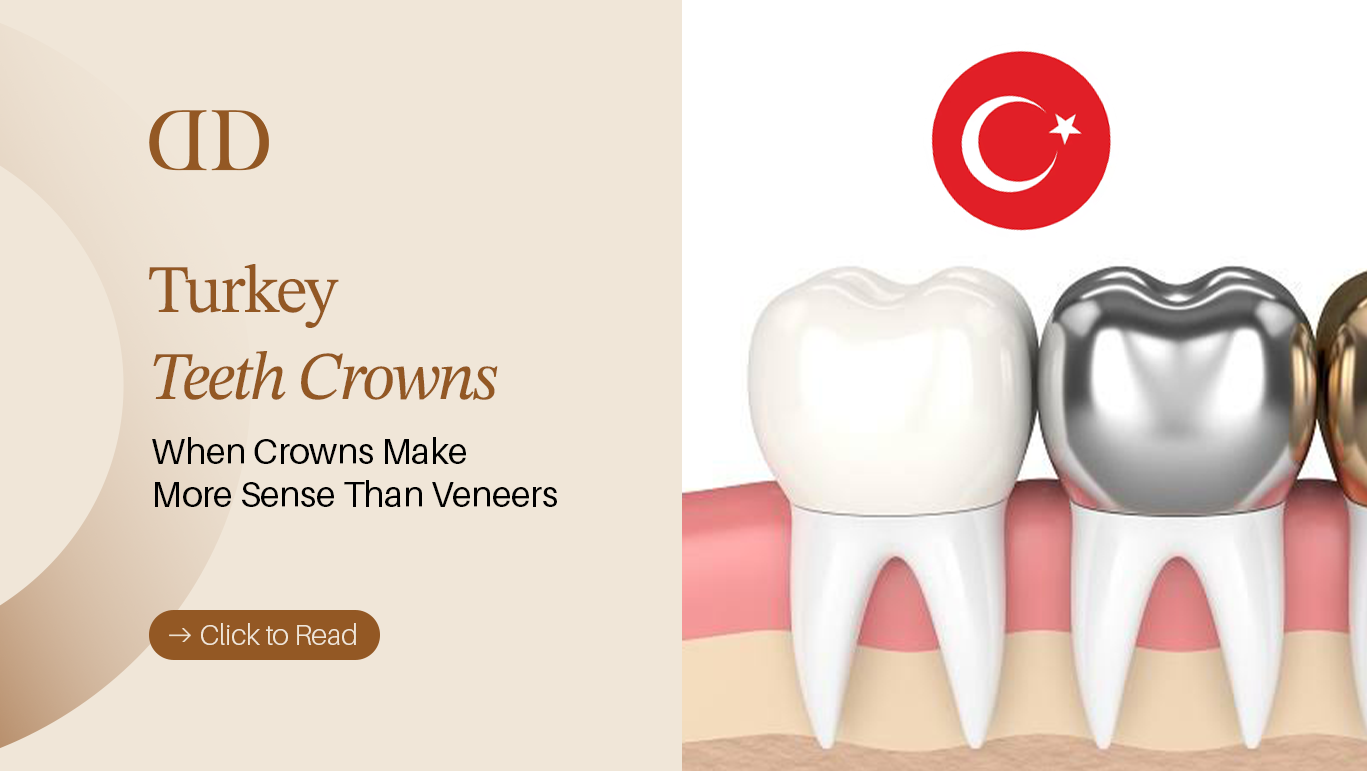

A dental crown makes significantly more sense than a veneer when an individual tooth has suffered major structural loss, structural cracking, extensive decay, or severe weakening following a root canal. While veneers are ultra-thin ceramic shells designed strictly to enhance the front visible surface of healthy enamel, crowns surround the entire visible tooth structure providing full 360° coverage, bio-mechanical reinforcement, and long-term protection against heavy biting forces. For international patients seeking turkey teeth crowns, choosing between these two treatments comes down to assessing whether a tooth requires cosmetic refinement or fundamental structural rehabilitation.
At Darya Dental Clinic in Istanbul, every smile transformation begins with an accurate assessment of structural health rather than a blanket aesthetic fix. Understanding the exact mechanical and biological differences between crowns and veneers ensures that your restorative journey in Turkey yields results that are as durable as they are naturally beautiful.
Understanding Teeth Crowns And Veneers
Both dental crowns and porcelain veneers are staple treatments in modern restorative and cosmetic dentistry, but they serve fundamentally different clinical purposes. Confounding the two often leads to inappropriate treatment planning, compromised tooth integrity, or premature restoration failure.
What Are Dental Crowns?
A dental crown often referred to as a cap is a custom-milled prosthetic restoration that entirely covers the visible portion of a prepared tooth above the gumline. By encasing the tooth completely, a crown restores its original shape, size, strength, and overall appearance while sealing the underlying natural dentin against bacterial infiltration.
Modern crowns are fabricated from high-strength biocompatible materials such as monolithic zirconia or lithium disilicate glass-ceramics. At Darya Dental Clinic, patients pursuing comprehensive dental crown treatment receive restorations engineered via high-precision CAD/CAM technology, ensuring a flush marginal fit at the gumline that protects natural root tissue for decades.
What Are Dental Veneers?
A dental veneer is an ultra-thin laminate shell typically between 0.3 mm and 0.5 mm in thickness that is custom-sculpted and permanently bonded exclusively to the anterior (front) surface of a tooth. Veneers are designed to alter the color, contour, width, or length of teeth that are structurally sound but visually compromised.
Because a veneer covers only the front face of the tooth, it requires minimal enamel preparation. Patients exploring dental veneers generally present with intact natural enamel, seeking to correct minor gaps, mild surface chipping, or intrinsic stains that do not respond to chemical bleaching.
How Are Crowns And Veneers Different?
The core distinction between crowns and veneers lies in the degree of tooth coverage and the amount of preparation required:
- Coverage Extent: A veneer acts as a front-facing shield, leaving the back, sides, and biting surface of the natural tooth untouched. A crown encapsulates the entire circumferential perimeter of the tooth.
- Structural Support: Veneers rely completely on the strength of the underlying natural enamel for structural integrity. Crowns provide independent structural resistance, reinforcing fragile or fractured tooth walls.
- Preparation Volume: Fitting a veneer requires shaving a microscopic layer of front enamel. Placing a crown involves reshaping the tooth circumferentially to create a stable, supportive core (stump).
When Do Crowns Make More Sense Than Veneers?
Choosing a crown over a veneer is primarily a functional decision dictated by the amount of remaining sound natural tooth structure. Clinical guidelines published by the American Dental Association (ADA) emphasize that applying a cosmetic veneer to a structurally compromised tooth significantly elevates the risk of micro-fracture and debonding under functional load.
Premium Dental Care in Turkey
Expert treatments with high-end technology. Get your personalized quote today via WhatsApp.
When A Tooth Has Significant Structural Damage
When a tooth has lost more than 50% of its natural structure due to extensive tooth decay, trauma, or historical wear, it lacks the necessary surface area for a veneer to bond securely. A veneer bonded to exposed dentin rather than healthy enamel exhibits a substantially lower bond strength. In such cases, a full-coverage crown acts as a protective helmet, distributing masticatory (chewing) forces evenly across the entire foundation.
When A Tooth Is Cracked Or Fractured
Structural cracks that extend through the enamel and deep into the dentin compromise the tooth’s internal integrity. Biting down on a cracked tooth causes flexing, which generates sharp pain and accelerates deep root fracture. A veneer cannot stop this flexing motion. A rigid zirconia or lithium disilicate crown completely clamps the fractured segments together, stabilizing the tooth structure and preventing catastrophic vertical root fractures that would otherwise necessitate complete tooth extraction.

Want trusted dental advice in your Google AI answers?
Add Darya Dental Turkey as a Preferred Source on Google to make our dental guides easier to find in your search results and AI Overviews.
When A Tooth Has A Large Filling
Teeth containing oversized historical composite or amalgam fillings are inherently fragile. Because filling materials do not bond to tooth structure with the same structural density as natural enamel, the remaining thin outer enamel walls are vulnerable to snapping off. Replacing a failing large filling with a veneer leaves those weak walls unsupported. A full-coverage crown encapsulates both the filling and the remaining tooth walls, creating a unified, fracture-resistant unit.
After Root Canal Treatment
Endodontic therapy (a root canal) removes the infected nerve and blood supply from inside the tooth. While this saves the tooth from extraction, it permanently dehydrates the dentin matrix, leaving the tooth brittle and prone to shattering under normal biting pressures. Furthermore, access openings created during root canal treatment remove significant central tooth volume. A full crown is universally recognized as the clinical standard of care following root canal therapy on posterior teeth and structurally weakened front teeth to seal the internal canal system and restore structural resilience.
When A Tooth Needs Full Coverage
Certain clinical conditions demand 360° surface encapsulation regardless of cosmetic goals:
- Severe Nighttime Bruxism: Patients who suffer from heavy, unmanaged clenching or teeth grinding exert immense lateral shear forces. Thin veneers are prone to shearing off, whereas full monolithic zirconia crowns withstand flexural forces exceeding 1000 MPa.
- Deep Intrinsic Discoloration with Structural Decay: When a tooth is both internally discolored and structurally degraded, a thin veneer may allow the dark underlying root shadow to bleed through. A full-coverage crown completely masks dark internal dentin while re-establishing full mechanical function.
- Altering Occlusal Bite Alignment: Re-establishing vertical height or correcting a collapsed bite requires modifying the biting (occlusal) surfaces of posterior molars, an anatomical area that veneers simply cannot cover.
When Are Veneers A More Suitable Option?
While crowns reign supreme in scenarios requiring total structural rehabilitation, porcelain veneers are the undisputed gold standard for conservative aesthetic enhancements. Recommending a full crown when a tooth retains its healthy structural integrity violates the principle of minimally invasive dentistry.
For Minor Cosmetic Imperfections
Veneers excel at correcting localized visual flaws on structurally sound teeth. If a tooth suffers from slight surface chipping, developmental enamel pitting, or small surface irregularities, a veneer conceals these defects without compromising the underlying tooth framework.
For Changes In Tooth Shape And Colour
Intrinsic discoloration caused by tetracycline staining, fluorosis, or aging often fails to respond to chemical teeth whitening. Veneers offer a permanent, stain-impervious ceramic shield that can alter both the shade and the micro-geometry of a tooth. Whether lengthening short teeth or closing unwanted gaps (diastemas), veneers deliver immediate visual refinement.
When The Tooth Structure Is Mostly Healthy
The primary clinical prerequisite for a veneer is the presence of abundant, healthy enamel. Etching protocols achieve their highest bond strength when bonding glass-ceramics directly to enamel. If a tooth has never suffered from deep decay, large fillings, or structural cracking, preserving its natural dentin and nerve vitality by opting for a veneer is biologically superior.
For Conservative Cosmetic Improvements
Modern patients increasingly demand conservative options like no-prep veneers. These ultra-thin laminates require virtually zero enamel reduction, allowing international patients to achieve a dramatic Hollywood Smile while preserving 100% of their natural dental anatomy.
Crown Or Veneer For Different Dental Concerns
Navigating specific dental problems requires evaluating how each restoration performs under real-world mechanical and aesthetic demands.
Crown Or Veneer For Broken Teeth?
If a tooth suffers a minor chip restricted entirely to the outer enamel, a porcelain or composite bonding application is sufficient. However, if a severe fracture removes a significant portion of the cusp or exposes underlying dentin, a dental crown is required to rebuild the structural outline and prevent nerve exposure.
Crown Or Veneer For Cracked Teeth?
Hairline crazelines in the surface enamel are purely cosmetic issues easily hidden by veneers. Deep structural cracks extending toward the root line represent a major risk for tooth loss. A full-coverage crown completely encircles the tooth, locking the cracked segments together like a steel hoop on a wooden barrel.

Crown Or Veneer For Discoloured Teeth?
For surface stains or general yellowing, professional bleaching or thin veneers are ideal. However, if a single front tooth has turned dark grey following nerve trauma or a historical root canal, a thin veneer may allow the underlying dark root to shadow through. A high-opacity zirconia crown effectively blocks internal dark dentin while matching the surrounding natural smile line.
Crown Or Veneer After Root Canal Treatment?
Root canal treatment leaves teeth intrinsically brittle and hollowed out. On posterior molars and premolars, placing a full-coverage crown is a mandatory clinical standard to prevent catastrophic fractures under chewing loads. On front teeth, if the original access opening was small and the surrounding enamel walls remain thick and intact, a conservative veneer or direct restoration may occasionally be considered.
Crown Or Veneer For Front Teeth?
Choosing between crowns and veneers in the anterior visible zone comes down to structural integrity versus conservative preservation. When front teeth are structurally healthy but uneven or stained, veneers are preferred. If front teeth are heavily restored, fractured, or post-endodontic, an ultra-aesthetic E-Max crown delivers exceptional light transmission without sacrificing strength.
Crown Or Veneer For Worn Teeth?
Severe tooth wear (attrition or erosion) often flattens biting edges and reduces vertical facial height. Because worn teeth have already lost their protective enamel layer, placing thin veneers on exposed dentin leads to high failure rates. Rebuilding a severely worn bite requires 360° full-coverage crowns or overlay restorations to establish new occlusal stability.
Crown Vs Veneer: Key Differences
To summarize the decision-making framework, the key distinctions between dental crowns and veneers are categorized below:
Structural and Clinical Parameters
| Feature | Dental Crowns | Porcelain Veneers |
|---|---|---|
| Main Coverage | Full 360° circumferential encapsulation | Anterior (front) surface only |
| Tooth Preparation | Circumferential reduction (1.5 mm to 2.0 mm) | Micro-shaping of front enamel (0.3 mm to 0.5 mm) |
| Main Purpose | Structural reinforcement & protection | Cosmetic improvement & minor alignment |
| Suitable For | Compromised, cracked, or root-canaled teeth | Healthy teeth with visual defects |
| Tooth Damage Level | Moderate to severe structural loss | Minor cosmetic concerns or enamel wear |
| Primary Consideration | Mechanical strength & biological sealing | Esthetic integration & enamel conservation |
Clinical Suitability Matrix
| Dental Concern | Dental Crown | Dental Veneer |
| Severely Damaged Tooth | Often Considered | Usually Not First Choice |
| Minor Discoloration | Case Dependent | Often Considered |
| Large Historical Filling | Often Considered | Usually Less Suitable |
| Root Canal Treated Tooth | Highly Recommended | Case Dependent |
| Minor Shape Correction | Usually Unnecessary | Often Considered |
| Structural Tooth Crack | Highly Recommended | Usually Not Appropriate |
Teeth Crowns In Turkey: What Should Patients Consider?
Undergoing a smile transformation abroad requires looking beyond basic cosmetic claims to evaluate clinical protocols, material standards, and long-term care plans.
Treatment Planning For International Patients
At Darya Dental Clinic in Istanbul, treatment planning for international visitors begins long before travel. Utilizing 3D CBCT bone scans and digital intraoral scans sent remotely, our prosthodontists map out whether a patient requires full structural crowns, conservative veneers, or a combination of both.
Choosing The Right Crown Material
Material selection dictates both aesthetic success and longevity. Modern dentistry has largely abandoned older porcelain-fused-to-metal (PFM) restorations due to their unsightly grey gumline shadows. Today, patients choose between two primary materials:
- Monolithic Zirconia: Boasting a flexural strength exceeding 1000 MPa, zirconia is unmatched for posterior strength and dark core masking.
- E-Max (Lithium Disilicate): Offering 400 MPa strength with superior glass-like translucency, E-Max is ideal for single front crowns and cosmetic veneers.
Number Of Visits And Treatment Planning
A complete treatment cycle for turkey teeth crowns at Darya Dental Clinic typically requires a single stay of 5 to 7 days in Istanbul. During this window, initial preparations, CAD/CAM digital milling, master hand-layering, and final adhesive bonding are executed sequentially without rushing the biological healing of soft tissues.
Follow-Up And Aftercare
Long-term success depends on proper post-operative care. International patients receive custom stabilization night guards to protect their new restorations against bruxism, alongside detailed hygiene guidelines to maintain the health of the surrounding gum tissue.
How Much Do Crowns And Veneers Cost In Turkey?
Evaluating the investment required for crowns and veneers in Turkey involves looking at materials, clinical expertise, and overall care quality. Rather than comparing raw numbers alone, understanding the factors driving pricing helps international patients make informed decisions about their restorative options.
What Affects Crown Costs?
The overall cost of a dental crown is primarily influenced by the underlying material selected and the complexity of the preparation required. High-grade materials such as monolithic zirconia or high-translucency lithium disilicate (E-Max) carry higher laboratory manufacturing fees than older porcelain-fused-to-metal (PFM) alternatives due to precision CAD/CAM milling and sintering requirements.
Additionally, if a tooth requires preparatory therapies such as endodontic root canal treatment, core buildup, or micro-surgical gum contouring to level an uneven gum line these necessary foundational steps naturally influence the final treatment quote.
What Affects Veneer Costs?
Veneer pricing depends heavily on the chosen material, the fabrication technique, and the total number of units included in the smile design.
High-purity glass-ceramics crafted in specialized laboratories carry a different cost profile than direct composite bonding, which is shaped manually in the dental chair. The extent of custom hand-characterization by master ceramists to mimic natural enamel translucency also plays a key role in the overall fee structure.
Why Treatment Costs Differ Between Patients
Dental fees vary significantly from person to person because no two oral environments present the exact same biological conditions. One patient may require a single full-coverage zirconia crown to stabilize a fractured, post-root canal molar, while another seeking a smile transformation may choose eight porcelain veneers across healthy upper front teeth.
At Darya Dental Clinic, treatment quotes are fully transparent and itemized, ensuring international patients receive an accurate, comprehensive plan with no hidden fees before traveling to Istanbul. For detailed information about materials, procedures, and options, explore our dedicated dental crown treatment page.
Choosing Between Crowns And Veneers At Darya Dental
Deciding between a full crown and a conservative veneer is a nuanced clinical judgment that prioritizes tooth longevity, structural safety, and long-term aesthetic harmony. At Darya Dental Clinic, our approach combines evidence-based prosthodontics with personalized care to ensure every restoration strengthens your smile.
Clinical Assessment Before Treatment
Every smile transformation at Darya Dental Clinic begins with a thorough diagnostic assessment. Utilizing low-radiation 3D CBCT bone imaging and high-definition intraoral digital scanners, our prosthodontists evaluate:
- Remaining natural enamel volume
- Dentin integrity and structural health
- Root canal history and endodontic stability
- Bite mechanics (occlusal load distribution)
- Periodontal health and gum margins
This comprehensive diagnostic protocol prevents treatment mismatch ensuring fragile teeth receive protective crowns while sound, healthy teeth are preserved with conservative veneers.
Personalised Treatment Planning
At Darya Dental Clinic, we believe in face-driven smile architecture. Rather than applying a standard template, our team customizes every restoration to match your natural facial proportions, lip movement, and personal expectations.
By integrating digital smile simulation tools, patients preview their planned outcomes before any physical enamel preparation begins, creating clarity and confidence throughout the process.
Crown And Veneer Options For International Patients
For visitors traveling to Turkey, Darya Dental Clinic streamlines the treatment journey into an efficient, stress-free experience. International patient coordinators manage private airport transfers, local accommodation, and appointments, allowing you to focus entirely on your transformation. Our in-house CAD/CAM laboratory technology allows custom restorations to be designed, milled, and hand-finished within a single 5 to 7-day visit to Istanbul without compromising clinical standards.
Dental Crowns And Veneers Near Ataşehir And In Ümraniye
Selecting the right clinic location ensures both high clinical standards and logistical convenience during your treatment journey in Istanbul.
Dental Treatment Near Ataşehir
Patients living in Ataşehir and nearby Asian-side districts can reach Darya Dental Clinic in Ümraniye for comprehensive crown and veneer consultations. Situated adjacent to primary transit corridors, our facility offers easy access for local residents and international visitors staying in nearby business and shopping centers.
Darya Dental In Ümraniye, Istanbul
Our physical clinic is located in the vibrant district of Ümraniye, Istanbul. Modern, fully equipped operating suites, advanced 3D diagnostic imaging systems, and strict European sterilization protocols define our clinical environment.
By maintaining our primary practice in Ümraniye, Darya Dental Clinic delivers top-tier prosthodontic and cosmetic care in a comfortable, state-of-the-art environment.
Frequently Asked Questions About Crowns And Veneers
1. When is a crown better than a veneer?
A dental crown is clinically superior to a veneer when a tooth has lost significant structural volume, contains large historical fillings, suffers from deep cracks, or has undergone root canal treatment. Crowns encapsulate the entire tooth circumferentially, providing full structural protection that a front-facing veneer cannot offer.
2. What is the main difference between a crown and a veneer?
The primary difference lies in coverage and enamel preparation. A veneer is an ultra-thin ceramic laminate bonded exclusively to the front surface of a healthy tooth, requiring minimal enamel reduction (0.3 mm to 0.5 mm). A crown fully encapsulates all surfaces of the tooth (360°), requiring circumferential preparation (1.5 mm to 2.0 mm) to restore severely damaged teeth.
3. Can a veneer replace a dental crown?
No, a veneer cannot replace an existing dental crown. Once a tooth has been prepared for a full-coverage crown, the circumferential enamel and dentin have already been reshaped. A veneer requires intact front enamel to bond securely, meaning a tooth previously fitted with a crown must be restored with a new crown.
4. Is a crown or veneer better for a damaged tooth?
If the damage is minor such as a small enamel chip or slight surface crack a conservative veneer or direct bonding is sufficient. If the damage involves deep structural fractures, lost cusps, or extensive decay, a full dental crown is required to prevent total tooth failure.
5. Is a crown or veneer better after root canal treatment?
A full-coverage crown is almost universally recommended following root canal therapy, especially on posterior chewing teeth. Root canal treatment removes internal blood supply, leaving the tooth structure brittle. A crown completely seals the endodontic access and protects against vertical root fractures.
6. Are crowns or veneers better for front teeth?
For front teeth that are structurally sound, intact, and free of deep decay, veneers are preferred because they preserve healthy natural enamel while transforming color and shape. However, if a front tooth is heavily restored, severely fractured, or dark after trauma, an ultra-aesthetic ceramic crown is the safer long-term choice.
7. Are veneers more conservative than crowns?
Yes, veneers are significantly more conservative. Fitting a veneer requires shaving only a microscopic layer of the front enamel surface, leaving the back, sides, and internal dentin untouched. Crowns require circumferential reduction to create a stable foundational core.
8. Can you have crowns and veneers at the same time?
Yes. Many comprehensive smile designs combine both restorations based on individual tooth health. For example, a patient may receive conservative veneers on six healthy front teeth alongside full crowns on adjacent root-canaled or heavily filled premolars to achieve a uniform, beautiful smile line.
9. Are crowns more expensive than veneers in Turkey?
Crown and veneer pricing in Turkey is comparable, as both utilize premium glass-ceramics or zirconia milled via high-precision CAD/CAM systems. However, total costs depend on whether preliminary treatments such as root canals, post-and-core rebuilds, or gum reshaping are required before fitting a crown.
10. How do I know whether I need a crown or veneer?
Determining the right treatment requires a clinical evaluation and 3D digital imaging by an experienced prosthodontist. At Darya Dental Clinic, we evaluate remaining enamel thickness, structural loss, and bite alignment to recommend the safest, most durable option for your smile.
Determining whether your smile requires full structural reinforcement or conservative aesthetic refinement is the foundational step of a successful dental transformation. By prioritizing clinical diagnosis over visual trends, Darya Dental Clinic ensures that every restoration enhances both long-term health and natural beauty.
Whether you require structural rehabilitations with crowns or subtle refinements with veneers, our specialized team in Istanbul delivers care tailored directly to your needs. Contact Darya Dental Clinic today to schedule your digital consultation and take the first step toward a functional, confident smile.
