
Temporary vs Permanent Crowns During Dental Treatment Abroad
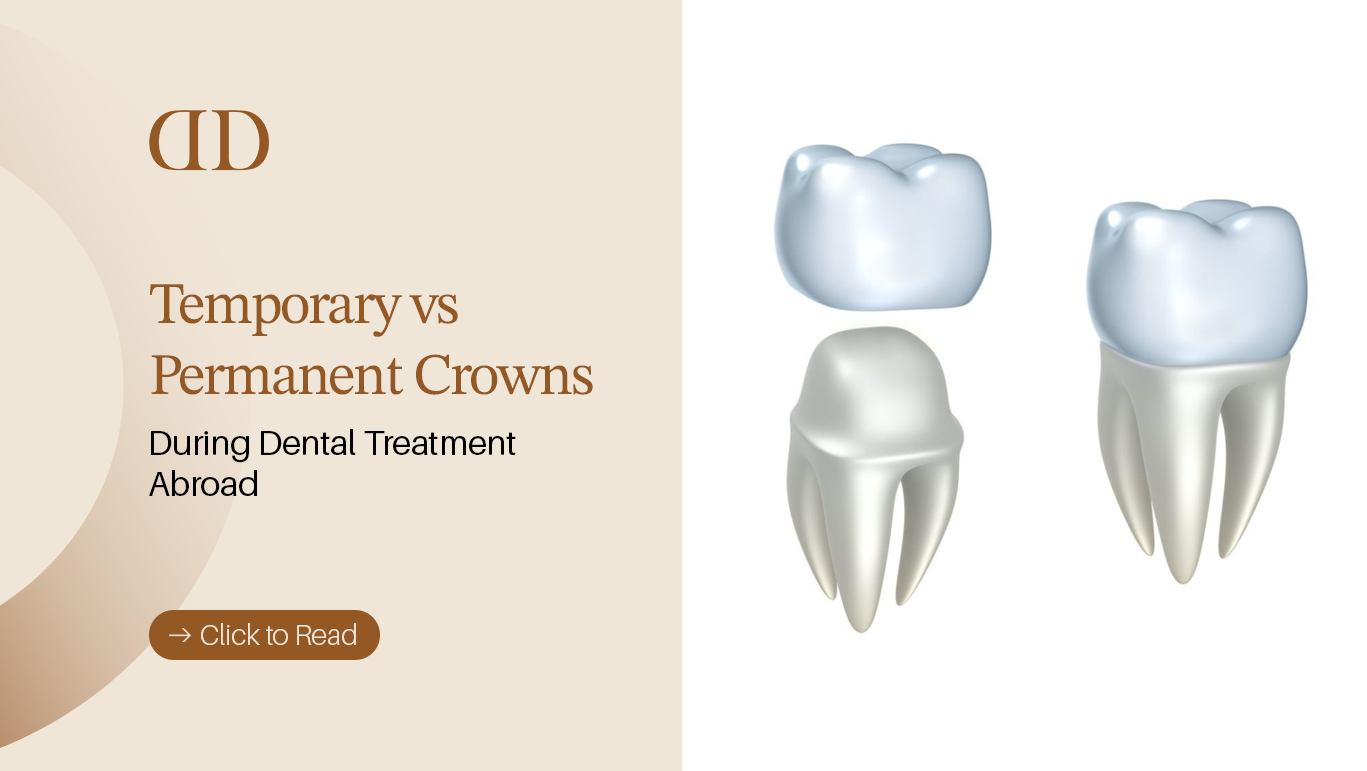

When dental treatment takes place over more than one appointment, a temporary crown is usually used to protect the prepared tooth until the permanent crown is ready. The temporary restoration is designed for short-term protection and function, while the permanent crown is made to provide the longer-term fit, strength and appearance expected from the final restoration.
For international patients, this distinction matters because crown treatment may involve several appointments during a stay in Turkey. Understanding what each crown does can make the treatment timeline easier to plan and helps patients know what to expect while travelling.
The exact sequence and timing depend on the tooth, the planned restoration, the material selected and the dentist’s clinical assessment. If you are researching dental crowns in Turkey, it is useful to discuss the complete treatment schedule before arranging travel.
For a broader overview of the treatment itself, see our guide to dental crown treatment in Turkey.
What Is a Temporary Dental Crown?
A temporary dental crown, sometimes called a provisional crown, is a short-term restoration placed over a prepared tooth before the permanent crown is fitted.
Preparing a tooth for a crown usually means removing a controlled amount of tooth structure so that the final restoration can fit correctly. Once this preparation has been completed, the underlying tooth may need protection while the permanent crown is being produced or prepared.
A temporary crown can serve several practical purposes:
- Protecting the prepared tooth from external irritation
- Reducing sensitivity after tooth preparation
- Helping maintain the tooth’s position while the permanent crown is being prepared
- Allowing the patient to use the tooth during the interim period
- Providing an opportunity to assess the general shape and function before final placement
A temporary crown is not simply a cheaper version of the permanent crown. It has a different purpose and is generally designed to be worn for a limited period.
For patients travelling internationally, the temporary stage can also be important from a scheduling perspective. Rather than leaving a prepared tooth uncovered while waiting for the final restoration, the temporary crown provides interim protection during the treatment journey.
Premium Dental Care in Turkey
Expert treatments with high-end technology. Get your personalized quote today via WhatsApp.
The temporary restoration may look similar to the final crown, but its material, strength, fabrication method and intended lifespan can differ.
What Is a Permanent Dental Crown?
A permanent dental crown is the final restoration intended to remain on the tooth for the long term, provided that the tooth and surrounding oral tissues remain healthy and the crown is properly maintained.

Want trusted dental advice in your Google AI answers?
Add Darya Dental Turkey as a Preferred Source on Google to make our dental guides easier to find in your search results and AI Overviews.
Permanent crowns can be manufactured from different dental materials, depending on factors such as the location of the tooth, functional demands, appearance and the treatment plan. Common options include ceramic-based restorations and zirconia, although the appropriate choice should be determined on an individual basis.
Unlike a temporary crown, the permanent crown is designed around the final fit and function of the restoration. Before it is permanently bonded or cemented, the dentist checks aspects such as:
- Fit against the prepared tooth
- Contact with neighbouring teeth
- Bite and occlusion
- Shape and overall appearance
- Colour, where aesthetics are relevant
The permanent crown therefore represents the final stage of the restoration rather than an interim solution.
Patients interested in a specific material can also explore the porcelain crown treatment process for more information about that treatment pathway.
Temporary vs Permanent Crowns: Key Differences
The simplest way to understand temporary crown vs permanent crown is to consider their different roles.
| Feature | Temporary dental crown | Permanent dental crown |
| Main purpose | Protect the prepared tooth during the interim stage | Provide the final long-term restoration |
| Intended duration | Short term | Long term |
| Material | Often a provisional dental material | Depends on the selected final restoration |
| Final fit | Functional interim fit | Carefully checked final fit |
| Durability | Lower than a permanent restoration | Designed for greater long-term durability |
| Final appearance | May resemble the planned crown | Designed as the definitive restoration |
| Placement | Usually before the final crown is ready | Final stage of crown treatment |
These differences explain why wearing a temporary crown does not mean the treatment is unfinished or unsuccessful. It is a planned stage of many crown treatment workflows.
Materials and Durability
One of the clearest differences between a temporary and permanent crown is the material used.
Temporary restorations are generally made from materials intended to provide adequate protection and function for a limited period. They are not normally designed to withstand the same long-term demands as the final restoration.
Permanent crowns use materials selected for their intended clinical function and appearance. Depending on the treatment plan, this may include porcelain or zirconia-based restorations.
This difference in durability is one reason patients should not assume that a temporary crown can simply be treated as a permanent one.
How long does a temporary crown last? There is no single duration that applies to every patient. It depends on why it was placed, the condition of the tooth, the restoration itself and how long the permanent treatment stage is expected to take.
Fit, Function and Appearance
Both types of crown should provide useful protection and allow reasonable everyday function, but their clinical roles are different.
The temporary crown provides an interim covering while the permanent restoration is being prepared. The permanent crown undergoes the final fitting process, during which the dentist can assess its relationship with the prepared tooth and surrounding teeth.
Appearance can also differ. A temporary restoration may be made to approximate the planned shape and appearance, but it is not necessarily intended to reproduce the exact characteristics of the final crown.
This distinction can be particularly relevant when treatment involves visible front teeth. Patients may want to ask how the temporary restoration will look and how it relates to the planned final result before treatment begins.
If the treatment involves zirconia, our zirconia crown treatment timeline provides a more specific reference for that material-based workflow.
Why Do Patients Wear a Temporary Crown Before the Permanent One?
The main reason for placing a temporary crown before a permanent crown is to protect the prepared tooth during the period between tooth preparation and final restoration.
After preparation, the tooth may be more sensitive because some of its natural structure has been reduced. A temporary crown can cover the prepared area and help protect it while the permanent restoration is being made ready.
There are also practical reasons for using this intermediate stage. The temporary crown can help maintain the tooth’s position and provide a functional covering until the final crown is fitted. This is particularly relevant when treatment involves multiple appointments.
For international patients, the temporary stage can also make the overall treatment journey easier to understand. A patient may leave one appointment with a temporary restoration and return for the final fitting once the permanent crown is ready.
It is important to remember that the temporary crown is not necessarily an indication of a problem or delay. In many treatment workflows, it is an expected part of the process.
However, the exact sequence depends on the individual treatment plan. Some cases may involve different laboratory or digital workflows, while some patients may require additional dental treatment before a permanent crown can be placed.
What Happens During Crown Treatment in Turkey?
The general crown treatment journey involves preparing the tooth, protecting it with a temporary restoration when appropriate, preparing the permanent crown and then completing the final fitting.
For international patients, the important point is that crown treatment in Turkey should be planned around the actual clinical requirements rather than a fixed number of days that applies to everyone.
The treatment schedule can depend on:
- The number of teeth being treated
- Whether the teeth require additional treatment
- The type of crown being planned
- The method used to fabricate the restoration
- Laboratory requirements
- The condition of the teeth and surrounding tissues
- The dentist’s assessment at each stage
Tooth Preparation and Temporary Crown Placement
The first stage generally involves an examination and treatment planning. The tooth is then prepared according to the requirements of the planned crown.
After preparation, a temporary dental crown may be placed over the tooth. The dentist checks that it is appropriately positioned and that the patient can use the tooth comfortably.
At this point, patients should remember that the temporary crown is intended as an interim restoration. It should therefore be treated with more care than the final crown, particularly with very hard, sticky or chewy foods.
For an international patient, this stage may occur relatively early in the treatment journey. The precise timing depends on the treatment plan and should be confirmed before travel.
If you are comparing the practical experience of the procedure with what happens afterwards, our guide on what to expect after getting a dental crown covers issues such as sensitivity and temporary-crown care.
Permanent Crown Fitting and Final Adjustments
Once the permanent crown is ready, it is assessed before final placement.
The dentist may check the restoration’s fit, contacts with neighbouring teeth, bite and overall appearance. If an adjustment is needed, this can be addressed before the crown is permanently bonded or cemented.
This stage is particularly important because the permanent crown is intended to function as the definitive restoration.
Patients should not assume that the final crown is simply placed without checking it first. The fitting process gives the dentist an opportunity to assess whether the restoration works appropriately with the patient’s bite and surrounding teeth.
The exact final-placement procedure varies according to the tooth, crown material and clinical circumstances.
How Long Do You Need to Stay in Turkey for Crown Treatment?
There is no single stay length that applies to every crown patient. The required time in Turkey depends on the number of crowns, the condition of the teeth, the treatment sequence and how the permanent restorations are produced and fitted.
A simple case may involve fewer appointments than a more extensive treatment plan. Additional procedures can also affect the schedule.
The temporary crown stage can be especially relevant when planning travel. Patients should know whether they are expected to return for a separate appointment and how much flexibility may be needed if the dentist identifies an issue during treatment.
Before booking flights, accommodation or return travel, patients should confirm their proposed schedule with the dental provider. A treatment timeline should be based on the individual’s clinical plan rather than a generic promise of a particular number of days.
For patients considering dental treatment abroad, this is one of the most important practical differences compared with routine local dental care: travel arrangements need to accommodate the clinical process.
How Should You Care for a Temporary Crown While Travelling?
A temporary crown can usually support everyday activities, but it deserves additional care because it is not intended to have the same long-term durability as the final restoration.
While travelling, practical precautions can include:
- Avoiding very hard foods around the temporary crown.
- Being cautious with sticky or chewy foods that could pull against the restoration.
- Maintaining normal oral hygiene unless your dentist has given different instructions.
- Brushing gently around the crown and gumline.
- Paying attention to changes such as unusual movement, significant discomfort or the crown coming loose.
- Following the specific aftercare instructions provided by your dental team.
You do not necessarily need to avoid eating altogether. Whether you can eat normally depends on the condition of the temporary crown and your dentist’s instructions. Immediately after placement, it may also be sensible to follow any guidance about eating and drinking while the restoration settles.
Travelling does not change the basic principles of temporary-crown care, but it can make a minor problem more inconvenient. This is why patients should know whom to contact if the restoration becomes loose during their trip.
What Happens If a Temporary Crown Comes Loose Abroad?
If a temporary crown comes loose, contact your dental provider as soon as possible and follow their instructions.
Do not assume that the crown should simply be glued back permanently at home. The appropriate response depends on the condition of the crown and the prepared tooth.
If you can safely keep the crown, take it with you. Avoid chewing on the affected side until you have received professional advice, particularly if the underlying tooth is sensitive or exposed.
If you cannot reach your original dental provider, a local dentist may be able to assess the tooth and temporary restoration. Tell them that the crown is a temporary restoration and explain when and where the original treatment was performed.
For an international patient, having the clinic’s contact details available during the trip is therefore a sensible part of preparation.
The key point is that a loose temporary crown does not automatically mean that the permanent treatment has failed. It does, however, warrant professional advice so that the prepared tooth remains protected until the definitive restoration can be fitted.
Frequently Asked Questions
What is the difference between a temporary and permanent crown?
A temporary crown is a short-term restoration used to protect a prepared tooth until the permanent crown is ready. A permanent crown is the definitive restoration designed for longer-term use.
The two crowns can look similar, but they differ in their intended duration, materials, durability and role within the treatment process.
Why do dentists use a temporary crown before the permanent crown?
Dentists may use a temporary crown to protect the prepared tooth, reduce sensitivity and allow normal function while the permanent restoration is being prepared.
It also provides an interim solution when crown treatment requires more than one appointment.
How long can you wear a temporary dental crown?
A temporary dental crown is intended to be worn for a limited period, but there is no universal timeframe that applies to every patient.
The appropriate duration depends on the treatment plan, the condition of the tooth and when the permanent crown can be fitted. Patients should follow the schedule and care instructions provided by their dentist rather than treating a temporary crown as a permanent restoration.
Can I eat normally with a temporary crown while travelling?
You can generally continue eating, but extra care may be necessary with a temporary crown.
Hard, sticky and very chewy foods can place additional stress on the temporary restoration. It is sensible to follow the specific dietary instructions given by your dentist and avoid chewing particularly hard foods directly on the temporary crown.
How long does crown treatment take in Turkey?
The length of crown treatment in Turkey varies according to the individual treatment plan, number of teeth, crown material, laboratory requirements and whether additional dental procedures are needed.
International patients should confirm the expected appointment sequence before arranging flights and accommodation. A treatment timeline cannot reliably be determined from the crown type alone.
What happens when the permanent crown is ready?
When the permanent crown is ready, the dentist checks its fit, contacts, bite and appearance before completing the final placement.
If an adjustment is required, it can generally be addressed as part of this fitting stage. Once the restoration has been appropriately assessed and placed, it becomes the definitive crown rather than an interim restoration.
What should I do if my temporary crown comes loose during a dental trip?
Contact your dental provider promptly for advice. If possible, keep the temporary crown and take it with you if you need to see a dentist.
Avoid chewing on the affected side until you receive professional guidance, especially if the prepared tooth is sensitive or exposed. If your original provider cannot be reached, a local dentist can assess the tooth and restoration.
The difference between a temporary vs permanent crown is mainly a difference in purpose. The temporary crown protects the prepared tooth and provides interim function while the permanent crown is being prepared. The permanent crown is the definitive restoration, with its fit, function and appearance assessed during the final fitting stage.
For patients having dental treatment abroad, understanding this sequence can make travel planning easier. The temporary crown should be regarded as one stage of the treatment journey rather than as the final result, and its care is particularly important while travelling.
The exact timeline depends on the individual clinical plan. Before travelling to Turkey, patients should discuss the expected number of appointments, temporary-crown stage, permanent fitting and any potential changes to the schedule with their dental provider.
