Straumann Dental Implants (2026): Cost, Types & Success Rates
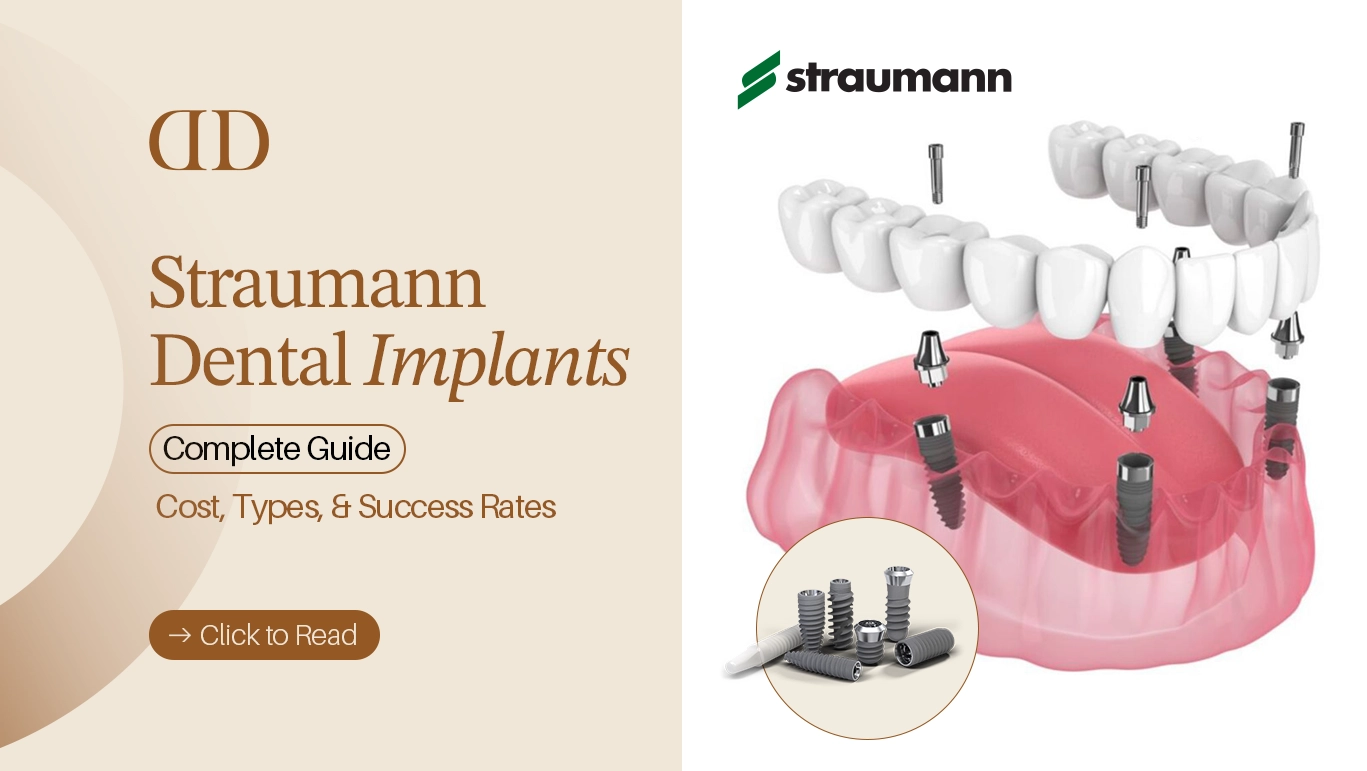

Straumann dental implants are premium implant systems known for their long-term clinical documentation, material options such as Roxolid, and surface technologies such as SLActive. Whether they are the right choice depends on factors including bone quality, implant position, treatment timeline and overall treatment cost.
Straumann has held the title of “gold standard” in implant dentistry since the 1970s. But is that reputation still earned in 2026, or are you paying for brand prestige rather than measurable clinical advantages? This guide cuts through the marketing to examine what Straumann actually offers and whether it’s worth the premium over alternatives like Nobel Biocare, BEGO, or Korean systems like Hiossen. Patients comparing implant brands can review our dental implant treatment options to understand how implant type, bone condition and restoration design affect treatment planning.
What Makes Straumann Dental Implants Different?
Straumann’s implant portfolio is not a single product. Different systems, materials and surface technologies are designed for different clinical situations. In practice, the choice between options such as BLT, BLX, Roxolid and SLActive is based on the patient’s anatomy and treatment plan rather than on the brand name alone.
Three things separate Straumann from the pack:
1. Roxolid: The Material Advantage
Most dental implants use commercially pure titanium (Grade 4) or titanium alloy (Grade 5). Straumann developed Roxolid, a titanium-zirconium alloy that’s 50% stronger than pure titanium while maintaining identical biocompatibility.
Why does this matter? Stronger material allows for smaller-diameter implants that can be placed in bone that would otherwise require grafting. A standard implant requires at least 6mm of bone width. A Roxolid implant can function reliably in bone as narrow as 3-4mm. For patients with bone loss which is most people missing teeth for more than a year this can mean the difference between immediate implant placement and months of bone augmentation procedures.
Clinical research consistently validates Roxolid’s performance in challenging cases. A large-scale retrospective cohort study published in Clinical Oral Implants Research examined 4,591 Straumann implants in private practice settings over 10 years and found that Straumann Bone-Level implants achieved 99% survival rates at 3 years, with Tissue-Level implants maintaining that 99% survival rate throughout the entire study period.
Roxolid is a titanium-zirconium alloy used in selected Straumann implant configurations. Its higher mechanical strength can be useful when implant diameter or available bone volume is an important consideration. However, using a narrower implant does not automatically eliminate the need for bone augmentation. Implant diameter and the need for grafting must be determined from the patient’s anatomy and treatment plan.
2. SLActive: Accelerated Healing
This is where Straumann’s pricing premium becomes clinically defensible. SLActive is a hydrophilic (water-attracting) surface treatment that fundamentally changes how quickly bone integrates with the implant.
```html
```
Premium Dental Care in Turkey
Expert treatments with high-end technology. Get your personalized quote today via WhatsApp.
Standard implants use SLA (sandblasted, large-grit, acid-etched) surfaces, which are hydrophobic meaning protein molecules from blood struggle to adhere initially. Healing takes 8-12 weeks before the implant can support a crown.
SLActive undergoes additional processing in a nitrogen-protected atmosphere, creating a chemically active surface that attracts proteins and bone cells immediately upon placement. Osseointegration time drops to 3-4 weeks less than half the industry standard.
```html  ```
```
Want trusted dental advice in your Google AI answers?
Add Darya Dental Turkey as a Preferred Source on Google to make our dental guides easier to find in your search results and AI Overviews.
Research from the University of Bern demonstrated that SLActive surfaces achieved 74% bone-to-implant contact at 4 weeks versus 54% for conventional SLA surfaces. For patients who need faster treatment timelines whether due to an upcoming wedding, job interview, or simply impatience that difference is meaningful.
3. Five Decades of Clinical Documentation
Straumann’s first commercially successful implant was placed in 1974. That means the company has 50 years of continuous clinical data on long-term outcomes, material performance, and evolving surgical protocols.
This matters less for the implant surgery itself and more for what happens 15 years later when you need a replacement crown or abutment. Straumann’s commitment to backward compatibility means components from 1990s-era implants are still manufactured and available. You won’t find that guarantee with every brand.
Straumann Implant Types Explained
Straumann doesn’t make “one implant.” The company produces distinct systems optimized for different clinical situations. Understanding which system your dentist is recommending and why is critical.
Straumann offers implant systems in different designs and configurations rather than one universal implant model. The choice may depend on available bone, implant position, primary stability, restoration type and whether conventional, immediate or early treatment protocols are being considered.
Straumann BLX
What it is: The newest addition to the Straumann lineup, designed specifically for immediate placement and immediate loading protocols.
The BLX system is designed around Straumann’s Dynamic Bone Management concept, which focuses on achieving primary stability through implant design and controlled bone engagement. Straumann positions BLX particularly for immediate treatment concepts, although suitability still depends on the individual clinical situation.
Key features:
- Enhanced primary stability through aggressive thread design
- Optimized for extraction sockets and softer bone (Type III/IV density)
- Available in Roxolid material for maximum strength in compromised bone
Best for: Immediate implant placement after tooth extraction, or cases where you want the temporary crown placed the same day as surgery.
Straumann BLT (Bone Level Tapered)
What it is: The workhorse of the Straumann lineup. Tapered design mimics natural tooth root shape.
Key features:
- CrossFit connection for superior microgap sealing (reduces bacterial leakage)
- Excellent for both anterior aesthetics and posterior strength
- Available in SLA or SLActive surfaces
- Full range of diameters (3.3mm to 6.5mm)
Best for: Often considered for a wide range of bone-level implant cases, including single-tooth replacement, depending on the clinical assessment..
BLT is a tapered bone-level implant system available in different diameters and configurations. Its selection should be based on the available bone, implant position and restorative requirements rather than treating BLT as a default option for every patient.
Straumann Standard (Tissue Level)
What it is: The original Straumann design, where the implant-abutment connection sits at the gum level rather than bone level.
Key features:
- One-piece abutment-implant design available
- Reduced surgical complexity
- Proven track record (this is the system with 40+ years of data)
Best for: Posterior (back teeth) cases where aesthetics are less critical, or in patients with thinner soft tissue where bone-level implants risk exposure.
Straumann Pro Arch (Full Arch Solution)
What it is: Straumann’s answer to Nobel Biocare’s All-on-4, designed for full-arch restoration.
Key features:
- Works with both straight and angled multi-unit abutments
- Compatible with digital workflow for screw-retained prosthetics
- Available in both BLX and BLT implant platforms
Best for: Edentulous (fully toothless) patients seeking fixed full-arch restoration.
Cost at Darya Dental Istanbul: €4,300–€6,800 per arch (complete treatment)
Straumann BLT vs BLX: What’s the Difference?
BLT and BLX are both bone-level Straumann implant systems, but their designs emphasize different clinical considerations. BLT is a tapered implant system used across a broad range of cases, while BLX incorporates Straumann’s Dynamic Bone Management concept and is particularly associated with immediate treatment protocols. The better option depends on the anatomy, implant position and treatment plan.
Feature Straumann BLT Straumann BLX Implant concept Bone-level tapered implant Bone-level implant with Dynamic Bone Management Main design consideration Tapered implant geometry Primary stability and bone engagement Material options Includes Roxolid configurations Includes Roxolid configurations Surface options Available with SLActive Available with SLActive Treatment context Broad range of implant cases Particularly associated with immediate treatment concepts Final selection Case dependent Case dependent Neither BLT nor BLX is universally better. The implant selected should match the patient’s bone anatomy, restorative needs and treatment protocol.
Straumann Cost Breakdown: US vs UK vs Turkey
A Straumann implant price does not necessarily represent the total cost of replacing a tooth. A complete implant treatment may also involve the surgical procedure, abutment, crown, diagnostic imaging, temporary restoration and, when necessary, additional procedures such as bone grafting.
Single Implant Pricing (Fixture Only)
| Location | Straumann BLT/BLX | What’s Included |
|---|---|---|
| United States | $1,200–$1,800 | Implant fixture only |
| United Kingdom | £600–£900 | Implant fixture only |
| Turkey (Darya Dental) | ₺30,000–₺42,000 ($700–$1,060) | Implant fixture + placement surgery + temporary crown |
Important distinction: In the US and UK, that price typically covers only the implant body itself. You’ll pay separately for:
- Surgical placement ($500–$1,500)
- Abutment ($300–$800)
- Crown ($1,200–$2,500)
- Diagnostic imaging ($200–$500)
Total single-tooth Straumann implant cost:
- US: $3,200–$6,800
- UK: £2,100–£5,200
- Turkey (Darya Dental): ₺45,000–₺60,000 ($1,150–$1,600) all-inclusive
Full Arch Restoration Pricing (Straumann Pro Arch)
| Location | Per Arch Cost | What’s Included |
|---|---|---|
| United States | $20,000–$30,000 | Implants + temporary prosthetic |
| United Kingdom | £15,000–£25,000 | Implants + temporary prosthetic |
| Turkey (Darya Dental) | €4,300–€6,800 | Implants + surgery + temporary + final zirconia prosthetic + 5-night hotel + VIP transfers |
What Is Included in the Total Straumann Implant Cost?
The total treatment cost is usually more useful for patients than the price of the implant fixture alone. Before comparing quotes, check whether the package includes the implant, surgery, abutment, temporary restoration, final crown and diagnostic imaging. Additional procedures, such as bone augmentation or sinus lifting, may increase the final cost when clinically necessary.
Cost component What it covers Implant The Straumann implant fixture Surgery Implant placement procedure Abutment Connects the implant to the restoration Crown Visible tooth replacement Imaging Diagnostic planning and assessment Additional procedures Bone grafting or other procedures when required
How Much Do Straumann Implants Cost in Turkey?
Straumann implant costs in Turkey vary according to the implant system, number of implants, restoration type, clinic, laboratory work and any additional procedures required. A quoted price should therefore be evaluated based on what is included rather than compared as a single implant fixture price. Patients should ask whether surgery, abutment, temporary and final restorations, imaging and follow-up are included.
SLActive Surface Technology: What It Actually Does
Marketing materials describe SLActive as “the most advanced implant surface in the world.” But what does that mean in practical terms?
The Chemistry: Standard SLA surfaces are created by sandblasting titanium with corundum particles, then acid-etching to create micro-roughness. This creates a hydrophobic surface water (and blood proteins) bead up rather than spread across the surface.
SLActive takes the SLA surface and processes it in a nitrogen-protected environment, then stores it in isotonic saline solution. This preserves the chemically reactive hydroxyl groups on the titanium surface, creating a hydrophilic surface with high surface energy.
Why it matters: When an implant is placed into bone, the initial protein adsorption on the surface determines how quickly bone-forming cells (osteoblasts) colonize the implant. On hydrophobic surfaces, protein adhesion is slow and random. On SLActive’s hydrophilic surface, proteins adhere within seconds in an organized pattern that actively recruits osteoblasts.
The clinical payoff:
- Week 1: SLActive implants show 50% more bone formation than SLA implants
- Week 3: Sufficient osseointegration for provisional loading in many cases
- Week 4: Comparable bone integration to what SLA achieves at 8 weeks
This isn’t just theoretical. A multicenter study across 8 European clinics found that early loading (at 21 days) of SLActive implants had identical success rates to conventional loading protocols at 12 weeks.
When SLActive matters most:
- Immediate or early loading cases
- Patients with compromised bone quality (diabetics, smokers, osteoporosis)
- Extraction socket placements where initial stability is marginal
- Patients who simply cannot wait 3 months for a crown
When it doesn’t matter: If you’re placing an implant in pristine bone with excellent primary stability and you’re fine waiting 12 weeks for the final crown, standard SLA surfaces will perform identically long-term.
Straumann vs Nobel Biocare: Head-to-Head Comparison
These are the two brands that dominate high-end implant dentistry. If you’re comparing quotes and trying to decide between them, here’s what actually differentiates them:
| Feature | Straumann | Nobel Biocare |
|---|---|---|
| Country of Origin | Switzerland | Sweden |
| Flagship Material | Roxolid (Ti-Zr alloy) | Grade 4 pure titanium |
| Surface Technology | SLActive (hydrophilic) | TiUnite (anodized oxidized) |
| Osseointegration Speed | 3-4 weeks (SLActive) | 6-8 weeks (TiUnite) |
| Connection Type | CrossFit conical | Tri-channel internal |
| Primary Strength | Faster healing, narrow-diameter options | All-on-4 full-arch protocol |
| Ideal Use Case | Compromised bone, immediate loading, aesthetic zone | Full-arch restoration, complex full-mouth cases |
| Cost (Single Implant at Darya Dental) | ₺30,000–₺42,000 ($700–$1,060) | ₺27,000–₺37,000 ($650–$900) |
| Success Rate (10-year data) | 98.8% | 98.2% |
Bottom line: For single-tooth or limited implant cases where bone quality is questionable or you want faster healing, Straumann edges ahead. For full-arch All-on-4 restorations, Nobel Biocare’s clinical protocols and training infrastructure give them an advantage. Both are excellent choices the “better” option depends on your specific clinical situation.
For a comprehensive comparison of Straumann against 9 other premium implant brands including Nobel Biocare, BEGO, Zimmer Biomet, and Korean systems, see our complete dental implant brands comparison guide.
What Is the Success Rate of Straumann Dental Implants?
Straumann implants have strong long-term clinical documentation, but there is no single success rate that applies to every Straumann implant, patient or treatment protocol. Reported outcomes vary according to the implant system, follow-up period, patient factors, implant location and definition of success used by the study.
Implant Survival vs Implant Success
Implant survival means that the implant remains in place and functional at a defined follow-up point. Implant success is a stricter clinical assessment that can include factors such as implant stability, bone levels and the absence of certain biological or technical complications. These terms should not be treated as interchangeable.
Straumann vs BEGO: German Engineering at Different Price Points
BEGO Semados implants offer German manufacturing quality at roughly half the cost of Straumann. The question: what are you giving up?
Material: BEGO uses Grade 4 pure titanium vs Straumann’s Roxolid. In standard bone, this makes zero clinical difference. In compromised bone or narrow ridges, Roxolid’s strength advantage becomes relevant.
Surface: BEGO’s TiPure Plus is a conventional SLA surface same family as Straumann’s standard SLA, but without the SLActive modification. Expect standard 8-12 week healing times.
Clinical data: BEGO has been manufacturing implants since 1990 with documented 10-year success rates of 96-98% statistically identical to Straumann’s long-term outcomes.
Where BEGO makes sense: Straightforward posterior (back tooth) cases in healthy bone where you don’t need immediate loading and aesthetics aren’t the primary concern. You’ll save £400–£600 per implant with essentially identical 10-year outcomes.
Where Straumann justifies the premium: Anterior (front tooth) aesthetics, compromised bone requiring narrow-diameter implants, or immediate/early loading protocols.
Read on: Bredent vs Straumann Implants
Who Should Choose Straumann Implants
Not everyone needs a Straumann implant. Here’s an honest assessment of when the premium is justified:
Ideal Straumann Candidates:
1. Patients with bone loss or narrow bone ridges
Roxolid’s strength allows 3.3mm and 4.1mm diameter implants that can be placed without bone grafting in situations where standard implants would require augmentation. If grafting can be avoided, the total cost equation shifts dramatically bone grafts add $1,500–$3,000 per site.
2. Immediate placement/loading cases
Extracting a front tooth and leaving with a temporary crown the same day requires exceptional primary stability and rapid osseointegration. SLActive’s accelerated healing significantly reduces the risk of early loading failure.
3. Medically compromised patients
Diabetics, smokers, and patients with osteoporosis have impaired bone healing. SLActive’s ability to achieve faster, more predictable osseointegration in compromised bone is well-documented.
4. High aesthetic demand (front teeth)
Straumann’s tapered BLT design, platform switching, and extensive soft tissue management components make it one of the strongest options for achieving natural-looking results in the smile zone.
5. Patients who value documented longevity
If 40+ years of clinical data and the confidence that replacement parts will be available in 2045 matters to you, Straumann and Nobel Biocare are the only brands with that track record.
When to Consider Alternatives:
- Simple posterior (back tooth) replacement in healthy bone → BEGO, Zimmer Biomet, or Hiossen will perform identically at lower cost
- Full-arch restoration → Nobel Biocare’s All-on-4 protocol has more extensive training and clinical data
- Budget constraints → Korean systems like Hiossen offer 95%+ success rates at 50% lower cost
Straumann Implants at Darya Dental Clinic Istanbul
Darya Dental Clinic in Istanbul’s Ümraniye-Ataşehir district is a Straumann-certified implant center one of the requirements for this designation is that all surgeons complete Straumann’s advanced training curriculum and meet minimum case volume thresholds.
Why we stock Straumann:
Darya Dental exclusively uses globally recognized implant brands (Straumann, Nobel Biocare, Medigma, BEGO, Hiossen) because international traceability matters. When you leave Istanbul with a Straumann implant, you carry official documentation including:
- Implant serial number and lot number
- Manufacturer certificate of authenticity
- Straumann’s international warranty
- Treatment records compatible with any dentist globally
This isn’t a trivial detail. If you need a replacement crown in 10 years while living in Australia, any Straumann-certified dentist can access your implant specifications and fabricate compatible components. That level of global serviceability is worth paying for.
Straumann treatment packages at Darya Dental:
Single Implant Package:
₺45,000–₺60,000 ($1,150–$1,600)
- Includes: Initial consultation, 3D CBCT imaging, implant placement surgery (performed by oral & maxillofacial surgeon), Straumann BLT or BLX implant, temporary crown, abutment, final Ivoclar Emax crown
Smile Makeover with Implants:
Custom pricing based on number of implants + veneers/crowns
- Includes: AI-supported digital smile design, 3D-printed mock-ups for approval before final production, implant placement, temporary restorations, final Ivoclar Emax crowns
Full Arch Straumann Pro Arch:
€5,300–€6,800 per arch
- Includes: 4-6 Straumann implants per arch, full digital planning, immediate temporary prosthetic, final zirconia hybrid prosthetic, 5-night hotel accommodation, VIP airport transfers
All surgery is performed by oral and maxillofacial surgeons not general dentists. This is non-negotiable for Darya Dental’s implant protocols and aligns with international best-practice standards
FAQ: Straumann Dental Implants
How much do Straumann dental implants cost?
Straumann implants cost $1,200–$1,800 per implant in the US, £600–£900 in the UK, and ₺30,000–₺42,000 ($700–$1,060) at Darya Dental Clinic in Istanbul, Turkey. Total treatment cost including surgery, abutment, and crown ranges from $3,200–$6,800 in the US, £2,100–£5,200 in the UK, and $1,150–$1,600 all-inclusive at Darya Dental Istanbul.
Are Straumann implants better than Nobel Biocare?
Both Straumann and Nobel Biocare are premium Swiss/Swedish brands with 98%+ success rates over 10 years. Straumann’s advantages: faster healing with SLActive surfaces (3-4 weeks vs 6-8 weeks), Roxolid material for narrow-diameter implants in compromised bone. Nobel Biocare’s advantages: more extensive All-on-4 clinical protocols and training for full-arch restoration. The “better” choice depends on your specific clinical situation.
Discover our full guide on Nobel Biocare Implants: Nobel Biocare Implants: All-on-4 Pioneer vs Modern Alternatives
What is SLActive and is it worth the extra cost?
SLActive is Straumann’s hydrophilic surface treatment that accelerates bone integration, reducing healing time from 8-12 weeks to 3-4 weeks. It’s worth the premium if you need immediate or early loading, have compromised bone quality (diabetes, smoking, osteoporosis), or want faster treatment timelines. For standard cases in healthy bone with no time pressure, conventional SLA surfaces perform identically long-term.
On another note: Smart Dental Implants: How Technology is Revolutionizing Tooth Replacement
How long do Straumann implants last?
Straumann implants have a documented survival rate of 99.3% at 3 years, 99.0% at 5 years, and 98.4% at 7 years according to a large-scale study of 4,591 implants. Long-term data shows approximately 95-97% survival at 20 years. With proper oral hygiene and regular maintenance, the titanium implant fixture can last a lifetime. The crown attached to the implant typically needs replacement every 10-15 years due to normal wear.
Why are Straumann implants cheaper in Turkey?
Lower operating costs in Turkey (clinic rent, surgeon salaries, laboratory fees) allow clinics like Darya Dental to offer Straumann implants at 50-60% lower prices than the US or UK without compromising quality. The implants themselves are identical manufactured in Switzerland and distributed globally. The difference is in the cost structure of providing dental care, not in the implant quality or clinical expertise.
Can I get Straumann implants in one visit to Turkey?
For single implant immediate loading cases in healthy bone, a single 7-10 day visit may be possible, where the implant is placed and a temporary crown is delivered. The final crown is typically placed 8-12 weeks later (second visit) or can be shipped to your local dentist for placement. Full-arch cases typically require two visits 3-4 months apart.
Does Darya Dental provide international warranties for Straumann implants?
Yes. Every Straumann implant placed at Darya Dental Clinic comes with manufacturer certification, serial number documentation, and Straumann’s international warranty. These documents are recognized globally, allowing any Straumann-certified dentist worldwide to service your implant if needed.
Is Straumann worth it compared to cheaper Korean brands?
For straightforward posterior cases in healthy bone, Korean brands like Hiossen or MegaGen offer 95%+ success rates at 40-50% lower cost and may be the smarter financial choice. Straumann justifies its premium in specific situations: compromised bone requiring narrow-diameter implants, aesthetic zone (front teeth) cases, immediate loading protocols, or when you value 50 years of clinical documentation.
