
How Do Dentists Choose the Right Dental Implant Size?
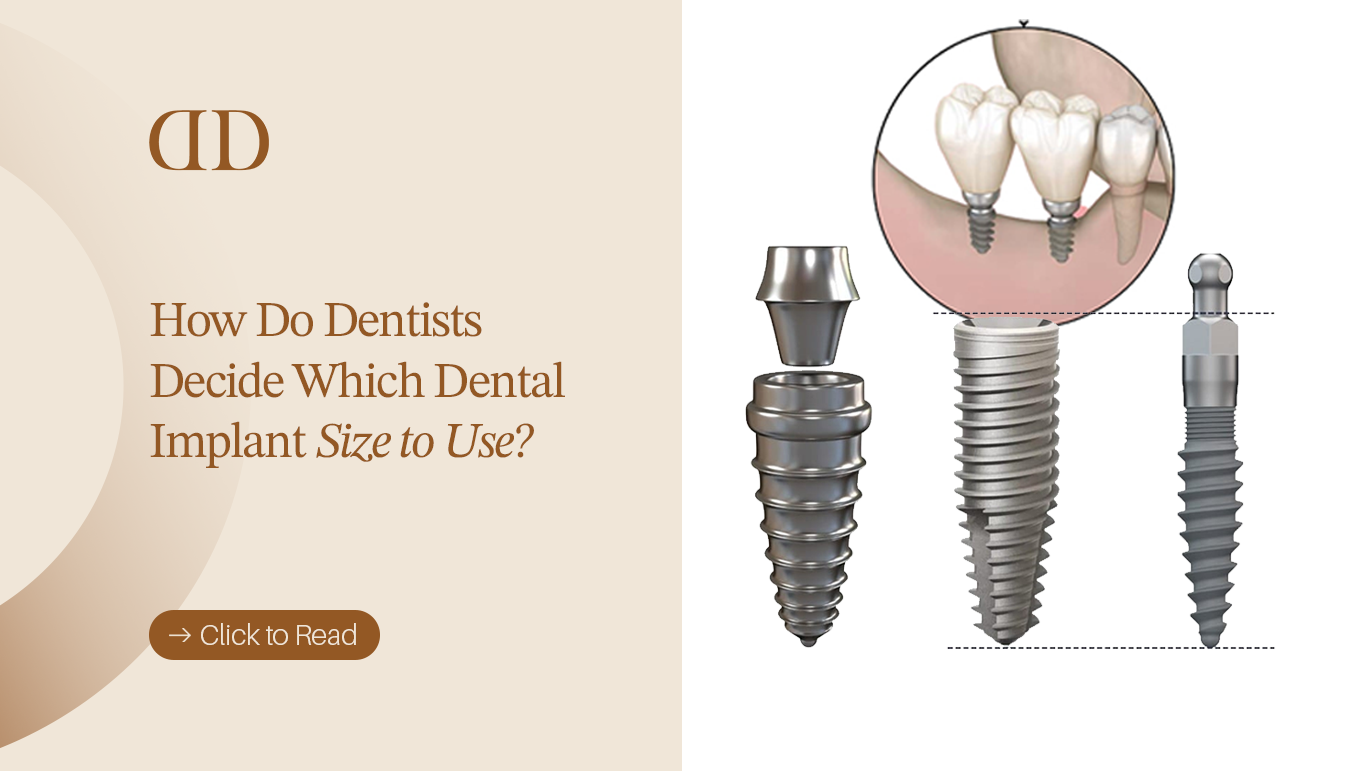

Dentists choose the right dental implant size by evaluating the available bone, the position of the missing tooth, surrounding anatomical structures, bite forces and the planned restoration. Implant size mainly refers to two dimensions: diameter and length. A clinical examination and 3D imaging such as CBCT can help determine which dimensions can be used safely and appropriately for an individual case.
There is no single implant size that works for every patient. The goal is not simply to choose the largest or longest implant available, but to select dimensions that fit the patient’s anatomy and support the planned crown, bridge or other restoration.
What Does Dental Implant Size Mean?
When dentists talk about dental implant sizing, they are generally referring to the implant’s diameter and length.
Implant Diameter vs Implant Length
Implant diameter describes how wide the implant is. It is particularly relevant when the available bone is narrow or when the implant must be positioned between adjacent teeth or other structures.
Implant length describes how far the implant extends into the jawbone. Bone height, the location of anatomical structures and the planned implant position all influence how much length is available.
These dimensions are considered together rather than independently. For example, an implant may have enough space in one dimension but not the other. A patient’s jaw may provide adequate bone height but insufficient width, or sufficient width but limited height.
The final choice therefore depends on the combination of anatomical and restorative factors.
Why There Is No Single Implant Size for Everyone
The appropriate dental implant size varies from one patient and tooth location to another. Even two people replacing the same type of tooth may require different implant dimensions because their jawbone anatomy, bone quality, spacing and surrounding structures are different.
Implant terminology such as short, long, narrow and wide is also not completely standardized across all research and clinical contexts. For this reason, these terms should not be treated as universal prescriptions or as a simple ranking of implant options.
Premium Dental Care in Turkey
Expert treatments with high-end technology. Get your personalized quote today via WhatsApp.
Instead, dentists consider the dimensions that are realistically available at the intended implant position and then determine which implant configuration is compatible with the planned restoration.
What Factors Determine Dental Implant Size?
Several factors influence how dentists determine the appropriate implant dimensions. The most important question is whether the implant can be positioned within the available bone while maintaining an appropriate relationship with neighbouring teeth, anatomical structures and the final restoration.

Want trusted dental advice in your Google AI answers?
Add Darya Dental Turkey as a Preferred Source on Google to make our dental guides easier to find in your search results and AI Overviews.
| Clinical factor | What the dentist assesses | Possible implication for implant dimensions |
| Bone width | The thickness of the available jawbone | May influence the implant diameter that can be accommodated |
| Bone height | The vertical bone available at the planned site | May limit implant length |
| Bone density and quality | The characteristics of the bone at the implant site | Can influence implant-selection and stability considerations |
| Missing tooth location | Front tooth, premolar or molar region | Affects available space, anatomy and functional requirements |
| Adjacent teeth or implants | Distance between the implant site and neighbouring structures | Helps determine where the implant can be positioned and which diameter may fit |
| Nerves and sinuses | Location of important anatomical structures | Can limit the available implant position or length |
| Bite forces | Functional loading expected at the site | May influence the overall implant and restoration plan |
| Planned restoration | Crown, bridge or other prosthetic design | The implant must be positioned to support the final restoration appropriately |
Available Bone Width
Bone width is one of the key considerations when selecting dental implant diameter. The implant needs to fit within the available bone at the planned position.
A narrow ridge may restrict the diameter that can be considered. However, the decision is not based on bone width alone. The dentist also has to consider the position of the implant in relation to neighbouring teeth, the intended restoration and other anatomical structures.
This is why simply asking for a particular implant diameter is not enough to determine whether that dimension is appropriate for an individual patient.
Available Bone Height
Bone height is particularly important when determining dental implant length.
The dentist needs to assess the vertical space available at the intended implant site and identify structures that could affect the available space. Depending on the location of the missing tooth, these may include the maxillary sinus in the upper jaw or important nerves in the lower jaw.
A longer implant is therefore not automatically a better implant. The implant must fit the available anatomy and be positioned appropriately for the final restoration.
Bone Density and Quality
Bone dimensions describe how much physical space is available, but dentists also consider the characteristics of the bone itself.
Bone quality and density can affect the mechanical environment around an implant and are therefore part of the overall planning process. These factors are considered alongside the implant’s diameter and length rather than used as a single rule for selecting one particular size.
Location of the Missing Tooth
The location of the missing tooth can affect implant sizing because different areas of the mouth have different anatomical and functional conditions.
For example, implant size for molars may be influenced by the amount of available bone, the space left by the missing tooth and the forces generated during chewing. In the front of the mouth, implant size for front teeth must also be considered in relation to the available space, surrounding anatomy and the position required for the final restoration.
The tooth location is therefore one part of a larger planning process rather than a direct formula for selecting an implant size.
Space Between Adjacent Teeth or Implants
The implant must be positioned with appropriate consideration for the structures around it. The available space between adjacent roots, teeth or other implants can affect both the implant’s position and the diameter that can be considered.
This is one reason why implant planning cannot be based only on the visible size of the gap left by a missing tooth. The underlying anatomy may provide different spatial constraints.
Nerves, Sinuses and Other Anatomical Structures
Important anatomical structures can place limits on implant positioning and dimensions.
In the lower jaw, the location of major nerves is an important consideration when evaluating available bone height. In the upper jaw, the maxillary sinus can influence the amount of bone available in the posterior region.
These structures are evaluated during treatment planning so that the proposed implant position and dimensions can be assessed in three dimensions.
Bite Forces and the Planned Restoration
Implant selection is also connected to what the implant will ultimately support.
The dentist considers the planned crown, bridge or other prosthetic restoration and how forces are expected to act on it. Implant positioning should therefore be planned in relation to the final restoration rather than simply placing an implant in the centre of the empty space.
This prosthetically driven approach helps connect three parts of the decision:
available anatomy → implant dimensions → final restoration.
The correct dental implant size is therefore the result of an overall treatment-planning process, not a measurement chosen in isolation.
How CBCT Helps Dentists Select Implant Dimensions
When conventional examination does not provide enough information about the three-dimensional anatomy, CBCT dental implant planning can help dentists evaluate the proposed implant site in greater detail.
CBCT, or cone beam computed tomography, produces three-dimensional images of the jaw. This allows the dental team to assess bone dimensions and the position of important anatomical structures before implant placement.
Measuring Bone in Three Dimensions
A dental implant site is not simply a flat space that can be measured from the front or side.
The available bone has width, height and depth, and these dimensions can vary along the proposed implant path. A CBCT scan can provide three-dimensional information that helps the dentist assess the anatomy around the planned site.
This can be particularly relevant when determining:
- how much bone is available around the proposed implant position
- whether bone width can accommodate the planned diameter
- whether sufficient bone height is available for the planned length
- where nerves, sinuses and other anatomical structures are located
- how neighbouring roots or implants relate to the proposed implant position
Research comparing imaging approaches has shown that the imaging information available to clinicians can influence implant-length and diameter selection. CBCT provides three-dimensional anatomical information that may be useful when conventional two-dimensional imaging does not adequately represent the site.
The scan is therefore not used simply to “find an implant size.” It contributes to a broader assessment of whether a proposed implant position and dimension are compatible with the patient’s anatomy.
Planning the Implant Position Before Surgery
Implant planning involves more than deciding how large the implant should be.
The proposed position needs to work with the final restoration, surrounding anatomy and available bone. Digital planning can help the dental team visualize the intended implant position before surgery and evaluate the relationship between these factors.
This is particularly important because the ideal position of an implant is not necessarily the centre of the visible gap. The final crown or other restoration influences where the implant needs to be positioned.
In simple terms, the planning sequence can be understood as:
Clinical examination → 3D imaging → anatomical assessment → prosthetic planning → implant selection
The exact sequence and tools used can vary according to the individual case.
How Implant Diameter Is Chosen
Dental implant diameter refers to the width of the implant body. Dentists consider the available bone width, the space between neighbouring structures, the planned implant position and the functional requirements of the restoration.
There is no universal diameter that should be used for every tooth or every patient.
Narrow-Diameter Implants
Narrow-diameter implants may be considered when the available space or bone width places limitations on the implant dimensions.
For example, a relatively narrow ridge or a site with limited space between adjacent structures may lead the dentist to consider a narrower implant option.
However, “narrow” should not be interpreted as automatically better or worse. Its suitability depends on the individual anatomy, the planned restoration and the clinical circumstances.
The terminology used to classify implant diameter also varies across research and clinical contexts, so fixed labels should not be treated as universal measurements.
Standard-Diameter Implants
Standard-diameter implants are commonly used when the available anatomy and restorative requirements allow an implant within that category to be selected.
The important point is that a “standard” implant is not a universal default that can be prescribed without assessment. The dentist still needs to determine whether the available bone, surrounding structures and planned restoration support that choice.
Wide-Diameter Implants
A wider implant may be considered when the anatomy and restorative plan allow it and when the clinical situation makes that dimension appropriate.
But a wider implant is not automatically a better implant.
The dentist must first establish whether sufficient bone width is available and whether the proposed position provides appropriate relationships with adjacent structures. The final restoration and expected functional demands also form part of the decision.
This is why narrow vs wide dental implants should be understood as a clinical planning question rather than a simple comparison in which one size category is always preferable.
How Implant Length Is Chosen
Dental implant length describes the vertical dimension of the implant within the jawbone. Bone height and the location of anatomical structures are particularly important when evaluating this dimension.
As with diameter, implant length is selected in combination with other clinical and restorative considerations.
Short Implants
Short implants may be considered when available bone height is limited and the clinical situation allows this approach.
They can be relevant in areas where increasing implant length would bring the implant closer to important anatomical structures or where additional procedures to increase available bone may not be appropriate or necessary.
A short implant should not simply be viewed as an inferior version of a longer implant. Its suitability depends on factors such as the individual anatomy, bone characteristics, implant position and restoration.
Standard and Longer Implants
Where the available bone height and anatomy permit, an implant with greater length may be considered as part of the treatment plan.
However, the decision is not based on length alone. The implant must remain compatible with the surrounding anatomy and the intended restoration.
Different clinical situations may therefore lead to different implant-length choices, even when the missing teeth appear similar.
Why Longer Is Not Automatically Better
It may seem logical that a longer implant would always provide a better result because it extends farther into the bone. Clinical implant planning is more nuanced than that.
If the available bone height is limited, increasing implant length may bring the implant too close to an important anatomical structure. In other cases, a shorter implant may provide a suitable option within the available anatomy.
The objective is therefore not to maximize implant length. It is to select an implant dimension that fits the patient’s anatomy and works with the overall treatment plan.
What Happens When There Is Not Enough Bone?
Limited bone volume does not necessarily mean that dental implants are impossible.
When the available bone is insufficient for the preferred implant position or dimensions, the dentist may consider different treatment strategies. The appropriate option depends on the location and characteristics of the bone deficiency and the overall treatment plan.
Bone Grafting
Bone grafting before dental implants may be considered when additional bone volume is needed to support the planned implant treatment.
The purpose of grafting is to modify the available site so that implant placement may become possible or provide additional options for planning. Whether grafting is appropriate depends on the individual clinical situation.
It should not be assumed that every patient with limited bone needs a graft. In some cases, alternative implant dimensions or positions may be considered instead.
Sinus Augmentation
In the posterior upper jaw, the maxillary sinus can limit the available vertical bone height.
A sinus augmentation procedure may be considered in selected cases when additional bone height is needed in this region. The decision depends on the anatomy and the intended implant treatment.
The presence of limited bone height therefore does not automatically determine one treatment. It prompts the dentist to assess the available alternatives.
When Shorter or Narrower Implants May Be Considered
If bone volume is limited, dentists may sometimes consider a shorter or narrower implant when the anatomy and restorative requirements make that option appropriate.
This can be part of a conservative planning approach that works within the patient’s existing anatomy rather than assuming that additional surgical procedures are always necessary.
However, implant dimensions should not be selected from a chart based only on bone measurements. The dentist needs to consider the complete clinical picture, including bone quality, anatomical structures, implant position and the planned restoration.
The central principle remains:
The implant should be selected to fit the anatomy and treatment plan not the other way around.
How Dentists Finalize the Implant Size
Selecting an implant size is the result of combining clinical examination, imaging, anatomical assessment and prosthetic planning. The dentist does not normally determine diameter or length from one measurement alone.
The process can be summarized as:
Examination → imaging → anatomical mapping → prosthetic planning → implant selection
Each step provides information that helps determine which implant dimensions are realistic for the individual case.
Clinical Examination
The process begins with an assessment of the patient’s oral condition and the area where the tooth is missing.
The dentist evaluates the condition of the gums and surrounding tissues, the location of the missing tooth and the available space. The overall treatment plan is also considered before an implant dimension is selected.
Clinical examination provides information that cannot be obtained from an implant measurement alone. It helps the dentist understand the condition of the site and identify whether additional investigation or treatment may be necessary.
Imaging and Digital Planning
Imaging provides additional information about the underlying anatomy.
Depending on the case, 3D imaging such as CBCT can help assess bone width and height and identify structures such as nerves and the maxillary sinus. Digital planning can then be used to evaluate the proposed implant position in relation to the surrounding anatomy and the intended restoration.
This is particularly useful because implant placement is a three-dimensional procedure. The available bone may not have the same dimensions throughout the proposed implant path.
Matching the Implant to the Final Crown, Bridge or Prosthesis
The implant is ultimately part of a restorative treatment, so its dimensions and position need to be considered alongside the final crown, bridge or other prosthesis.
The goal is not simply to fill the space left by a missing tooth with an implant. The implant position needs to support the planned restoration while respecting the patient’s anatomy.
This is why dental implant planning is often described as prosthetically driven: the intended final restoration helps guide the position and dimensions of the implant.
Frequently Asked Questions
What size dental implant do I need?
There is no single dental implant size that is appropriate for everyone. The required diameter and length depend on factors such as available bone width and height, bone quality, tooth location, surrounding anatomy, bite forces and the planned restoration.
A dentist can determine the appropriate dimensions only after evaluating the individual treatment site.
Does dental implant size depend on the missing tooth?
Yes. The location of the missing tooth is one factor that can influence implant sizing. The anatomy, available space and functional demands can differ between front teeth, premolars and molars.
However, tooth location alone does not determine implant size. Two patients replacing the same type of tooth may still require different dimensions because their anatomy and restorative requirements differ.
Is a wider dental implant always better?
No. A wider implant is not automatically better.
The diameter must be compatible with the available bone width and the surrounding anatomy. The dentist also considers the implant position and the planned restoration.
The appropriate choice is the dimension that fits the individual treatment plan, rather than simply the widest available option.
Are short dental implants safe when bone height is limited?
Short implants may be considered in selected cases where bone height is limited. Whether they are appropriate depends on the patient’s anatomy, bone characteristics, implant position and planned restoration.
The decision should therefore be made as part of an individual clinical assessment rather than based solely on the fact that available bone height is limited.
How does a CBCT scan help determine implant size?
A CBCT scan provides three-dimensional information about the proposed implant site. It can help the dental team assess bone width and height and visualize important anatomical structures such as nerves and the maxillary sinus.
This information can contribute to decisions about implant position, diameter and length. CBCT is therefore a planning tool rather than a standalone method for automatically selecting an implant size.
Can I get a dental implant if I do not have enough bone?
Possibly. Limited bone does not necessarily rule out implant treatment.
Depending on the clinical situation, the dentist may consider bone grafting, sinus augmentation, a different implant position or an implant with different dimensions. The appropriate approach depends on the location and extent of the bone limitation and the overall treatment plan.
How much space is needed around a dental implant?
The required space depends on the implant position, its dimensions and the surrounding anatomical structures. The dentist needs to assess the relationship between the proposed implant and neighbouring teeth, roots, implants and other structures.
Because these relationships are three-dimensional, the available space should be evaluated as part of clinical and imaging-based planning rather than reduced to one universal measurement.
Does bone density affect implant diameter or length?
Bone density and quality are among the factors considered during implant planning. They can influence the mechanical conditions around the implant and therefore form part of the overall assessment of implant dimensions and stability.
However, bone density alone does not determine a specific implant diameter or length. It is considered together with bone dimensions, anatomy, implant position and the planned restoration.
The right dental implant size is not a universal number. Dentists select implant diameter and length by considering available bone width and height, bone quality, the location of the missing tooth, surrounding anatomical structures, functional demands and the final restoration.
CBCT and other planning tools can provide important three-dimensional information, but the final decision remains patient-specific. When bone volume is limited, options such as bone grafting, sinus augmentation or alternative implant dimensions may be considered depending on the clinical situation.
For patients considering implant treatment, the most useful question is therefore not simply “What size implant do I need?” but “Which implant dimensions are appropriate for my anatomy and planned restoration?”
For a broader overview of implant treatment and planning, see Dental implants. If limited bone is a concern, Bone grafting before dental implants provides a relevant next step. For selected treatment situations, Same-day dental implants can also be considered in the context of individual clinical assessment.
