
Cracked Tooth or Cavity? How the Symptoms Differ
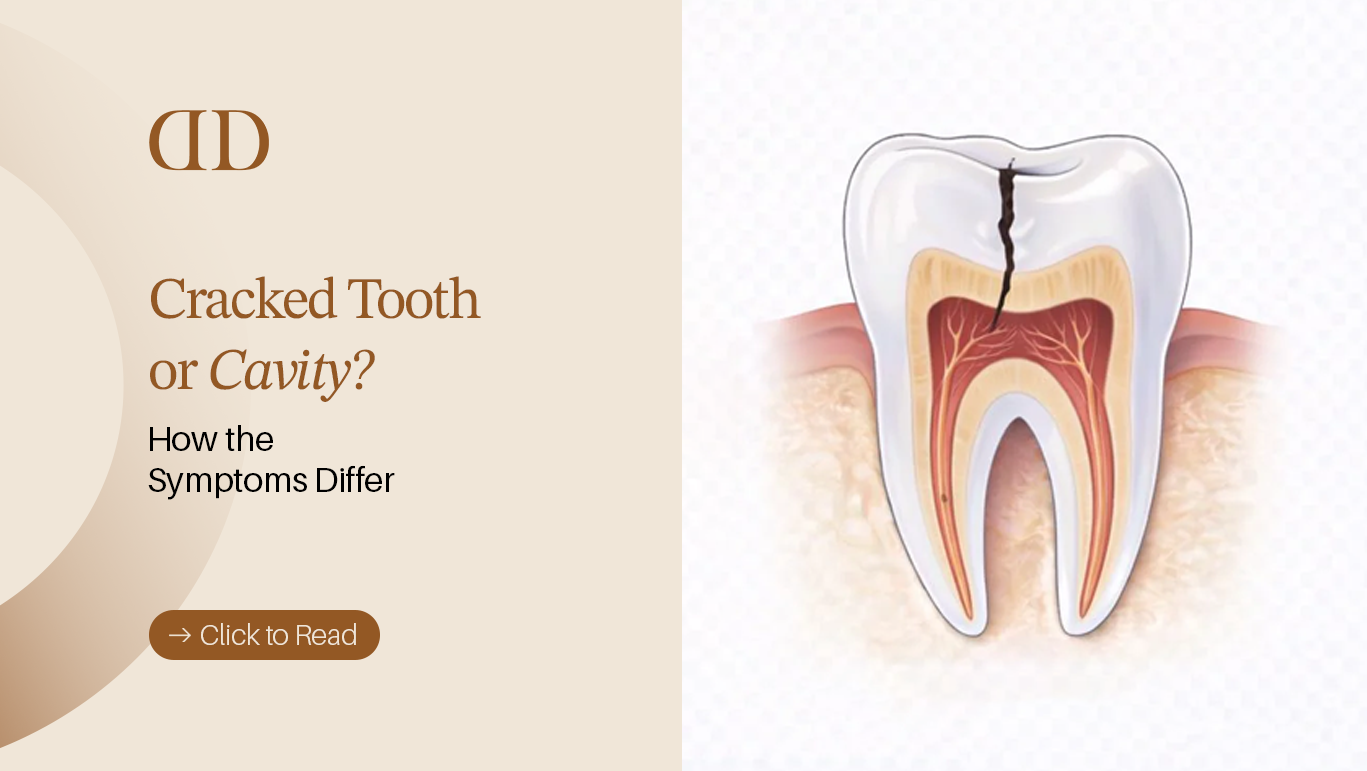

If your tooth hurts when you bite, reacts to cold drinks, or becomes sensitive to sweets, it can be difficult to know whether the problem is a cracked tooth or a cavity. Some symptoms overlap, so pain alone cannot reliably identify the cause. However, the pattern of the pain can provide useful clues.
A cracked tooth often causes sharp, unpredictable pain during chewing, particularly when biting pressure is released. A cavity, especially as tooth decay progresses, is more commonly associated with sensitivity to hot, cold, or sweet foods and drinks. Early tooth decay can also cause no symptoms at all.
The distinction matters because a crack and a cavity affect the tooth in different ways and may require different forms of treatment. If decay has reached the dental pulp, root canal treatment may be considered to help preserve the tooth. If pain keeps returning, becomes stronger, or is difficult to locate, a dental examination is the safest way to determine what is happening.
Cracked Tooth vs Cavity: What Is the Difference?
A cracked tooth has a structural crack in the tooth. Cracks can develop from injury, repeated stress, biting forces, or general wear. Depending on the location and extent of the crack, chewing can cause movement within the tooth and irritate the tissue containing the tooth’s nerves. This can produce sudden or intermittent pain.
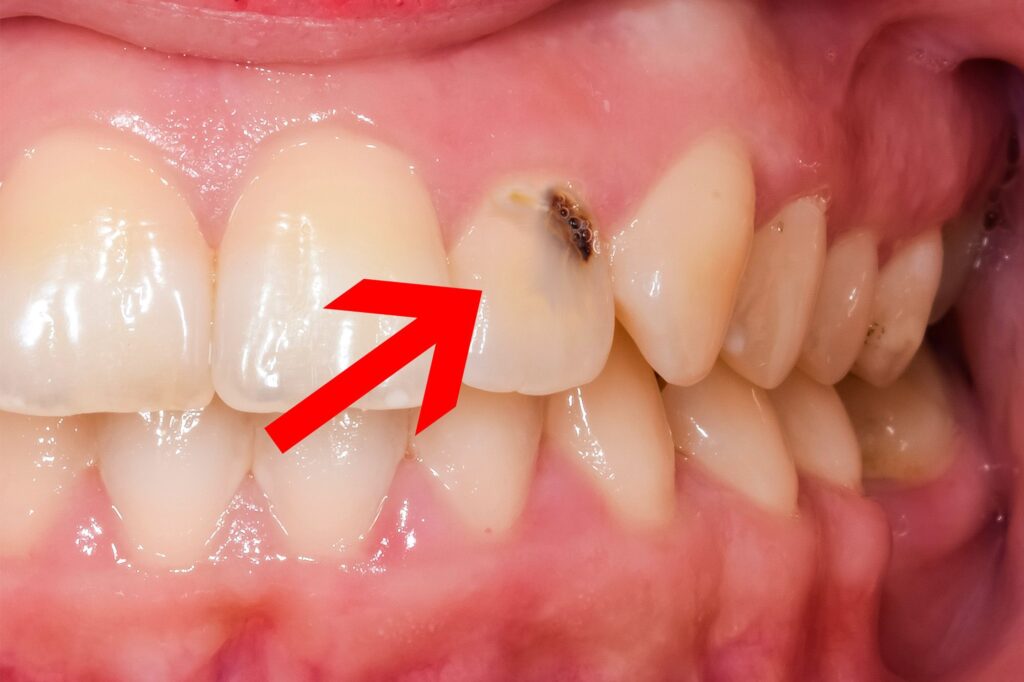
A cavity, on the other hand, is the result of tooth decay. Bacteria use sugars and starches from food and drinks to produce acids that gradually damage the tooth’s enamel. As decay progresses, the damaged area can develop into a cavity, and symptoms such as toothache or sensitivity may appear.
The simplest way to think about the difference is:
| Symptom or sign | Cracked tooth | Cavity |
| Sharp pain when biting | Common clue | Possible, especially with deeper decay |
| Pain when releasing the bite | Can be particularly suggestive | Less characteristic |
| Hot or cold sensitivity | Possible | Common as decay progresses |
| Sweet sensitivity | Possible, but less characteristic | Common |
| Pain that comes and goes | Common | Possible |
| Visible hole | Not necessarily present | May appear with an established cavity |
| Visible crack | Often difficult to see | Not applicable |
| Can be diagnosed reliably at home? | No | No |
These are patterns rather than diagnostic rules. A cavity can cause pain when chewing, while a cracked tooth can also be sensitive to hot or cold. This overlap is why a professional assessment may be needed when symptoms persist.
Sharp Pain When Biting or Releasing the Bite
One of the more characteristic cracked tooth symptoms is sharp pain when chewing. Some people notice it when they bite down on a particular food, while others feel the pain as they release the biting pressure.
This happens because chewing forces can cause the cracked parts of the tooth to flex slightly. If the crack irritates the inner tissues of the tooth, the resulting pain may be sudden and difficult to predict. The American Association of Endodontists describes erratic pain during chewing, sometimes accompanied by pain when the bite is released, as a common presentation of cracked teeth.
Premium Dental Care in Turkey
Expert treatments with high-end technology. Get your personalized quote today via WhatsApp.
This does not mean that every instance of tooth pain when biting indicates a crack. Dental decay, a loose filling, or irritation of the pulp can also cause sharp pain when biting.
The pattern is therefore more useful than the symptom by itself.

Want trusted dental advice in your Google AI answers?
Add Darya Dental Turkey as a Preferred Source on Google to make our dental guides easier to find in your search results and AI Overviews.
For example:
- Pain specifically when biting or releasing pressure may raise suspicion of a cracked tooth.
- Pain that occurs mainly with cold drinks or sweet foods may fit better with tooth decay.
- Pain with both chewing and temperature changes can occur with either condition, particularly when the tooth’s inner tissues have become irritated.
If the same tooth repeatedly produces a sharp pain when you chew, it is worth having it assessed rather than repeatedly testing it by biting on the painful side.
Sensitivity to Hot, Cold, and Sweet Foods
Temperature and food sensitivity can occur with both a cracked tooth and a cavity, but the circumstances can differ.
With a cavity, sensitivity to hot, cold, or sweet foods and drinks can develop as tooth decay advances. Early tooth decay may have no noticeable symptoms, but deeper decay can eventually affect the more sensitive inner parts of the tooth.
For a cracked tooth, exposure to very hot or cold temperatures can also trigger sudden pain. A cracked tooth may therefore produce cracked tooth sensitivity alongside chewing-related pain.
The timing of the discomfort can provide another clue. A brief response that stops quickly after the stimulus is removed is different from pain that lingers. Lingering sensitivity can indicate that the dental pulp is significantly irritated and should be evaluated rather than ignored.
Sweet sensitivity can be particularly associated with tooth decay, but it is not specific enough to diagnose a cavity on its own. Likewise, cold sensitivity does not automatically mean that a tooth is cracked.
If you are trying to work out how to tell if a tooth is cracked or a cavity, focus on the complete symptom pattern rather than one trigger.
Intermittent Pain vs More Persistent Discomfort
Another useful distinction is whether the pain appears occasionally or becomes increasingly persistent.
A cracked tooth can produce intermittent pain. You may feel a sudden sharp sensation while chewing and then have no symptoms for hours or even longer. This unpredictable pattern can make a cracked tooth particularly difficult to identify. The painful tooth may also be difficult to locate because the discomfort can be brief and inconsistent.
A cavity may also cause intermittent symptoms, particularly in its earlier stages. In fact, early tooth decay may not cause any symptoms at all. As decay progresses, however, sensitivity or toothache can become more noticeable.
Persistent or worsening pain deserves particular attention. Ongoing tooth pain can be associated with decay, a cracked tooth, or irritation or infection of the pulp, so it should not be assumed to be a minor cavity simply because the tooth is sensitive.
This is also why symptom duration should not be used as a standalone test. A person can have a cavity without continuous pain, while a cracked tooth can eventually develop more persistent symptoms if the inner tissues become affected.
Common Symptoms of a Cracked Tooth
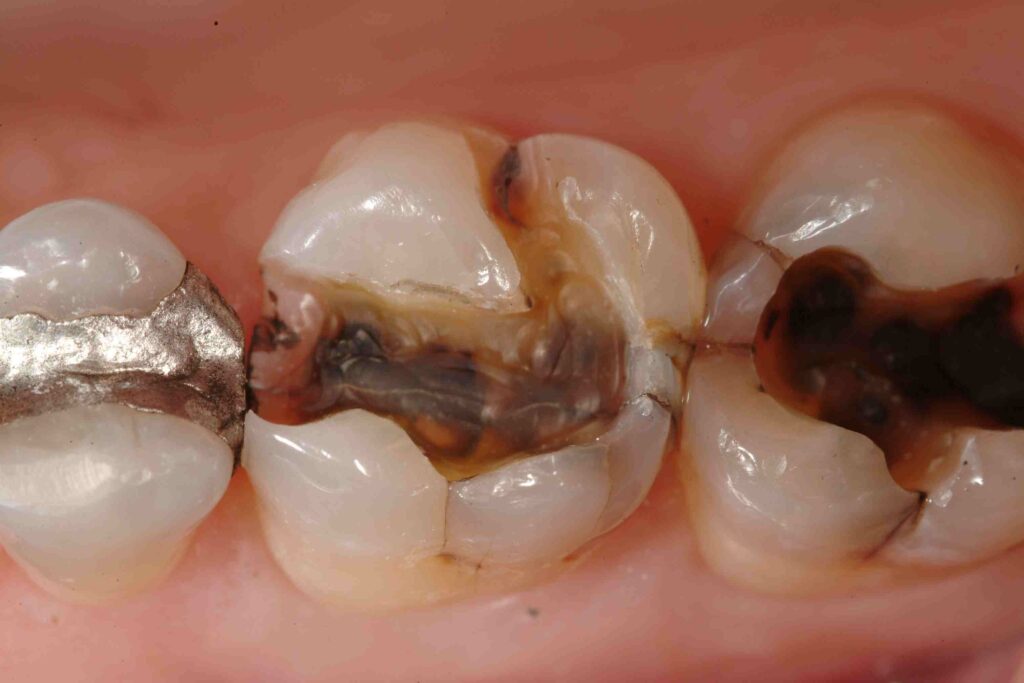
Cracked tooth symptoms can vary considerably depending on where the crack is located, how extensive it is, and whether the pulp inside the tooth has become irritated.
Common patterns include:
- Sharp or erratic pain when chewing
- Pain when releasing biting pressure
- Pain that comes and goes
- Sensitivity to cold or hot foods and drinks
- Difficulty identifying exactly which tooth is causing the pain
- Increasing discomfort as the tooth is repeatedly exposed to chewing forces
A crack may not be visible when you look at the tooth in a mirror. Some cracks are small or positioned in areas that are difficult to see, so the absence of a visible line does not rule out a cracked tooth.
Similarly, a normal-looking tooth does not necessarily mean that there is no underlying problem. A dental examination may involve several clinical tests, and imaging may be used when appropriate. Importantly, cracks are not always clearly visible on standard dental X-rays, so a normal X-ray should not automatically be interpreted as proof that a crack is absent.
If you suspect a crack, repeatedly biting on the tooth to “test” it is not a reliable diagnostic method and may aggravate an already damaged tooth.
A cracked tooth can also become more complicated if the crack extends toward the inner tissues. When the pulp becomes involved, symptoms may change from occasional chewing pain to more significant sensitivity or spontaneous pain. In some cases, treatment such as root canal therapy may become necessary depending on the extent of the damage.
For more information about symptoms of tooth decay, see tooth decay symptoms.
Common Symptoms of a Cavity
Cavity symptoms can be different depending on how far tooth decay has progressed. An early cavity may cause no noticeable symptoms, which means a lack of pain does not necessarily mean that a tooth is healthy. As decay advances, sensitivity, discomfort, or toothache may become more apparent.
Common cavity symptoms can include:
- Sensitivity to cold foods and drinks
- Sensitivity to hot foods and drinks
- Sensitivity to sweet foods or drinks
- Toothache or localized discomfort
- Pain that becomes more noticeable as decay progresses
- A visible dark spot, discoloration, or hole in the tooth
- Food repeatedly becoming trapped in a damaged area
The location and appearance of a cavity can vary. Some cavities are easy to see, while others develop between teeth or in areas that are difficult to inspect at home.
Pain when chewing can also occur with a cavity, particularly when decay has become deeper. However, tooth pain when biting is not specific to cavities. A cracked tooth, damaged restoration, or irritation of the pulp can produce similar symptoms.
This is why comparing one symptom in isolation can be misleading. A better approach is to consider the combination of triggers, timing, and severity.
For a more detailed explanation of decay symptoms and progression, see tooth decay symptoms.
If a cavity has caused enough structural damage to require restoration, treatment may involve a filling. You can learn more about dental fillings for cavities.
Can You Tell the Difference at Home?
You can look for symptom patterns at home, but you cannot reliably diagnose a cracked tooth or cavity yourself.
The most useful question is not simply “Does my tooth hurt?” but when does it hurt, and what triggers the pain?
For example, a tooth that produces a sudden, sharp pain when you bite down or release your bite may raise more concern about a crack. In contrast, predictable sensitivity when drinking something cold or eating something sweet may fit more closely with tooth decay.
But these patterns overlap.
| What you notice | What it may suggest | Why it is not conclusive |
| Sharp pain when biting | Cracked tooth | Deep decay and other dental problems can also hurt when biting |
| Pain when releasing the bite | Cracked tooth | This pattern is suggestive but cannot establish a diagnosis by itself |
| Cold sensitivity | Cavity or cracked tooth | Both can irritate the tooth’s inner tissues |
| Sweet sensitivity | Cavity | Other causes of exposed or irritated tooth structure can cause sensitivity |
| Intermittent, unpredictable pain | Cracked tooth | Other dental problems can also produce intermittent pain |
| Visible hole or dark area | Cavity | Discoloration does not always indicate active decay |
| No visible problem | Neither can be ruled out | Cracks and decay can occur where they are difficult to see |
A useful distinction is that symptoms can suggest a diagnosis, but they do not confirm one.
Trying to inspect the tooth with a mirror can sometimes reveal an obvious cavity or damaged area, but a crack may be too small or positioned in a way that makes it invisible. Likewise, the absence of a visible hole does not rule out decay.
It is also possible for the two problems to coexist. A tooth with a cavity can develop structural weakness, while a damaged or cracked tooth can develop additional problems over time. That means the question is not always simply “cracked tooth or cavity?” A dentist may need to determine whether there is one problem or more than one.
When Symptoms Can Be Misleading
Tooth pain is not always perfectly localized. The nerves supplying nearby teeth can make it difficult to identify the exact source of discomfort.
For this reason, repeatedly pressing, tapping, or biting different teeth at home is not a dependable way to identify the problem. It may also aggravate a sensitive or damaged tooth.
Another reason symptoms can be misleading is that early tooth decay may be silent, while a cracked tooth may produce symptoms only under particular chewing forces. Consequently, symptom severity does not necessarily correspond directly to the amount of structural damage.
If discomfort persists or keeps returning, professional assessment is more useful than continued self-testing.
How Dentists Diagnose a Cracked Tooth or Cavity
A dentist usually combines your symptoms with a clinical examination rather than relying on one symptom or one test.
The evaluation may include questions about:
- When the pain started
- Whether it occurs during biting or releasing a bite
- Whether hot, cold, or sweet foods trigger it
- Whether the pain stops quickly or lingers
- Whether the pain occurs spontaneously
- Whether you can identify a specific tooth
The dentist may then examine the tooth for visible decay, cracks, damaged fillings, changes in tooth structure, or other abnormalities.
Depending on the situation, additional diagnostic tests may be used. These can include bite tests, sensitivity or pulp testing, periodontal assessment, magnification, and dental imaging.
Why an X-Ray Alone May Not Be Enough
A common misconception is that a normal dental X-ray automatically means that there is no crack.
That is not necessarily the case.
Some tooth cracks are difficult or impossible to visualize directly on conventional dental X-rays. A crack may run in a direction that is not captured clearly by the image, or it may be too small to identify radiographically.
For that reason, dentists consider the clinical findings and symptom pattern alongside imaging, rather than treating a single X-ray as a definitive test for every type of crack.
Cavities can also vary in how easily they appear on imaging. The clinical examination remains important, particularly when decay is at an early stage or located in a difficult-to-see area.
If the tooth’s pulp appears to be involved, further assessment may be necessary to determine whether the tooth needs treatment beyond a simple restoration. For information about this type of treatment, see root canal treatment.
The goal of diagnosis is not simply to identify whether there is a “crack” or “cavity.” It is to determine what is causing the symptoms, how extensively the tooth is affected, and what treatment—if any—is appropriate.
When Tooth Pain Needs Prompt Dental Assessment
Not every episode of mild tooth sensitivity is a dental emergency, but persistent, worsening, or unexplained pain should not be ignored.
A dental assessment is particularly important when:
- Pain keeps returning in the same tooth
- You experience sharp pain when chewing
- Temperature sensitivity is becoming stronger or lasting longer
- Tooth pain occurs without an obvious trigger
- You notice a visible hole, fracture, or significant discoloration
- A filling or other restoration has become damaged or loose
- Pain is interfering with eating or sleeping
More urgent assessment may be needed if tooth pain is accompanied by facial or gum swelling, fever, significant trauma, difficulty swallowing, or difficulty breathing. These symptoms can indicate a more serious dental infection or another condition requiring prompt care.
For guidance on recognizing situations that may require urgent attention, see dental emergency signs.
The important point is that you do not need to determine the diagnosis yourself before seeking care. If you cannot tell whether you have a cracked tooth or cavity, the combination of your symptoms and a dental examination can provide a much more reliable answer than trying to diagnose the tooth at home.
FAQ
Is pain when biting more likely to be a cracked tooth?
Pain when biting can be a sign of a cracked tooth, especially when the pain is sharp or occurs when releasing the bite, but it does not prove that a tooth is cracked. Deep cavities, damaged fillings, and other dental problems can also cause pain when chewing. A dentist may need to examine the tooth to determine the actual cause.
Can a cavity cause pain when chewing?
Yes, a cavity can cause pain when chewing, particularly when tooth decay has progressed and affected deeper parts of the tooth. However, chewing pain is also commonly associated with cracked teeth, so this symptom alone cannot distinguish the two conditions.
If chewing consistently causes pain in one tooth, a dental examination can help determine whether decay, a crack, or another problem is responsible.
Can a cracked tooth cause sensitivity to hot and cold?
Yes, a cracked tooth can cause sensitivity to hot and cold foods or drinks. Temperature changes can irritate the tissues inside a damaged tooth, producing sharp or uncomfortable sensations.
However, hot and cold sensitivity is also a common symptom of tooth decay. The presence of temperature sensitivity therefore does not by itself establish that a tooth is cracked.
The timing of the pain, whether it occurs with chewing, and whether it lingers after the stimulus is removed can all provide useful information during a dental assessment.
Can you tell the difference between a cracked tooth and a cavity at home?
You can identify patterns that may suggest one problem over the other, but you cannot reliably diagnose a cracked tooth or cavity at home.
Sharp, intermittent pain when biting or releasing pressure may be more suggestive of a crack, while predictable sensitivity to cold, hot, or sweet foods may occur with a cavity. But there is considerable overlap between the symptoms.
Some cracks are difficult to see, and early decay may produce no symptoms at all. A dentist can combine your symptoms with an examination and, when appropriate, diagnostic tests or imaging.
When should I see a dentist for tooth pain?
You should arrange a dental assessment when tooth pain persists, repeatedly returns, becomes worse, or has no clear explanation. You should also seek assessment if you experience recurring pain when chewing, significant temperature sensitivity, or notice a damaged or visibly abnormal tooth.
More urgent attention is appropriate when pain is accompanied by swelling, fever, significant trauma, difficulty swallowing, or difficulty breathing. These can indicate a more serious dental problem.
If you are unsure whether your symptoms represent an emergency, see the guidance on dental emergency signs.
Can a cracked tooth and a cavity cause similar symptoms?
Yes, cracked teeth and cavities can cause similar symptoms, including pain, temperature sensitivity, and discomfort while chewing. This overlap is one reason it can be difficult to distinguish them based on symptoms alone.
The pattern can still provide clues. A cracked tooth may be particularly associated with sharp, intermittent pain during biting or when releasing the bite, while a cavity may more commonly cause sensitivity to hot, cold, or sweet foods as decay progresses.
Neither pattern is definitive, however. A professional dental assessment is needed when the cause of the pain is unclear.
The main difference between a cracked tooth vs cavity is often the pattern of symptoms rather than the presence of pain itself. Sharp or unpredictable pain during chewing, particularly when releasing a bite, can be a clue to a cracked tooth. Sensitivity to hot, cold, or sweet foods may occur with a cavity, especially as tooth decay progresses.
But the symptoms overlap, and neither condition can be diagnosed reliably at home. A crack may be difficult to see and may not always appear clearly on a standard X-ray, while early tooth decay can exist without noticeable symptoms.
If tooth pain keeps returning, becomes more intense, or is triggered by chewing or temperature changes, a dental examination can help identify the cause before the problem progresses.
Darya Dental Turkey can assess tooth pain and help determine whether further evaluation or treatment is appropriate based on the individual condition of the tooth.
