
All-on-4 vs All-on-6 in Turkey: Cost, Stability and Which Is Better?

Choosing between All-on-4 vs All-on-6 dental implants in Turkey comes down to your individual jawbone density, bite force requirements, and long-term structural goals. Both full-arch restoration protocols permanently replace missing teeth using fixed prostheses, but they differ in implant distribution, stability under heavy chewing forces, and candidate suitability. At Darya Dental Clinic in Ataşehir, Istanbul, our maxillofacial specialists use 3D CBCT imaging to evaluate your oral anatomy and select the optimal surgical technique for your smile.
All-on-4 vs All-on-6 Dental Implants: What Is the Difference?
Understanding the distinction between All-on-4 and All-on-6 dental implants is essential for anyone evaluating full-mouth reconstruction. While both options replace an entire arch of missing teeth with a fixed, non-removable bridge, the fundamental difference lies in structural load distribution.
What Are All-on-4 Dental Implants?
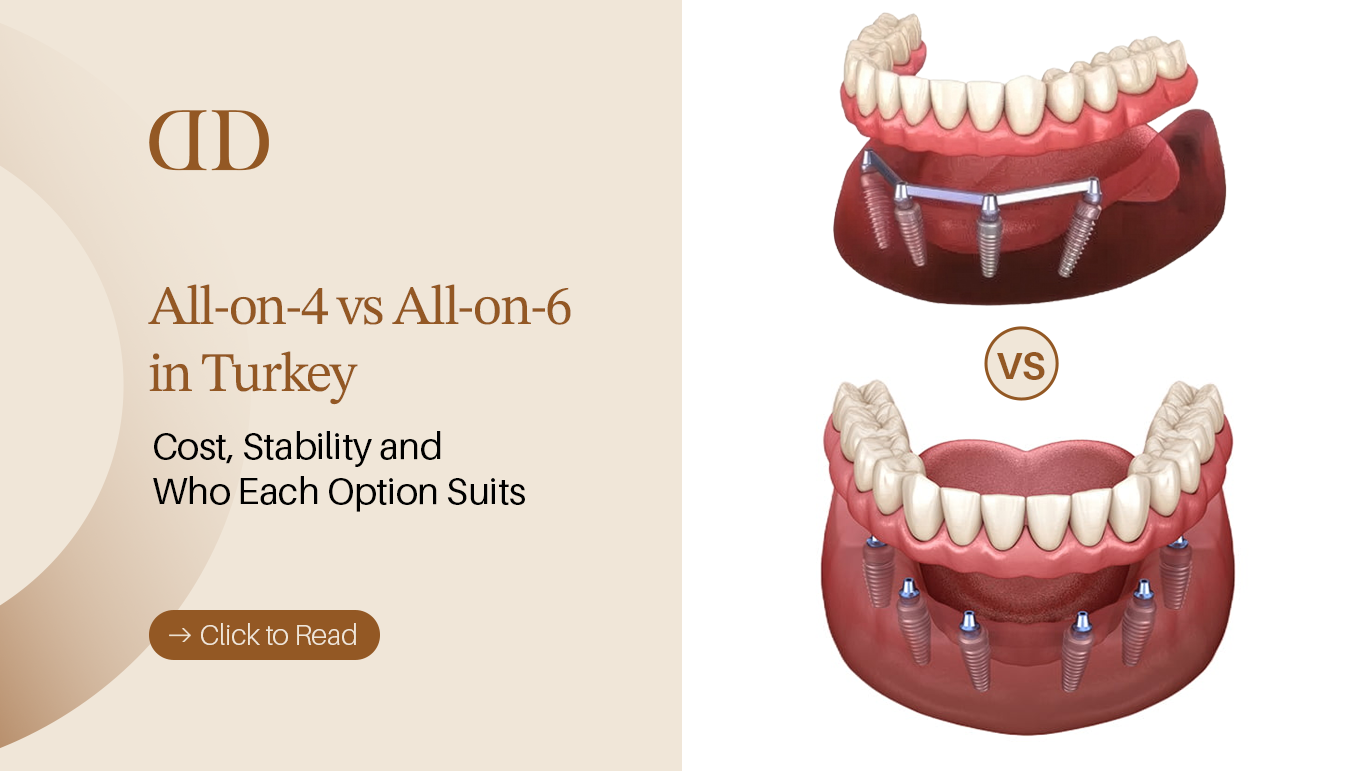
All-on-4 dental implants are a full-arch restoration technique that uses four strategically placed titanium posts per jaw to support a permanent bridge. Developed to help patients with reduced bone density, the protocol places two straight implants in the anterior (front) region and two posterior (back) implants tilted at an angle of up to 45 degrees. This precise angulation maximizes contact with existing bone tissue and frequently eliminates the need for complex bone grafting or sinus lift procedures.
What Are All-on-6 Dental Implants?
All-on-6 dental implants use six titanium posts distributed evenly across the dental arch to anchor a fixed full-arch prosthesis. By adding two additional support points in the posterior regions, this protocol distributes biting forces over a wider surface area. The additional implants provide increased rigidity, making All-on-6 an exceptional choice for patients with sufficient jawbone volume or those who exert higher-than-average masticatory forces.
The Main Difference Between All-on-4 and All-on-6
The primary difference lies in how load is distributed across the jawbone and the level of bone density required for placement. All-on-4 uses four implants with angled posterior placement to navigate bone loss, whereas All-on-6 uses six upright or slightly angled implants to spread forces across a larger surface area. Neither treatment is universally “better” the choice depends entirely on your anatomical requirements and clinical evaluation.
All-on-4 vs All-on-6 Quick Comparison
To help you understand how these two full-arch options compare side by side, the following table breaks down the core clinical metrics:
| Feature | All-on-4 Implants | All-on-6 Implants |
| Number of Implants | 4 titanium posts per arch | 6 titanium posts per arch |
| Posterior Implant Angulation | Tilted up to 45° to bypass bone loss | Usually straight or minimally angled |
| Bite Force Distribution | Concentrated across 4 points | Distributed across 6 points |
| Minimum Bone Requirement | Moderate bone loss acceptable | Moderate-to-high bone volume required |
| Need for Bone Grafting | Frequently avoided due to angulation | More likely if posterior bone is deficient |
| Primary Indication | Patients with localized bone resorption | Patients with strong bone & high bite force |
| Surgical Complexity | Highly precise angulation planning | Requires broader anatomical bone real estate |
| Relative Cost in Turkey | Highly cost-effective | Slightly higher due to extra hardware |
Detailed Biomechanical Comparison
Evaluating full-arch restorations requires looking beyond implant counts. How those implants interact with your jawbone over decades of chewing determines their long-term success.
Number and Position of Dental Implants
- All-on-4 Placement: Two posts are placed vertically in the front jaw where bone density is naturally higher. Two posterior posts are angled backward to extend the support base toward the molar region without penetrating the maxillary sinus or inferior alveolar nerve.
- All-on-6 Placement: Implants are spaced symmetrically across the entire arch two in the front, two in the premolar regions, and two in the molar regions. This creates a uniform foundation that closely mirrors natural root spacing.
Stability and Bite Force Distribution
According to clinical data published in the Journal of Oral Implantology, full-arch restorations experience masticatory forces exceeding $300\text{ N}$ during daily chewing. All-on-6 spreads these forces across six anchor points, reducing stress concentrations on individual posts. However, All-on-4 achieves remarkable biomechanical stability by engineering an arch-like support system where the angled posts widen the load triangle.
Bone Requirements and Grafting Needs
- All-on-4: Engineered specifically for patients who have experienced bone loss following tooth loss. The angled posterior implants utilize remaining dense bone near the front of the jaw, minimizing the need for bone grafts.
- All-on-6: Requires sufficient bone depth and width in the back of the jaw. If bone resorption has occurred, targeted bone grafting or a sinus lift may be necessary before placement.
Expected Longevity and Success Rates
Long-term clinical studies demonstrate that both protocols boast exceptional success rates between 95% and 98% when placed by experienced maxillofacial surgeons. The titanium posts fuse permanently with the jawbone through osseointegration, providing a lifetime root foundation, while the prosthetic bridge typically lasts 10 to 15 years before routine maintenance or relining is needed.
Premium Dental Care in Turkey
Expert treatments with high-end technology. Get your personalized quote today via WhatsApp.
All-on-4 vs All-on-6: Which Is Better?
A common misconception is that “more implants automatically equal a better result.” In modern implantology, the right treatment is the one that best fits your anatomical reality.
When All-on-4 May Be More Suitable
- You have experienced moderate jawbone loss since losing your teeth.
- You want to avoid extensive preliminary surgeries like sinus lifts or bone grafting.
- You are seeking an efficient full-arch restoration with streamlined surgical treatment.
- Your anatomical structure allows the dentist to achieve strong primary stability with four posts.
When All-on-6 May Be More Suitable
- You possess ample jawbone height and density throughout your upper and lower jaws.
- You have a wider jaw structure or strong facial muscles that exert heavy bite forces.
- You desire maximum load distribution and structural redundancy across your prosthetic bridge.
- You are restoring the upper jaw, where bone is naturally softer and less dense than in the lower jaw.
Does More Implants Always Mean Better Results?
Not necessarily. Placing six implants into an area with poor bone density or restricted space can crowd the posts, hindering blood supply and compromising osseointegration. Conversely, placing four implants in a wide jaw with heavy bite forces could overload the prosthesis over time. Clinical success depends on precise positioning, sound prosthetic design, and accurate diagnostic planning not simply maximizing implant count.

Want trusted dental advice in your Google AI answers?
Add Darya Dental Turkey as a Preferred Source on Google to make our dental guides easier to find in your search results and AI Overviews.
All-on-4 vs All-on-6 for Patients With Bone Loss
Jawbone resorption is one of the most significant consequences of long-term tooth loss. When tooth roots are missing, the jawbone no longer receives the mechanical stimulation required to maintain its density and volume, causing it to shrink over time.
Bone Density and Implant Placement
For full-arch restorations, sufficient jawbone volume is necessary to secure the titanium posts. When evaluating patients at Darya Dental Clinic in Ataşehir, Istanbul, our oral surgeons analyze bone height, width, and cortical density using 3D Cone Beam Computed Tomography (CBCT).
If a patient has experienced severe bone loss in the posterior (back) regions of the jaw, placing traditional vertical implants can risk penetrating the maxillary sinus in the upper jaw or damaging the inferior alveolar nerve in the lower jaw.
Does All-on-4 Require Bone Grafting?
In most clinical cases, All-on-4 does not require bone grafting. The biomechanical innovation of the All-on-4 protocol lies in tilting the two posterior implants at an angle of up to 45 degrees. This technique allows the surgeon to anchor the implants into the dense bone of the anterior (front) jaw, effectively bypassing areas of severe bone loss in the back. By bypassing sinus lifts and block bone grafts, All-on-4 significantly reduces total treatment time, surgical complexity, and overall cost for patients with compromised bone structure.
Does All-on-6 Require Bone Grafting?
Because All-on-6 relies on placing six implants evenly across the arch including the molar regions it demands a larger volume of healthy bone tissue. If your posterior jawbone has resorbed, bone augmentation procedures (such as a sinus lift in the upper jaw or a ridge augmentation in the lower jaw) may be necessary before or during the placement of six implants. While bone grafting extends the healing timeline by 3 to 6 months, it provides a solid foundation capable of supporting maximum biting forces.
All-on-4 vs All-on-6 Cost in Turkey
Understanding the financial aspects of full-mouth restoration helps international patients make informed decisions. The primary reason international patients travel for dental implants in Turkey at Darya Dental Clinic is the significant cost advantage compared to the UK, US, and Western Europe, without compromising material quality or clinical expertise.
What Affects the Cost of All-on-4?
The overall cost of an All-on-4 treatment plan depends on several clinical components:
- Implant Brand: Premium Swiss or German titanium brands (such as Straumann or Nobel Biocare) vs. high-quality alternative systems (such as Osstem).
- Prosthetic Material: High-grade acrylic temporary bridges vs. final restorations made of zirconium crowns or layered ceramic.
- Surgical Complexity: Whether tooth extractions or minor soft-tissue adjustments are required prior to placement.
What Affects the Cost of All-on-6?
The cost of All-on-6 is generally higher than All-on-4 due to additional hardware and potential surgical procedures:
- Two Additional Titanium Posts & Abutments: Extra hardware components increase the base material costs.
- Bone Grafting or Sinus Lift Fees: If posterior bone volume is insufficient, preliminary grafting procedures will adjust the final quote.
- Larger Final Prosthetic Framework: Reinforcing a 6-implant bridge often requires larger structural frameworks to span the arch.
Why Can All-on-6 Cost More Than All-on-4?
On average, All-on-6 ranges from 15% to 30% more expensive than All-on-4 per arch. This price difference stems directly from the cost of the two extra implant posts, multi-unit abutments, laboratory milling time, and any auxiliary bone grafting surgeries required to support the wider implant distribution.
Read more: All on 4 Dental Implants Cost in Istanbul Turkey 2026
All-on-4 vs All-on-6 Treatment Process in Turkey
At Darya Dental Clinic in Ataşehir, Istanbul, your treatment journey is carefully structured to maximize structural stability, safety, and comfort within efficient travel schedules
1. Consultation and 3D Dental Imaging
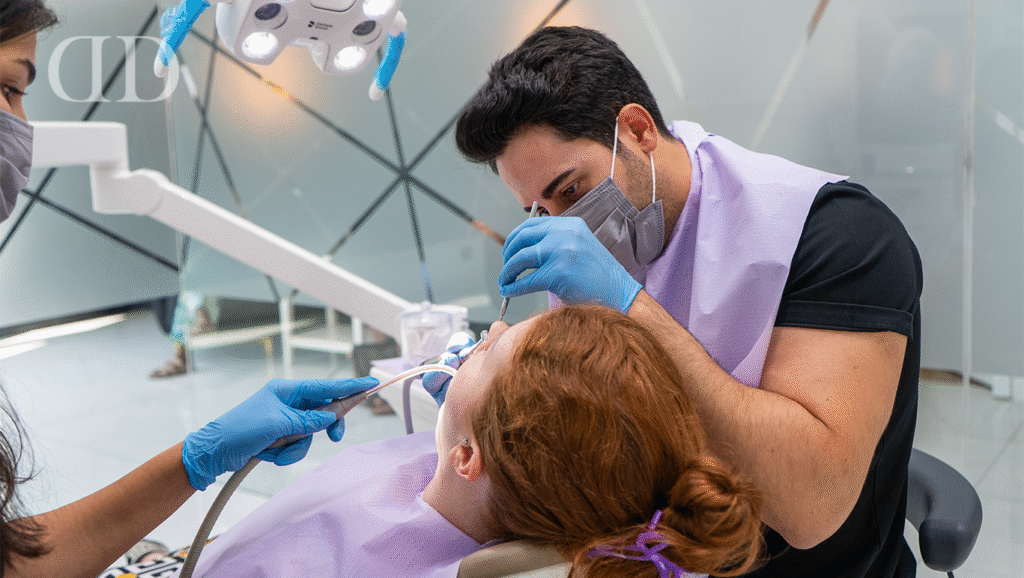
Your journey begins with a 3D CBCT scan and intraoral digital mapping. Our maxillofacial specialists evaluate bone density, map nerve paths, and simulate implant positioning to ensure maximum precision.
2. Implant Placement
Under local anesthesia or conscious sedation, the surgeon places the titanium posts into the jawbone. For All-on-4, the rear posts are carefully angled. For All-on-6, six posts are positioned symmetrically across the arch.
3. Temporary Fixed Teeth
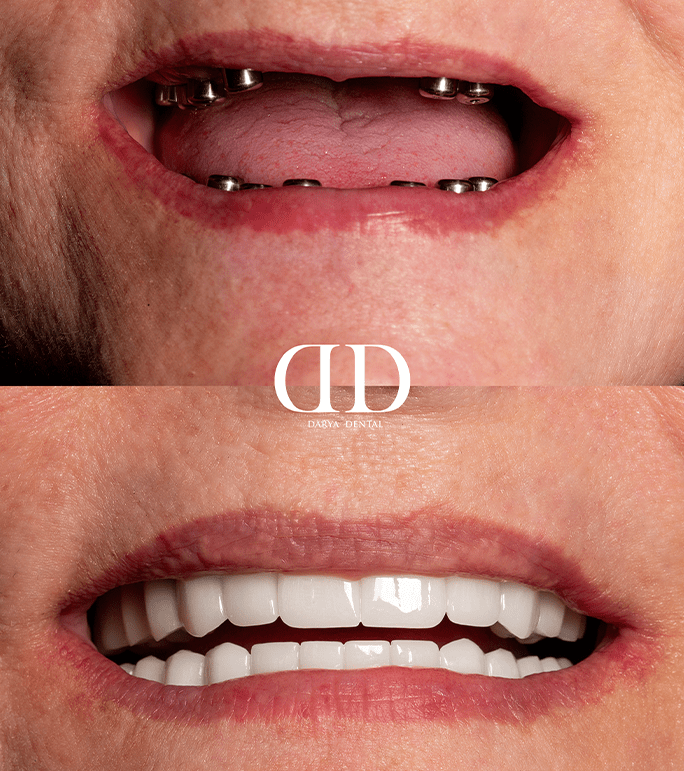
In accordance with immediate-loading protocols, a fixed temporary acrylic bridge is attached to the implants within 24 to 72 hours. This ensures you never leave our clinic without functional, aesthetic teeth during your healing phase.
4. Healing and Osseointegration
Over a period of 3 to 6 months, a biological process called osseointegration occurs, wherein your natural bone tissue fuses with the biocompatible titanium implant surface.
5. Placement of the Final Prosthesis
During your second visit to Istanbul, high-precision digital impressions are taken. Our laboratory crafts your permanent full-arch bridge using premium materials like monolithic zirconia or E-Max, ensuring flawless bite alignment, lifelike translucency, and permanent durability.
Recovery After All-on-4 and All-on-6 Implants
Post-operative recovery is similar for both All-on-4 and All-on-6 treatments, as both utilize minimally invasive surgical protocols.
First Days After Implant Surgery
Mild swelling, localized bruising, and minor tenderness are normal for the first 3 to 5 days following surgery. These post-operative effects are easily managed using prescribed pain relievers, anti-inflammatory medications, and cold compresses. Most patients return to light daily activities within 48 hours.
Eating After Full-Arch Implant Treatment
While your temporary fixed bridge allows you to smile and chew, following a soft-food diet for the first 8 to 12 weeks is critical. Avoiding hard, crunchy, or sticky foods prevents micro-movements of the implants, allowing osseointegration to occur without disruption.
Oral Hygiene and Implant Care
Maintaining pristine oral hygiene around your fixed bridge prevents peri-implantitis (inflammation of the tissue surrounding the implants). Patients should:
- Brush twice daily using a soft-bristled toothbrush.
- Use a specialized water flosser (oral irrigator) to clean beneath the bridge.
- Rinse with an alcohol-free antiseptic mouthwash as directed by the clinical team.
How Long Do All-on-4 and All-on-6 Implants Last?
When placed by experienced maxillofacial surgeons and maintained with proper home care, the titanium posts of both All-on-4 and All-on-6 implants can last a lifetime.
Clinical studies tracking full-arch restorations over 10 to 15 years show survival rates exceeding 95% to 98%. The final prosthetic bridge (crafted from durable zirconia or E-Max disilicate) typically lasts 10 to 15+ years before routine maintenance, screw tightening, or prosthetic polishing is required.
All-on-8 and 3-on-6 Dental Implants: Advanced Alternatives
While All-on-4 and All-on-6 remain the gold standards for full-arch reconstruction, certain clinical profiles require specialized load distribution or segmental design options.
All-on-8 Dental Implants: Maximum Load Support
For patients with an exceptionally wide arch, broad jawbone surface, or hyper-developed chewing muscles, an All-on-8 dental implant system provides the ultimate level of structural support.
- Biomechanical Advantages: Placing eight implants spreads masticatory stress evenly across eight independent points. This setup minimizes stress concentration on individual posts and delivers maximum rigidity for heavy chewing.
- Clinical Requirements: Requires dense, healthy jawbone across the entire arch. If significant bone resorption has occurred, extensive preliminary bone grafting and sinus lifts are typically necessary before placing eight implants.
3-on-6 Dental Implant Concept Explained
The 3-on-6 concept differs fundamentally from traditional All-on-4 or All-on-6 treatments. Instead of supporting a single, full-arch prosthetic bridge with 4 or 6 implants, the 3-on-6 protocol utilizes six implants to support three separate dental bridges (each spanning two implants and replacing 3–4 teeth).
- How 3-on-6 Differs: Because the restoration is divided into three distinct segments, it mimics natural tooth isolation. If a issue occurs under one bridge section, it can be serviced independently without removing the entire arch.
- Anatomical Suitability: Requires excellent bone density across all six anchor sites. Patients with severe posterior bone loss are generally better suited for standard All-on-4 or All-on-6 protocols.
Getting All-on-4 or All-on-6 Dental Implants in Istanbul
Istanbul has established itself as a global hub for advanced restorative dentistry, combining experienced maxillofacial surgeons, cutting-edge diagnostic technology, and highly accessible treatment costs.
All-on-4 and All-on-6 Treatment in Ataşehir
At Darya Dental Clinic, located in the modern district of Ataşehir, Istanbul, we provide personalized full-arch implant care. Ataşehir offers a calm, safe environment for international patients, featuring modern clinical infrastructure, top-tier hospitality, and convenient access to both Sabiha Gökçen (SAW) and Istanbul (IST) airports.
Convenient Access from Nearby Ümraniye
Located in Ataşehir, Darya Dental Clinic is easily accessible for patients traveling from nearby Ümraniye and surrounding districts on Istanbul’s Asian side. Our dedicated international patient team manages private hotel transfers, language interpretation, and diagnostic coordination to ensure a seamless medical journey from arrival to departure.
How Darya Dental Clinic Determines the Right Implant Option
At Darya Dental Clinic, we reject one-size-fits-all treatment plans. Selecting between All-on-4, All-on-6, or alternative protocols relies on a thorough, evidence-based clinical evaluation.
Our medical team evaluates your candidacy based on five critical anatomical indicators:
- 3D CBCT Bone Scanning: We measure exact millimeter-level bone height, width, and cortical density in both jaws.
- Anatomical Mapping: We trace the exact trajectory of the inferior alveolar nerve in the lower jaw and the sinus cavities in the upper jaw.
- Occlusal & Bite Dynamics: We evaluate your jaw closure, muscle strength, and masticatory force distribution.
- Overall Medical & Gum Health: We screen for underlying systemic conditions, controlled diabetes, or periodontitis to ensure safe osseointegration.
- Prosthetic Longevity Goals: We match your aesthetic expectations with structural materials such as monolithic zirconia crowns or high-purity E-Max ceramic to design a long-lasting, natural smile.
Frequently Asked Questions About All-on-4 vs All-on-6
Is All-on-6 better than All-on-4?
Not universally. All-on-6 provides wider load distribution for patients with dense bone structure and strong bite forces. However, for patients with moderate bone loss, All-on-4 is clinically superior because its angled posts utilize existing anterior bone, avoiding complex bone grafting.
Is All-on-6 more stable than All-on-4?
All-on-6 offers six load-bearing points across the arch, which reduces mechanical stress on individual posts. However, All-on-4 achieves exceptional biomechanical stability through its wide, engineered load triangle, boasting long-term clinical success rates between 95% and 98%.
Which lasts longer, All-on-4 or All-on-6?
Both treatment options feature titanium implant posts that can last a lifetime with proper oral hygiene and regular check-ups. The permanent fixed bridge typically lasts 10 to 15+ years before routine maintenance or relining is needed.
Which is more expensive, All-on-4 or All-on-6 in Turkey?
All-on-6 is generally 15% to 30% more expensive than All-on-4 due to the additional two titanium implant posts, extra abutments, and potential bone grafting or sinus lift procedures required in the molar regions.
Can All-on-4 be used with severe bone loss?
Yes. All-on-4 was engineered specifically to address bone loss without requiring extensive grafting. By angling the posterior implants up to 45 degrees, surgeons anchor the posts into dense anterior jawbone, bypassing areas of bone resorption.
Does All-on-6 require bone grafting?
All-on-6 often requires bone grafting or a sinus lift if the posterior jawbone has resorbed over time. Because the protocol places vertical implants in the molar regions, adequate bone height and width are necessary to support the posts securely.
How long does full-arch implant treatment take in Turkey?
The surgical placement and temporary fixed bridge attachment take 3 to 5 days during your first visit to Istanbul. After a 3 to 6-month healing phase for osseointegration, you return for a 5 to 7-day visit to receive your permanent zirconia or ceramic full-arch prosthesis.
Can international patients get All-on-4 or All-on-6 in Istanbul?
Yes. Darya Dental Clinic in Ataşehir, Istanbul specializes in full-arch restorations for international patients. We provide end-to-end support, including remote 3D scan evaluations, personalized treatment plans, airport-clinic transfers, and multi-lingual coordination.
Restore Your Smile at Darya Dental Clinic
Choosing between All-on-4 vs All-on-6 dental implants in Turkey is a life-changing decision that demands experienced surgical planning, advanced diagnostic technology, and transparent clinical guidance. At Darya Dental Clinic in Ataşehir, Istanbul, our maxillofacial team uses state-of-the-art 3D CBCT imaging to create a customized full-arch restoration plan tailored to your unique anatomical needs and lifestyle goals.
Take the first step toward a functional, permanent smile today. Contact our international patient team to upload your dental X-rays for a free remote assessment and receive an itemized treatment proposal tailored to your needs.
