E-Max Veneers in Turkey: What Should You Know Before Treatment?
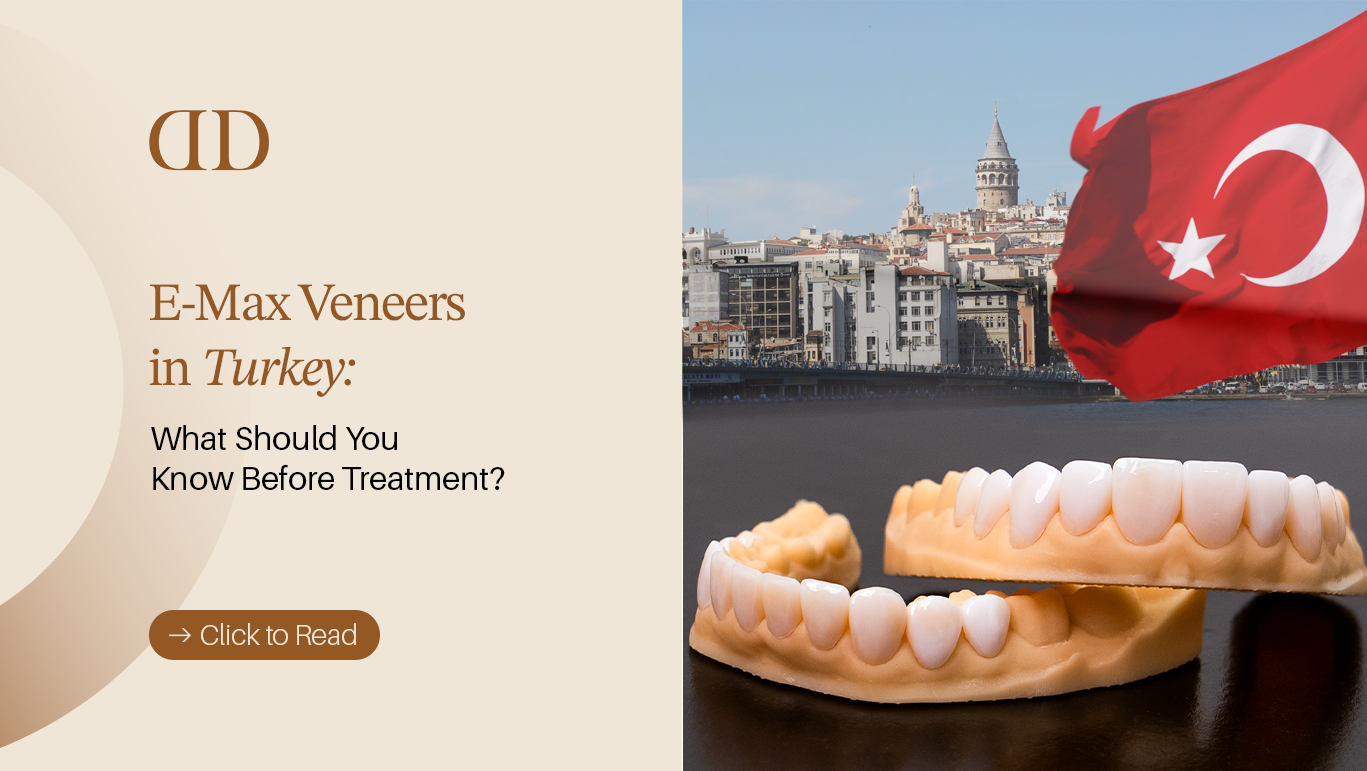

If you are considering E-Max veneers in Turkey, the decision should not be based only on the material name, treatment price or the promise of a quick smile transformation. Before treatment, your teeth and gums need to be assessed, the amount of tooth preparation should be discussed, your bite and aesthetic goals should be considered, and the proposed treatment plan should be clear.
E-Max veneers are lithium disilicate ceramic restorations known for their optical properties and adhesive bonding potential. However, choosing E-Max does not automatically mean that veneers are the right restoration for every tooth. The clinical condition of the teeth, available enamel, bite, existing dental problems and the desired aesthetic result all influence treatment planning. Current literature also emphasizes appropriate case selection, conservative preparation and careful bonding when lithium disilicate veneers are used.
For international patients considering dental treatment in Turkey, there is another layer to the decision: travel planning. Knowing what information to provide before travelling, how many appointments may be required and what questions to ask the clinic can help you evaluate a proposed treatment plan more effectively.
What Are E-Max Veneers?
E-Max veneers are thin ceramic restorations made from lithium disilicate glass ceramic and bonded to the visible surfaces of teeth. They may be used to address aesthetic concerns involving tooth colour, shape, proportions or minor morphological discrepancies when the teeth are clinically suitable for veneer treatment.
One important distinction should be made from the beginning:
E-Max is a material. Veneer is a type of restoration. Crown is another type of restoration.
Therefore, saying that someone needs “E-Max” does not by itself determine whether the final restoration should be a veneer or a crown. The restoration type depends on the clinical condition of the tooth and the treatment objective.
Lithium disilicate has been studied extensively in restorative dentistry. Research has reported favorable optical characteristics, adhesive performance and clinical outcomes when appropriate case selection and bonding protocols are used.
What Material Are E-Max Veneers Made From?
E-Max restorations are associated with lithium disilicate glass ceramic. The material is used in different dental restoration applications, including veneers and crowns, depending on the clinical indication.
Premium Dental Care in Turkey
Expert treatments with high-end technology. Get your personalized quote today via WhatsApp.
For veneers, the interaction between the ceramic, tooth surface and adhesive cement is particularly important. Clinical literature indicates that preserving enamel where possible and using an appropriate adhesive protocol are important considerations for predictable ceramic veneer treatment.
The exact laboratory manufacturing method can also vary. Lithium disilicate restorations may be produced using techniques such as CAD/CAM milling or heat pressing. Differences can exist between manufacturing workflows, so the appropriate process depends on the case and laboratory setup.

Want trusted dental advice in your Google AI answers?
Add Darya Dental Turkey as a Preferred Source on Google to make our dental guides easier to find in your search results and AI Overviews.
How Are E-Max Veneers Different From Other Veneer Options?
The main difference is the ceramic material and its properties rather than the basic concept of a veneer.
E-Max veneers use lithium disilicate glass ceramic, while other veneer options may use different ceramics or composite materials. These materials can differ in optical behavior, strength characteristics, preparation requirements, bonding protocols and laboratory workflow.
That does not mean E-Max is automatically the best material for every patient. Material selection should follow the clinical situation and aesthetic requirements rather than the material name alone.
Are E-Max Veneers Suitable for Your Teeth?
E-Max veneers may be suitable for some patients with aesthetic concerns, but suitability cannot be determined from photographs or the desired smile style alone.
A dental examination is needed to evaluate the condition of the teeth, gums, bite and existing restorations. The treatment plan should also consider whether the teeth can provide an appropriate foundation for adhesive ceramic restorations.
Tooth and Gum Health
Healthy supporting tissues are an important part of restorative treatment planning.
Existing tooth decay, gum inflammation, periodontal problems, cracks or other untreated dental conditions may need to be addressed before cosmetic treatment is considered. Placing veneers over untreated dental problems does not solve the underlying condition.
This is one reason why a consultation should not be treated simply as a discussion about veneer colour and shape. It should establish whether the teeth are clinically suitable for the proposed restoration.
Bite, Grinding and Existing Dental Problems
Your bite can influence how forces are distributed across restorations.
Clenching or grinding may also be relevant when assessing veneer treatment because excessive or unfavorable occlusal forces can affect restorative outcomes. Patient-specific risk assessment and occlusal considerations are important when planning ceramic veneer treatment.
If you have a history of grinding, jaw discomfort, fractured teeth or repeated restoration failures, tell the dentist before treatment planning begins.
Other existing dental problems may also change the recommended treatment. Depending on the condition of a tooth, another restorative approach may be more appropriate.
When Another Treatment May Be More Appropriate
E-Max veneers are not a universal solution.
A dentist may recommend another treatment when:
- A tooth has extensive structural loss.
- The tooth requires more extensive coverage.
- Active decay or gum disease needs treatment first.
- The bite creates a significant restorative risk.
- The aesthetic problem cannot be predictably corrected with a veneer.
- Another material or restoration type better matches the clinical requirements.
The purpose of treatment planning is therefore not to fit every patient into the same veneer protocol. It is to determine which restoration is appropriate for each tooth.
What Should Be Checked Before E-Max Veneer Treatment?
A proper pre-treatment assessment should cover more than the appearance of the teeth.
The dentist should consider the health and structure of the teeth, the surrounding gum tissue, the bite, the intended aesthetic result and the relationship between the proposed restorations and the patient’s existing dentition.
Dental Examination
The examination may include an assessment of:
- Existing restorations
- Tooth decay
- Tooth structure
- Gum health
- Tooth position
- Bite and occlusion
- Signs of grinding or clenching
- Tooth colour
- Existing dental problems
- The relationship between the proposed veneers and adjacent teeth
Additional diagnostic records, including photographs, radiographs or digital scans, may be appropriate depending on the case.
For an international patient, sending recent dental records before travelling can also help the clinic understand the case before the first appointment. However, remote information should not be treated as a replacement for an in-person clinical examination.
Tooth Preparation and Enamel Preservation
One of the most important questions to ask before E-Max veneer treatment is not simply “How much will my veneers cost?” but:
“What preparation is planned for my teeth, and why?”
Tooth preparation varies according to the individual tooth, the existing position and shape, the restorative design and the material requirements. There is no universal preparation amount that applies to every E-Max veneer case.
The preservation of enamel is an important consideration in adhesive ceramic veneer treatment. Published research supports conservative preparation and appropriate bonding strategies, particularly because the bonding substrate can influence restorative performance.
At the same time, “no preparation” should not automatically be interpreted as a better treatment. Whether a tooth requires preparation depends on the individual anatomy and the intended result.
Smile Design, Tooth Shape and Shade
A veneer treatment plan should define more than the ceramic material.
The proposed tooth shape, proportions, length, width, shade and relationship between the veneers and the surrounding teeth all influence the final appearance.
Depending on the case, digital smile design, photographs, scans, mock-ups or temporary restorations may help communicate the proposed result before final bonding.
Shade planning also deserves attention. If you are considering teeth whitening, the timing should be discussed before the final veneer shade is selected. The colour of natural teeth and the planned restorations need to be considered together.
For more information about this decision, see the Darya Dental article on whitening before veneers.
What Should You Ask a Dental Clinic in Turkey Before Treatment?
If you are travelling internationally for E-Max veneers, the consultation should give you enough information to understand what is actually being proposed.
Useful questions include:
- How many veneers do I actually need?
- Are the proposed restorations veneers or crowns?
- How much tooth preparation is planned for each tooth?
- What material and manufacturer will be used?
- Can I see the proposed smile design before final treatment?
- Will temporary veneers or another form of try-in be used?
- How long will the laboratory stage take?
- What happens if adjustments are needed before final bonding?
- What follow-up support is available after I return home?
You should also ask whether the proposed treatment plan can be provided clearly in writing, including the teeth being treated and the type of restoration planned.
If you are unsure how many veneers are appropriate, the number should be determined from the treatment plan rather than from a standard package.
How Does E-Max Veneer Treatment in Turkey Usually Work?
The exact sequence varies between patients and clinics, but an E-Max veneer treatment journey generally involves several decision and clinical stages.
Initial Consultation and Examination
The first stage is assessment.
The dentist evaluates the teeth, gums, bite and aesthetic objectives and determines whether veneer treatment is appropriate.
For an international patient, photographs, dental records and other available information may be reviewed before travel. The final treatment decision, however, should be based on an appropriate clinical assessment.
Smile Planning and Temporary Veneers
Once the treatment direction is established, the aesthetic design can be developed.
Depending on the case, a mock-up, digital smile design or temporary restorations may help evaluate tooth shape, proportions and overall smile appearance before final ceramic restorations are permanently bonded.
This stage can be particularly useful because changing the shape of a final ceramic restoration after bonding is more limited than adjusting a planned design beforehand.
Laboratory Fabrication
After the preparation and records are completed, the dental laboratory fabricates the restorations according to the treatment plan.
The laboratory stage can involve digital design, CAD/CAM manufacturing, pressing or other fabrication processes depending on the selected workflow.
The exact laboratory time therefore cannot be guaranteed in advance for every patient.
Try-In, Bonding and Final Checks
Before permanent bonding, the restorations may be evaluated for fit, shape, shade and relationship with the surrounding teeth.
If adjustments are required, they should be addressed before final cementation whenever possible.
The final bonding process is clinically important for lithium disilicate veneers. Careful treatment of both the ceramic and tooth surfaces is important for achieving reliable adhesion.
How Long Should You Stay in Turkey for E-Max Veneers?
There is no single treatment duration that applies to every patient.
The required stay depends on factors such as the number of veneers, preparation requirements, laboratory workflow, appointment availability, whether temporary restorations are used, and whether additional dental treatment is required.
Darya Dental’s existing veneer treatment information describes a treatment journey of approximately 5 to 7 days, but this should be understood as a treatment workflow rather than a universal guarantee for every patient.
Before booking flights, international patients should clarify:
- The expected number of appointments
- The anticipated treatment duration
- Whether laboratory work is required between appointments
- Whether temporary restorations are planned
- Whether additional dental treatment may extend the schedule
- What happens if an adjustment is needed
Planning travel around a confirmed treatment schedule is preferable to assuming that every E-Max veneer case can be completed within a fixed number of days.
How Should You Prepare for E-Max Veneers in Turkey?
International treatment requires preparation before the flight as well as preparation for the dental appointments.
Dental Records and X-Rays
If you have recent dental records, radiographs, photographs or information about previous dental treatment, provide them to the clinic when appropriate.
Tell the dental team about previous restorations, root canal treatments, sensitivity, dental trauma and other relevant dental history.
This information can help the clinic identify questions that may need to be investigated during the examination.
Existing Dental Problems
Do not plan cosmetic treatment around untreated dental problems.
If you have tooth pain, active decay, gum problems, broken teeth or other symptoms, mention them before travelling. The treatment sequence may need to change depending on the findings.
A veneer consultation should therefore establish both aesthetic goals and dental health.
Whitening and Shade Planning
If you are considering whitening, discuss it before the final veneer shade is selected.
Ceramic veneers do not simply change colour in the same way as natural enamel. For that reason, whitening and restoration shade selection need to be coordinated rather than treated as completely separate decisions.
More detailed information is available in the Darya Dental article about teeth whitening before veneers or crowns.
Planning Your Travel Around Appointments
Do not book a return flight based solely on a general treatment estimate.
Ask the clinic for the expected appointment sequence and allow some flexibility where possible.
International dental treatment involves both clinical and logistical planning. A realistic schedule should account for examinations, preparation, laboratory work, try-in and final fitting where applicable.
E-Max Veneers vs Crowns: Why the Difference Matters Before Treatment
The distinction between a veneer and a crown is essential when evaluating a proposed E-Max treatment.
E-Max describes a material. It does not describe the restoration type.
An E-Max veneer covers the visible surface of a tooth and is generally considered when the tooth can support that type of restoration.
A crown is a different type of restoration that provides more extensive coverage around the tooth.
Therefore, “E-Max” does not mean that a tooth automatically needs a crown, and it does not mean that every tooth is suitable for an E-Max veneer.
If you are comparing the two options, the key question is not simply which material sounds better. The relevant question is which restoration provides an appropriate balance between tooth preservation, structural requirements, function and aesthetic objectives.
For a more detailed discussion, see Darya Dental’s existing article on veneers vs crowns.
What Should You Consider Before Choosing E-Max Veneers in Turkey?
Before committing to treatment, evaluate the complete treatment plan rather than the material name alone.
Material
Ask why lithium disilicate has been selected for your case and whether the proposed material matches the functional and aesthetic requirements.
Tooth Preservation
Understand what preparation is planned and whether the dentist expects to preserve enamel wherever clinically possible.
There is no universal preparation amount for every patient. The preparation should be based on the individual tooth and restoration design.
Aesthetic Expectations
Discuss tooth shape, length, width, shade and overall smile proportions before treatment begins.
A successful aesthetic plan is not simply about making teeth whiter. The restorations should be planned in relation to the patient’s facial features, smile and existing dentition.
Clinical Suitability
Confirm that active dental problems, gum health, tooth structure and bite have been assessed.
If grinding or clenching is present, ask how this will affect the treatment plan and maintenance requirements.
Laboratory and Treatment Planning
Ask where and how the restorations will be fabricated and how the laboratory stage fits into your appointment schedule.
You do not necessarily need to choose a clinic based on one manufacturing method alone. What matters is that the selected workflow is appropriate for the case and coordinated with the clinical plan.
Aftercare and Follow-Up
Before travelling, ask what happens after the final fitting.
Clarify what follow-up support is available if you experience a problem after returning home and whether the clinic provides guidance for maintenance and future dental care.
Long-term outcomes depend on more than the ceramic itself. Patient selection, preparation, bonding, occlusal factors and maintenance can all influence clinical performance.
Frequently Asked Questions About E-Max Veneers in Turkey
Are E-Max veneers a good option for everyone?
No. E-Max veneers are not suitable for every patient or every tooth. Suitability depends on factors such as tooth structure, enamel availability, gum health, bite, existing dental problems and aesthetic objectives.
Do E-Max veneers require tooth preparation?
Not always in the same way or to the same extent. Preparation depends on the individual tooth, its position, existing shape and the planned restoration. Some cases may be treated with very conservative or minimal preparation, while others require a different preparation design.
How long does E-Max veneer treatment take in Turkey?
The duration varies according to the number of veneers, preparation, laboratory workflow, appointment sequence and whether additional dental treatment is required. A fixed treatment time should not be assumed before the case has been assessed.
What should I ask a Turkish dentist before getting E-Max veneers?
Ask about your clinical suitability, the number of veneers required, whether the restorations are veneers or crowns, the planned tooth preparation, the material and manufacturer, smile design, temporary restorations, laboratory time and post-treatment support.
Can I see the planned result before my veneers are permanently bonded?
Depending on the treatment plan, a dentist may use a mock-up, digital smile design, temporary restorations or another try-in method to assess the proposed appearance before final bonding. Ask the clinic which planning method is appropriate for your case.
Should I have my teeth whitened before E-Max veneers?
If whitening is part of your treatment plan, it is important to discuss its timing before the final veneer shade is selected. The appropriate sequence depends on your existing tooth colour and the planned restorations.
Are E-Max veneers different from E-Max crowns?
Yes. E-Max refers to the lithium disilicate material, while a veneer and a crown are different restoration types. An E-Max veneer and an E-Max crown can therefore use the same material while serving different clinical purposes.
Choosing E-Max veneers in Turkey should be based on clinical suitability and treatment planning, not simply on the material name, price or the promise of a fast cosmetic transformation.
Before treatment, the important questions are whether your teeth and gums are healthy enough for the proposed treatment, how much preparation is required, whether your bite and existing dental conditions have been assessed, how the smile design will be developed, how the laboratory stage will be managed and what follow-up will be available after treatment.
For international patients, travel planning is part of the treatment decision as well. A clear treatment schedule, realistic appointment expectations and written information about the proposed restorations can help you make a more informed decision.
Before treatment begins, your dentist should confirm whether E-Max veneers are appropriate for your teeth and establish the treatment plan according to your dental condition, bite and aesthetic goals.
For general information about veneer treatment, you can also refer to Darya Dental’s dental veneers page.
Author and Medical Review
Written by: Darya Özcan, Founder, Darya Dental Turkey
Medically Reviewed by: Dt. Sedat, Dental Director, Darya Dental Turkey
Darya Dental’s official team page identifies Darya Özcan as Founder and Dt. Sedat as Dental Director.
This content is intended for general educational purposes and does not replace an individual dental examination or professional treatment recommendation.
Sources
- PubMed literature on lithium disilicate veneers and clinical considerations
- Peer-reviewed literature concerning ceramic veneer preparation and bonding
- Darya Dental Turkey official website and team information
