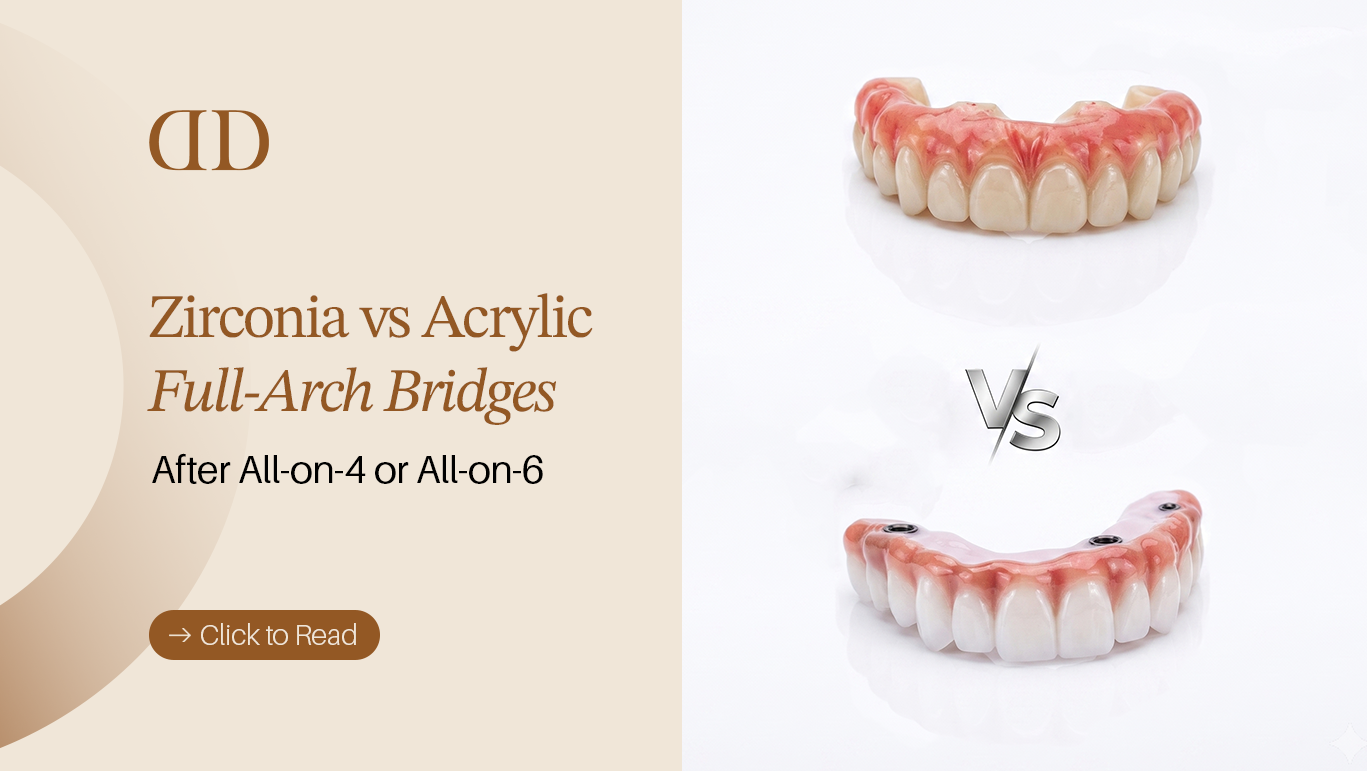
Zirconia vs Acrylic Full-Arch Bridges After All-on-4 or All-on-6

Choosing the right material for your permanent full-arch bridge after an All-on-4 or All-on-6 dental implant procedure is one of the most critical decisions in your full-mouth restoration journey. At Darya Dental Clinic in Istanbul, Turkey, a full-arch bridge must be designed to look like a natural smile while withstanding up to 200 pounds of daily biting force per square inch without cracking or shifting.
Monolithic zirconia full-arch bridges offer maximum durability, stain resistance, and a lifetime solution, whereas acrylic hybrid bridges provide a lightweight, shock-absorbing, and budget-friendly alternative. Understanding the trade-offs between strength, weight, maintenance, aesthetics, and long-term costs ensures you make an informed choice with your dental team.
Understanding Full-Arch Bridges After All-on-4 Or All-on-6
A full-arch restoration relies on a carefully engineered foundation to convert individual titanium implants into a single, cohesive jaw structure.
What Is A Full-Arch Bridge?
A full-arch bridge is a fixed implant prosthesis designed to replace an entire row of missing top or bottom teeth. Unlike traditional removable dentures that rest directly on the soft gum tissue, a fixed implant bridge is securely screwed or cemented onto four, six, or eight titanium implant posts anchored directly into your jawbone.
This rigid connection eliminates slipping, prevents painful gum sores, and restores up to 90–95% of natural chewing capacity. The bridge consists of a rigid internal structural framework topped with artificial tooth crowns and tissue-colored pink material that replicates your natural gum line.
Why Material Selection Matters
The material selected for your permanent full-arch bridge dictates how your new teeth feel, sound, wear down over time, and interact with the opposing jaw.
- Chewing Dynamics: Heavy chewers and patients with bruxism (nighttime teeth grinding) generate immense stress on the prosthesis framework.
- Tissue Health: Certain materials resist bacterial plaque adhesion, keeping your underlying gum tissue and titanium implant interfaces healthy and free of peri-implantitis.
- Aesthetic Integration: The choice of material impacts how light passes through your new teeth, determining whether your smile looks artificially opaque or naturally translucent under direct sunlight.
When Is A Permanent Bridge Placed?
Full-arch implant rehabilitation is structured in two distinct phases:
- Surgical Phase & Temporary Loading: On the day of your All-on-4 or All-on-6 implant placement surgery at Darya Dental Clinic, our maxillofacial surgeons fit you with a PMMA (polymethyl methacrylate) temporary bridge. This lightweight acrylic material protects the fresh implants while your jawbone undergoes osseointegration the biological process where titanium posts fuse permanently into the bone over a period of 3 to 6 months.
- Permanent Restoration Phase: Once integration is verified via 3D CBCT digital imaging, your temporary bridge is unscrewed. Final digital intraoral scans are taken, and your permanent zirconia full arch bridge or reinforced acrylic full arch bridge is fabricated, precision-milled, and fixed onto the implants.
Zirconia Full-Arch Bridges
Zirconia ($ZrO_2$) is a high-performance dental ceramic known as “ceramic steel” due to its exceptional flexural strength and fracture toughness.
What Is Monolithic Zirconia?
A monolithic zirconia full arch bridge is computer-milled from a single solid block of high-density zirconium dioxide utilizing CAD/CAM (Computer-Aided Design and Computer-Aided Manufacturing) systems. Unlike older dental frameworks that layered fragile porcelain over a base material, a monolithic structure contains no separate layers that can chip, micro-fracture, or delaminate under heavy stress. Modern multi-layered zirconia blocks feature built-in color and translucency gradients that mimic the transition from a denser gum line to a translucent biting edge.
Premium Dental Care in Turkey
Expert treatments with high-end technology. Get your personalized quote today via WhatsApp.
Advantages Of Zirconia Bridges
- Extreme Mechanical Strength: Monolithic zirconia boasts a flexural strength ranging from $1,000\text{ to }1,200\text{ MPa}$ nearly eight times stronger than standard acrylic resin and four times stronger than natural tooth enamel.
- Superior Stain and Odor Resistance: Sintered zirconia is non-porous. It does not absorb dark pigments from coffee, red wine, or tobacco, nor does it trap bacteria that cause chronic bad breath (halitosis).
- Exceptional Biological Compatibility: Zirconia is chemically inert and completely metal-free. Surrounding gingival tissue naturally heals flush against the smooth ceramic surface, drastically lowering the risk of gum inflammation or bacterial plaque accumulation.
- Lifelike Optical Aesthetics: Zirconia reflects and refracts ambient light identically to natural tooth enamel, eliminating the flat, opaque, or chalky white look often associated with older full-mouth prostheses.
Possible Limitations
- Higher Initial Financial Investment: Sintered zirconia blocks, advanced milling equipment, and master ceramic hand-characterization require a higher base cost compared to acrylic alternatives.
- Increased Material Weight: Zirconia is significantly denser and heavier than acrylic resin. While imperceptible to most patients once secured to four or six implants, some individuals require a brief adjustment period to get used to the weight.
- Auditory Feedback: Because zirconia is an ultra-hard crystal, when the top and bottom arches collide during aggressive chewing, they can make a subtle clicking sound, lacking the natural “give” of acrylic resin.
Who Is A Good Candidate?
A zirconia bridge after all on 4 or All-on-6 is ideal for patients with strong jaw muscles, heavy bite force, a history of teeth grinding, high aesthetic standards, or those seeking a permanent, non-porous solution that lasts decades with minimal maintenance.
Acrylic Full-Arch Bridges
Acrylic implant bridges often referred to as hybrid bridges or Toronto bridges have served as a foundational standard in full-arch dental implant restorations for decades.

Want trusted dental advice in your Google AI answers?
Add Darya Dental Turkey as a Preferred Source on Google to make our dental guides easier to find in your search results and AI Overviews.
What Are Acrylic Implant Bridges?
An acrylic full arch bridge consists of high-grade denture teeth resin bound within a pink acrylic PMMA base. To handle chewing forces without bending, this acrylic layer is permanently wrapped around an internal rigid structural framework made of cast titanium or cobalt-chromium metal.
Main Advantages
- Cost-Effective Entry Point: Acrylic hybrid bridges require less intensive computer milling and raw material costs, making them an accessible option for full-mouth reconstruction on a tighter budget.
- Natural Shock Absorption: Acrylic resin acts as a cushion during heavy chewing. It absorbs energy rather than transferring raw force directly into the jawbone and titanium implant anchors, which can be advantageous for patients with delicate bone structures or severe bone loss.
- Ease of Intraoral Repair: If an acrylic tooth chips or wears down over time, a dentist can easily rebuild or repair the damaged tooth directly inside the mouth using composite resin, or replace individual teeth in a short laboratory turn-around without remaking the entire bridge.
- Lightweight Feel: Acrylic bridges are lighter than zirconia bridges, making them comfortable for elderly patients or individuals with low bone density.
Potential Disadvantages
- Material Porosity: Acrylic resin contains microscopic pores that gradually absorb food dyes, coffee, nicotine, and liquid pigments over 3 to 5 years, leading to noticeable yellowing or surface dullness.
- Mechanical Wear and Tear: Acrylic teeth are softer than natural enamel. Over years of daily friction, the biting surfaces gradually flatten out, which can reduce chewing efficiency and require periodic occlusal adjustments or re-lining.
- Risk of Tooth Debonding: Although the internal titanium bar rarely breaks, individual acrylic resin teeth can occasionally pop loose or shear off from the metal bar under extreme bite force, requiring prompt clinical attention.
Ideal Patient Profile
An acrylic implant bridge is suitable for budget-conscious patients, elderly individuals seeking a lightweight option, patients with delicate jawbone structures who benefit from shock absorption, or those looking for a functional long-term solution that can be upgraded to zirconia later on.
Zirconia vs Acrylic Full-Arch Bridges
When evaluating a zirconia vs acrylic full arch bridge, comparing their physical properties, maintenance needs, and functional behaviors directly highlights how each material performs under real-world conditions.
Appearance
A zirconia full arch bridge provides an exceptionally natural, light-translucent appearance that matches real tooth enamel under any lighting condition. The ceramic layer does not dull or lose its surface glaze over time.
In contrast, an acrylic full arch bridge looks bright and natural when first fitted, but the PMMA resin can gradually lose its high-gloss polish after 2 to 3 years, leading to a flatter, less vibrant look.
Durability
Zirconia is virtually indestructible against standard chewing and grinding forces, featuring a flexural strength exceeding $1,000\text{ MPa}$. Acrylic hybrid bridges rely on an internal metal framework for structural integrity; while the metal bar rarely snaps, individual acrylic teeth can chip, wear down, or detach if subjected to severe biting stress.
Comfort
Both options are fixed permanently to your implant posts, meaning neither will slip, shift, or rub painfully against your gums like traditional dentures. Modern digital intraoral scanning at Darya Dental Clinic ensures that the tissue surface of both bridge types rests snugly against your gum line for maximum comfort.
Weight
Acrylic bridges are lighter, making them easier to adapt to for patients who have experienced significant jawbone loss. Zirconia is denser and noticeably heavier in the hand, though once it is permanently screwed onto four or six implants, most patients no longer notice the extra weight after a few days of wear.
Maintenance
Zirconia requires standard daily oral hygiene, including brushing with non-abrasive toothpaste, water flossing under the bridge, and routine professional cleanings. Acrylic bridges require extra attention around the gum line interface, as the slightly porous resin can trap plaque and food particles if interdental cleaning is neglected.
Stain Resistance
Because sintered zirconia is non-porous, dark liquids like coffee, tea, red wine, and smoking pigments cannot penetrate its crystal structure. Acrylic resin contains micro-pores that gradually absorb stains and odors over time, often requiring professional laboratory polishing every few years to refresh its appearance.
Repairability
If an acrylic bridge chips or a tooth breaks loose, a dentist can often fix the issue directly in the clinic chair using composite resin bonding in a single appointment. If a monolithic zirconia bridge suffers a structural fracture a rare occurrence usually caused by severe physical trauma it cannot be patched intraorally and typically requires a full remanufacturing of the bridge.
Longevity
A zirconia bridge after all on 4 or All-on-6 is built as a long-term, decades-long restoration, frequently lasting 15 to 25+ years with stable oral hygiene. An acrylic bridge after all on 4 typically has a functional lifespan of 5 to 10 years before the biting surfaces wear down or the resin base needs relining or replacement.
Overall Cost
An acrylic full-arch bridge carries a lower upfront price, making it an accessible entry point for immediate full-mouth rehabilitation. Zirconia represents a higher initial financial commitment due to raw material costs and CAD/CAM laboratory milling time, but its long-term durability often makes it a more economical choice over a lifetime by avoiding frequent repairs and remakes.
Which Material Lasts Longer?
Comparing long-term durability involves examining the expected lifespan of each material along with necessary daily care routines.
Expected Lifespan
Clinical studies tracking fixed implant restorations show that monolithic zirconia bridges maintain a structural survival rate above 95% over a 10-year period. Because zirconia does not undergo mechanical wear from chewing, its lifespan is limited primarily by the health of the underlying implants and bone rather than the material itself.
Acrylic hybrid bridges show comparable implant success rates, but the prosthetic framework itself frequently requires maintenance, tooth replacement, or full acrylic replacement within 5 to 8 years due to material abrasion and wear.
Daily Maintenance
To maximize the lifespan of either full-arch bridge material, daily home care is essential:
- Water Flossing: Use an oral irrigator at medium pressure daily to flush out food debris trapped underneath the bridge margins.
- SuperFloss / Threaders: Clean around each implant multi-unit abutment to prevent plaque buildup and protect against peri-implantitis.
- Non-Abrasive Brushing: Brush twice daily with a soft-bristled toothbrush and non-abrasive gel toothpaste to preserve the surface polish of your restoration.
Professional Check-Ups
Visiting your dentist every 6 months allows your team to evaluate implant stability, inspect the bridge for signs of wear or loose screws, perform professional cleaning under the bridge, and take 3D CBCT scans to confirm surrounding bone levels remain stable.
How Dentists Choose The Right Material
At Darya Dental Clinic in Ataşehir, Istanbul, recommending between zirconia and acrylic is a personalized process based on several biological and practical factors.
Bone Structure
Your jawbone density and residual bone volume dictate how biting stress is distributed across your titanium implants. Patients with preserved bone density often do exceptionally well with solid zirconia. Patients who have experienced severe bone loss or have thin bone walls may benefit from the shock-absorbing properties of an acrylic bridge to reduce direct force on the implants.
Bite Force
Male patients, individuals with strong masseter jaw muscles, and severe teeth grinders generate excessive vertical pressure during chewing. For these heavy chewers, a high-strength monolithic zirconia bridge provides the necessary fracture resistance. Light chewers or smaller individuals can comfortably choose either option.
Smile Expectations
If your natural lip line exposes a significant portion of your gums when you laugh, achieving a flawless, lifelike transition between artificial teeth and pink gum tissue is vital. Zirconia’s multi-layered translucency mimics natural teeth and gums seamlessly under direct sunlight.
Lifestyle Factors
Your daily habits play a major role in material selection. Heavy coffee drinkers, red wine lovers, and smokers are better suited for non-porous zirconia to prevent staining. Meanwhile, international patients seeking a practical, cost-effective initial option often choose acrylic with a plan to upgrade to zirconia in the future.
Patient Selection Guidance
Selecting the right full-arch bridge material comes down to matching your personal priorities with the appropriate structural solution.
- Maximum Aesthetics: Recommended Monolithic Zirconia. Zirconia reflects light naturally, mimicking real tooth enamel without looking opaque or chalky.
- Budget-Friendly: Recommended Acrylic Hybrid. Offers a functional, attractive full-mouth rehabilitation at an accessible initial price point.
- High Bite Force: Recommended Solid Zirconia. Withstands up to 1,200 MPa of pressure without cracking, making it ideal for night-time grinders.
- Easy In-Chair Repairs: Recommended Acrylic Hybrid. Minor chips or worn teeth can be repaired in the clinic chair in a single visit without remaking the entire bridge.
- Long-Term Investment: Recommended Monolithic Zirconia. High durability minimizes the need for future replacements or frequent laboratory repairs.
Treatment Process At Darya Dental Turkey
At Darya Dental Clinic, located in the modern healthcare hub of Ataşehir, Istanbul, full-arch rehabilitation is an integrated clinical journey. By replacing traditional manual impressions with digital workflows, our team eliminates guesswork and delivers highly predictable structural and aesthetic outcomes.
Digital Consultation
Your transformation begins with high-resolution 3D Cone Beam Computed Tomography (CBCT) scanning and 3D intraoral digital impressions. Our maxillofacial surgeons evaluate your jawbone volume, sinus proximity, and nerve pathways in a 3D virtual environment. Using Digital Smile Design (DSD), we preview your future smile, adjusting tooth size, lip support, and shade harmony before any treatment starts.
Implant Placement
Under local anesthesia or conscious sedation, our surgical team places titanium implant posts at precise angles into your jawbone. For All-on-4 Dental Implants, posterior implants are angled at 45 degrees to optimize existing bone density and avoid complex bone grafting or sinus lifts. If your bone volume permits, All-on-6 Dental Implants can be utilized to distribute chewing pressure across six anchor points.
Temporary Prosthesis
On the day of surgery, a temporary PMMA (acrylic resin) bridge is screwed onto the multi-unit implant abutments. This lightweight temporary bridge allows you to chew soft foods, speak comfortably, and smile naturally while your titanium implants undergo osseointegration fusing permanently with your jawbone over a 3-to-6-month healing window.
Final Bridge Placement
Once your jawbone has fully integrated with the implant posts, you return to our clinic for the final restoration phase. We take new high-precision digital intraoral scans to map the healed gum contours. Your custom zirconia full arch bridge or metal-reinforced acrylic full arch bridge is computer-milled using CAD/CAM systems, hand-characterized by master technicians, and permanently secured onto your implants.
Follow-Up Care
After seating your final bridge, our team verifies your bite alignment under dynamic chewing motions. We provide a comprehensive home care kit, including an oral irrigator and specialized threaders, and outline a long-term maintenance schedule to ensure your new smile remains healthy and functional for decades.
Zirconia And Acrylic Bridge Costs In Turkey
Understanding the investment required for a fixed implant bridge involves evaluating material engineering, laboratory processing, and regional healthcare economics.
What Affects The Cost?
The overall investment for full-arch bridge rehabilitation depends on several key variables:
- The total number of implants required (All-on-4 vs All-on-6).
- Preliminary surgical procedures, such as bone grafting, tooth extractions, or sinus lifts.
- The underlying framework material (Monolithic Zirconia vs Acrylic with Titanium Substructure).
- The diagnostic technology utilized, including 3D CBCT scans and guided surgical templates.
Why Material Changes The Price
Monolithic zirconia requires dense, high-purity zirconium dioxide ceramic blocks that undergo high-temperature kiln sintering for up to 12 hours. The precision milling process requires specialized diamond machinery and skilled hand-characterization by master ceramists. Acrylic hybrid bridges utilize PMMA resin and cast metal frameworks, which involve fewer laboratory heating cycles and lower raw material costs, making acrylic an accessible initial entry point.
Why Turkey Offers Better Value
Receiving full-arch restorations in Turkey provides exceptional financial value without compromising clinical quality or safety. Operational expenses, laboratory production fees, and facility overhead in Istanbul are significantly lower than in Western Europe or North America. At Darya Dental Clinic, we use the exact same globally recognized, certified titanium implant brands (such as Straumann and Nobel Biocare) and premium European zirconia blocks used in top Western clinics delivering elite care at a fraction of the cost.
Why Choose Darya Dental Turkey?
Located in the vibrant district of Ataşehir on Istanbul’s Asian side, Darya Dental Clinic delivers patient-centered, internationally accredited restorative dental care.
- Digital Smile Design: We utilize high-resolution digital scanning and 3D facial simulations to map out your new smile before surgical placement.
- CBCT Planning: Advanced 3D bone imaging allows our maxillofacial surgeons to evaluate bone density and map implant trajectories down to the millimeter.
- Experienced Implant Team: Our oral surgeons and prosthodontists specialize in complex full-mouth reconstructions, handling hundreds of international cases each year.
- International Patient Support: Dedicated patient coordinators assist with airport transfers, local accommodations, translation services, and detailed aftercare documentation.
- Ataşehir Location: Our modern clinic is located in Ataşehir, offering a comfortable environment with easy access from surrounding areas like Ümraniye and major travel routes.
- Premium Dental Laboratory: Direct integration with elite dental laboratories ensures micro-precise CAD/CAM milling and fast turnaround times for custom Zirconia Crowns and full-arch bridges.
- Personalized Treatment Plans: Every patient receives a transparent, fully itemized care plan tailored to their biological needs, aesthetic goals, and personal budget.
Frequently Asked Questions
1. Which is better, zirconia or acrylic full-arch bridges?
Zirconia is superior in terms of mechanical strength, stain resistance, and long-term lifespan (15–25+ years). Acrylic is a lightweight, budget-friendly alternative that provides shock absorption for delicate jawbones but typically requires maintenance or replacement after 5–10 years.
2. How long does a zirconia bridge last?
A monolithic zirconia full arch bridge frequently lasts 15 to 25 years or longer when supported by proper daily oral hygiene, water flossing, and routine dental check-ups.
3. How long does an acrylic bridge last?
An acrylic full arch bridge usually has a functional lifespan of 5 to 10 years. Over time, the acrylic resin teeth may flatten from chewing friction or develop surface discoloration, requiring relining, tooth replacement, or laboratory polishing.
4. Is zirconia stronger than acrylic?
Yes. Monolithic zirconia boasts a flexural strength of $1,000\text{ to }1,200\text{ MPa}$, making it roughly eight times stronger than acrylic resin ($120\text{ to }150\text{ MPa}$). It resists chipping, cracking, and surface wear under heavy chewing forces.
5. Which bridge looks more natural?
Zirconia offers exceptional, lifelike light translucency that mirrors natural tooth enamel. Acrylic looks attractive when first placed, but its PMMA resin can lose surface gloss and absorb faint stains over several years of use.
6. Is zirconia heavier than acrylic?
Yes, solid zirconia is denser and heavier than acrylic. However, because the bridge is screwed permanently onto four or six titanium implants, your jaw muscles adapt quickly, and the weight difference becomes unnoticeable within a few days.
7. Can acrylic bridges be repaired?
Yes. If an acrylic tooth chips or debonds, a dentist can often repair it directly in the chair using tooth-colored composite resin bonding. Zirconia fractures are rare, but if structural damage occurs, the entire bridge usually needs to be remilled.
8. Does zirconia stain?
No. Sintered zirconia is completely non-porous. Dark liquids like coffee, tea, red wine, and tobacco cannot penetrate its crystal structure, ensuring your restoration maintains its shade over time.
9. Which material is easier to clean?
Zirconia’s ultra-smooth, non-porous ceramic surface repels bacterial plaque accumulation better than acrylic resin, making it easier to maintain with daily brushing and water flossing.
10. Is zirconia worth the higher cost?
For patients looking for a long-term, highly durable, and stain-proof solution, zirconia is a worthwhile investment. Its extended lifespan and low repair requirements make it highly cost-effective over time.
11. Can I upgrade from acrylic to zirconia later?
Yes. Many patients start with a PMMA or acrylic hybrid bridge as an affordable initial option and later upgrade to a monolithic zirconia bridge using their existing All-on-4 or All-on-6 titanium implants.
12. Are zirconia bridges suitable after All-on-4?
Yes. A zirconia bridge after all on 4 is an established combination in restorative dentistry, provided your implants have integrated into healthy jawbone.
13. What material does Darya Dental Turkey recommend?
We evaluate bone density, bite force, bruxism history, aesthetic goals, and budget for every individual. We frequently recommend monolithic zirconia for maximum longevity and aesthetics, but acrylic bridges remain an excellent choice for patients needing a lightweight or budget-friendly option.
14. How many visits are required for treatment in Turkey?
Full-arch implant rehabilitation typically requires two separate visits. The first visit (3–5 days) covers 3D planning, implant surgery, and placement of your temporary bridge. After 3 to 6 months of osseointegration, the second visit (5–7 days) is for custom CAD/CAM scanning, trial fittings, and permanent bridge placement.
15. Is the treatment painful?
No. All surgical steps are performed under local anesthesia or conscious sedation to ensure total comfort. Mild post-operative swelling or soreness over the first 3 to 5 days is easily managed with prescribed medications.
16. How soon can I return home after treatment?
Most international patients can comfortably fly home 2 to 3 days after their initial implant surgery or final bridge fitting, once our surgical team completes post-operative checks.
Restore Your Smile Architecture At Darya Dental Clinic
Choosing between a zirconia and an acrylic full-arch bridge is a key step in regaining your chewing function, facial structure, and personal confidence. At Darya Dental Clinic in Ataşehir, Istanbul, our prosthodontists and maxillofacial surgeons combine 3D CBCT imaging, CAD/CAM laboratory technology, and individualized care to deliver durable, natural-looking results.
Whether you choose the strength of monolithic zirconia or the lightweight flexibility of an acrylic hybrid restoration, our team ensures your treatment is precise, comfortable, and built to last.
Contact Darya Dental Clinic today to submit your dental photos or X-rays for a free remote digital assessment, and receive a personalized treatment plan tailored to your smile.
