
When Does a Tooth Need a Crown Instead of a Filling?
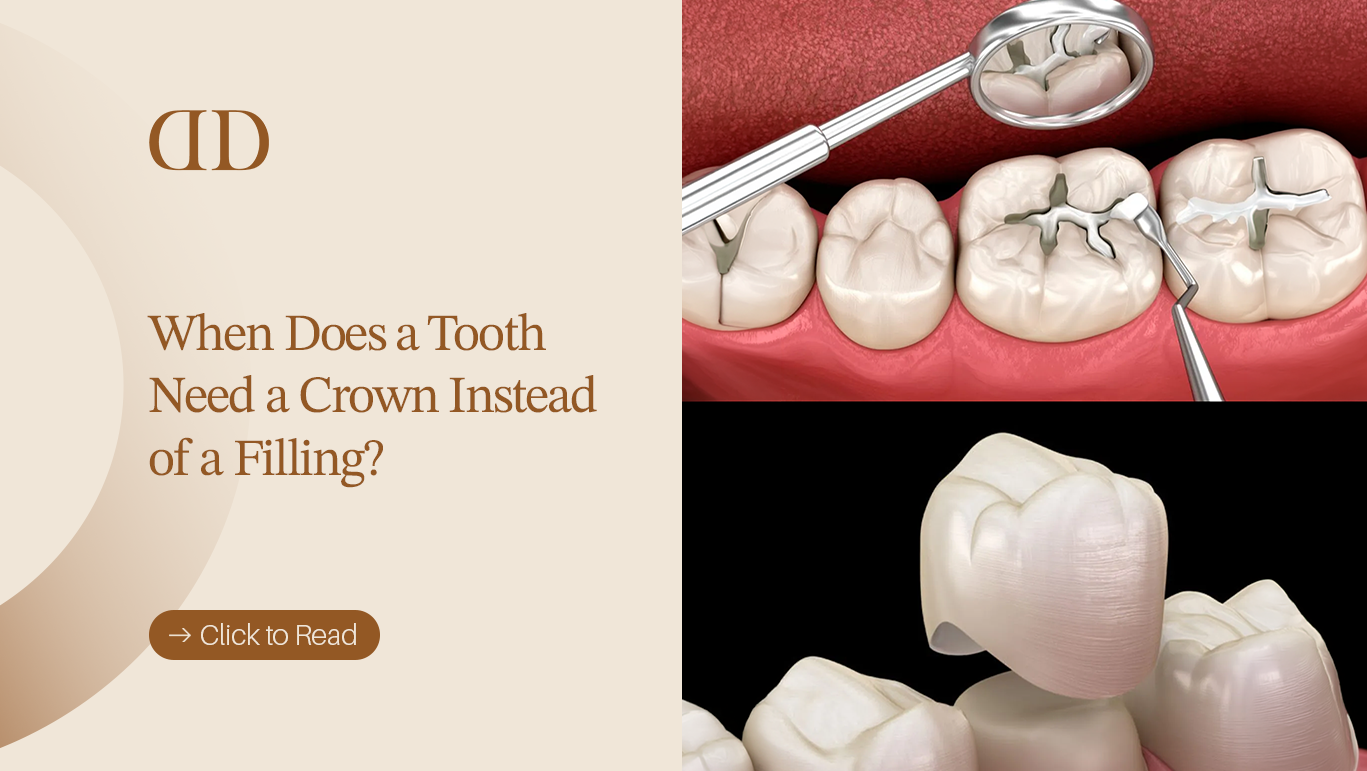

If a tooth needs a crown instead of a filling, the main reason is usually that there is not enough healthy tooth structure left to support a filling reliably. Dentists also consider the size and location of the damage, cracks or fractures, chewing forces, existing restorations, and whether the tooth has had root canal treatment.
A filling is generally used to repair a cavity while preserving as much natural tooth structure as possible. A crown, by contrast, covers and protects a larger portion of the tooth when the tooth has become significantly weakened or structurally compromised.
So, when does a tooth need a crown instead of a filling? There is no universal size or percentage of tooth loss that automatically determines the answer. The decision depends on the condition of the individual tooth and how much sound structure remains.
What Is the Difference Between a Filling and a Dental Crown?
The simplest way to understand the crown vs filling decision is to look at how much of the natural tooth needs to be restored.
| Filling | Dental crown |
| Usually repairs a cavity or limited area of tooth damage | Covers and protects a larger portion of the tooth |
| Preserves more natural tooth structure | Used when the remaining tooth needs greater structural protection |
| Often appropriate when enough healthy tooth remains to support the restoration | Considered when extensive damage, cracks, large restorations or other structural problems make a filling less suitable |
| Typically involves a more conservative restoration | Requires more extensive preparation of the tooth |
A filling replaces damaged or decayed tooth material. It does not normally surround the tooth in the way a crown does.
A crown is a full-coverage restoration designed to restore the tooth’s shape and provide protection when the remaining structure needs more support. The American Dental Association’s patient guidance notes that crowns may be used for weakened teeth, including teeth with large fillings when there is not enough tooth remaining to hold the filling securely.
This is why asking whether a crown is “better” than a filling is not quite the right question. They serve different restorative purposes. The more useful question is: Is there enough healthy tooth structure for a filling to provide an appropriate restoration?
When Is a Filling Usually Enough?
A filling may be appropriate when decay or damage is relatively limited and enough healthy tooth structure remains around the affected area.
For example, a dentist may recommend a filling when:
Premium Dental Care in Turkey
Expert treatments with high-end technology. Get your personalized quote today via WhatsApp.
- The cavity is localized.
- The surrounding tooth structure remains sound.
- The tooth does not have a significant structural crack.
- The remaining walls and cusps can adequately support the restoration.
- The damage does not extend in a way that compromises the overall strength of the tooth.
The goal of restorative dentistry is generally to preserve healthy natural tooth structure whenever possible. A filling can therefore be a suitable option when the tooth remains structurally capable of supporting one.
However, the visible size of a cavity is not the only consideration. A relatively small-looking defect can sometimes be associated with deeper or more extensive structural damage, while a larger cavity may still leave enough sound structure for a different conservative restoration.

Want trusted dental advice in your Google AI answers?
Add Darya Dental Turkey as a Preferred Source on Google to make our dental guides easier to find in your search results and AI Overviews.
This is why a dentist may recommend an examination, and sometimes dental X-rays, before deciding between a filling and a crown.
When Does a Tooth Need a Crown Instead?
A crown may be considered when a filling is unlikely to provide adequate structural support or protection.
The most common situations include extensive decay, significant cracks or fractures, large or failing fillings, and certain teeth that have undergone root canal treatment.
Extensive Tooth Decay or Significant Tooth Structure Loss
With extensive decay, the issue is not simply the size of the cavity. The key question is how much healthy tooth structure remains after the decay has been removed.
If substantial parts of the tooth have been weakened or lost, there may not be enough sound structure to support a conventional filling effectively. In such situations, a crown may be considered to restore and protect the remaining tooth.
This is particularly relevant when damage affects multiple surfaces or compromises important structural areas of the tooth.
The National Institute of Dental and Craniofacial Research distinguishes fillings, which are used to repair cavities, from crowns, which can be used when a tooth is badly broken down. The exact restoration, however, still depends on clinical examination.
Cracks, Fractures and Broken Cusps
A cracked tooth crown or filling decision requires more than simply measuring the visible defect.
A filling may be suitable for certain types of limited damage, but a significant crack can change the treatment approach because the problem involves the tooth’s structural integrity rather than decay alone.
A broken cusp can also leave a tooth vulnerable to further damage. If a large portion of the tooth is compromised, a dentist may consider a crown to cover and protect the remaining structure.
The location and extent of a crack matter. Not every cracked tooth can be treated with a crown, and a crown is not appropriate for every type of fracture. A clinical examination is needed to determine whether the tooth is restorable and what type of restoration is appropriate.
Large or Failing Existing Fillings
A tooth that already has a large filling may eventually require a different restoration.
Over time, the surrounding tooth structure can become increasingly compromised, particularly when a substantial amount of natural tooth has already been replaced by restorative material. If the remaining structure can no longer provide adequate support, a dentist may recommend replacing the existing restoration with a crown.
This addresses an important patient question: can a filling be replaced with a crown?
Yes, a large or failing filling can sometimes be replaced with a crown if examination shows that the tooth would benefit from greater coverage and protection.
The decision is not simply based on how old the filling is. The dentist needs to assess the condition of the filling, the tooth around it, and the amount of healthy structure that remains.
Teeth That Have Had Root Canal Treatment
Root canal treatment removes infected or inflamed pulp from inside the tooth, but it does not automatically mean that every treated tooth requires a crown.
The restoration after root canal treatment depends on factors such as the tooth’s location, remaining structure, the amount of tooth tissue lost, and the forces placed on the tooth during chewing.
The American Association of Endodontists notes that posterior teeth, such as molars and premolars, often require particular consideration for cuspal protection after root canal treatment because they experience substantial chewing forces. Anterior teeth may sometimes be restored without a full-coverage crown depending on the clinical circumstances.
Therefore, crown after root canal treatment should not be treated as an automatic rule. The appropriate restoration is determined by the condition and function of the individual tooth.
What Factors Do Dentists Consider Before Recommending a Crown?
If you are wondering, “do I need a crown or a filling?”, the answer cannot be determined from the cavity size alone. Dentists look at several aspects of the tooth together, particularly the amount of healthy structure remaining, the location of the damage, chewing forces, and whether the pulp or root has been affected.
How Much Healthy Tooth Structure Remains?
Remaining tooth structure is one of the most important factors in the crown vs filling decision.
A filling needs enough surrounding natural tooth structure to support it. If decay, previous restorations, fractures or other damage have removed too much of that structure, simply placing another filling may not provide the level of support the tooth needs.
This is also why there is no reliable universal rule such as “a crown is necessary when more than a certain percentage of the tooth is missing.” The clinical decision is based on the actual condition of the tooth rather than a single numerical threshold.
A dentist may assess:
- How much sound enamel and dentin remain
- Whether the tooth walls and cusps are intact
- Whether previous restorations have weakened the tooth
- Whether cracks extend into important structural areas
- Whether the remaining tooth can adequately support the proposed restoration
In some cases, preserving more natural tooth structure may make a filling or partial-coverage restoration possible. In others, the remaining structure may need the additional protection provided by a crown.
Where Is the Damage Located?
The position of the damage also matters.
A cavity or fracture affecting one limited area may be managed differently from damage involving several surfaces of a tooth. Similarly, damage involving a cusp can have different structural implications from a straightforward cavity between otherwise healthy tooth surfaces.
Molars and premolars are exposed to substantial forces during chewing. A damaged cusp or weakened posterior tooth may therefore require greater protection than a tooth with a small, localized cavity.
This is one reason a dentist may recommend a crown even when the visible hole does not appear particularly large. The concern may be the overall structural stability of the tooth, rather than the size of the visible cavity alone.
How Much Chewing Force Does the Tooth Receive?
Chewing forces are another part of the decision.
Back teeth, particularly molars, carry significant loads during chewing. If a tooth has lost substantial structure, those forces may increase the concern about further structural damage.
The restoration therefore needs to be considered in the context of how the tooth functions, not simply how it looks.
This does not mean that every damaged molar needs a crown. Instead, tooth position is one factor that helps the dentist determine whether a filling, onlay, crown or another restoration is appropriate.
Is the Pulp or Root Also Affected?
A dentist also needs to determine whether the damage involves the pulp or has led to the need for root canal treatment.
If the pulp is infected or irreversibly inflamed, a filling alone may not address the underlying problem. Root canal treatment may be necessary before the tooth is restored.
After root canal treatment, the appropriate final restoration depends on the amount of remaining tooth structure and the tooth’s location and function. Some teeth may benefit from full-coverage protection, while others may be restored differently.
For this reason, root canal treatment and crown placement are related decisions, but they are not interchangeable treatments.
A clinical examination, and when appropriate an X-ray, can help the dentist determine the condition of the tooth beneath the visible surface.
Could an Inlay or Onlay Be an Alternative to a Crown?
A dental inlay or onlay may sometimes provide an intermediate option between a conventional filling and a full crown.
An inlay is generally used to restore damage within the cusps of a tooth, while an onlay can extend over one or more cusps when more coverage is needed.
This can make an onlay relevant when a tooth has more extensive damage than would normally be suitable for a simple filling, but does not necessarily require complete coverage with a crown.
| Restoration | General role |
| Filling | Repairs a more localized area of decay or damage |
| Inlay | Restores damage within the cusps |
| Onlay | Provides partial coverage, including one or more cusps |
| Crown | Provides extensive coverage when the tooth requires greater structural protection |
An onlay vs crown decision depends on the amount and location of remaining healthy tooth structure and the specific pattern of damage.
A partial-coverage restoration is not automatically preferable to a crown, nor is a crown automatically preferable to an onlay. The appropriate choice depends on whether the remaining tooth can support the restoration and what type of protection is clinically required.
Can a Filling Be Replaced With a Crown Later?
Yes. A tooth can initially be treated with a filling and later require a crown if its structural condition changes.
For example, a filling may initially be appropriate when sufficient healthy tooth structure remains. If the tooth subsequently develops additional decay, a crack, cusp damage, or deterioration around a large restoration, the treatment plan may need to change.
This is why a large filling needs a crown is not necessarily an indication that the crown should have been placed from the beginning. Treatment decisions are based on the condition of the tooth at the time it is examined.
A dentist may also recommend replacing a large existing filling with a crown when the remaining tooth structure has become insufficient to reliably support another filling.
The important distinction is that a crown is not simply a “larger filling.” It is a different type of restoration designed to provide broader coverage and protection.
Questions to Ask Before Choosing a Crown or Filling
If your dentist recommends a crown when you expected a filling, asking a few specific questions can help you understand the reasoning behind the treatment plan.
Consider asking:
- How much healthy tooth structure remains?
- Why would a filling not provide enough support in this tooth?
- Is there a crack, fractured cusp or other structural damage?
- How much of the tooth would need to be restored?
- Would an inlay or onlay be clinically appropriate?
- Has the tooth had root canal treatment, or does the pulp need further evaluation?
- Does the location of the tooth or its chewing forces affect the recommendation?
- What could happen if the tooth is restored with a filling instead?
- Is the existing filling failing, and if so, how is the surrounding tooth structure affected?
- What findings from the examination or X-ray led to the recommendation?
These questions can help shift the conversation from “Which restoration is better?” to the more useful question: “Which restoration is appropriate for the condition of this particular tooth?”
For patients considering treatment in Istanbul, Darya Dental Turkey can provide the relevant clinical pathway through its dental crown treatment, dental filling treatment, and root canal treatment pages. The specific treatment, however, should be determined following an individual dental assessment.
Frequently Asked Questions
Is a crown better than a filling?
Neither restoration is universally better. A filling is generally used when enough healthy tooth structure remains to support a conservative restoration, while a crown may be considered when the tooth is significantly weakened or needs more extensive coverage.
The appropriate choice depends on the tooth’s condition, remaining structure, location and function.
How do dentists know if a cavity is too big for a filling?
Dentists do not determine this from cavity size alone. They assess how much healthy tooth structure remains after decay is removed, whether the tooth has cracks or weakened cusps, and whether the remaining structure can adequately support a filling.
An examination and, when indicated, dental X-rays can help determine the extent of the damage.
Can a large filling be replaced with a crown?
Yes. A large or failing filling can sometimes be replaced with a crown when the surrounding tooth structure has become too compromised to adequately support another filling.
The dentist will assess the existing restoration and the condition of the natural tooth before recommending a change in restoration.
Does every root canal-treated tooth need a crown?
No. Not every root canal-treated tooth automatically needs a crown.
The decision depends on factors including the tooth’s location, the amount of remaining tooth structure, the type and extent of previous damage, and the forces placed on the tooth during chewing. Posterior teeth may require particular consideration because of the forces they experience.
Can a cracked tooth be treated with a filling?
Sometimes, but it depends on the type, location and extent of the crack.
A limited area of damage may be treatable with a filling or another conservative restoration. More significant structural cracks or fractured cusps may require greater coverage, such as an onlay or crown, if the tooth is otherwise restorable.
Could an onlay be used instead of a crown?
In some cases, yes. An onlay can provide partial coverage when a filling is insufficient but complete coverage with a crown may not be necessary.
Whether an onlay is appropriate depends on the remaining healthy tooth structure and the location and pattern of the damage. It should be considered as a possible treatment option rather than an automatic alternative.
What happens if a tooth is too weak for a filling?
If insufficient healthy tooth structure remains to support a filling, the dentist may consider a restoration that provides greater coverage, such as an onlay or crown.
The purpose is to restore the tooth while providing the level of structural protection appropriate for its condition. The exact treatment depends on the findings during the dental assessment.
Can a dentist tell whether I need a crown from an X-ray?
An X-ray can provide important information, but it is not necessarily enough on its own to determine whether a crown is required.
The dentist may combine radiographic findings with a clinical examination, assessment of the remaining tooth structure, the condition of existing restorations, cracks or fractures, and how the tooth functions.
Does getting a crown require removing more tooth structure than a filling?
Generally, preparing a crown involves more alteration of the tooth than placing a conventional filling because the crown needs sufficient space and structure for full coverage.
However, the amount of tooth preparation depends on the specific restoration and clinical situation. This is one reason dentists consider whether a more conservative restoration can adequately restore and protect the tooth.
Can a tooth start with a filling and need a crown later?
Yes. A tooth may initially be suitable for a filling and later require a crown if additional decay, cracks, fractures, restoration failure or further loss of healthy tooth structure develops.
A change in treatment does not necessarily mean the original filling was inappropriate. The condition of the tooth can change over time, so treatment may need to be reassessed.
The answer to “when does a tooth need a crown instead of a filling?” depends primarily on the condition and structural support of the individual tooth.
A filling may be appropriate when enough healthy tooth structure remains to support a conservative restoration. A crown may be considered when extensive decay, cracks, broken cusps, a large failing filling or other structural damage leaves the tooth unable to provide sufficient support for a filling. Root canal treatment can also affect the restoration decision, particularly for posterior teeth.
An inlay or onlay may be another option in selected cases where partial coverage can provide adequate restoration without requiring full coverage.
Rather than choosing a crown or filling based only on the visible size of a cavity, it is important to have the tooth assessed as a whole. Asking your dentist how much healthy structure remains, why a particular restoration is recommended, and whether a more conservative option is appropriate can help you understand the treatment decision.
For patients considering treatment in Istanbul, the relevant next step is an individual dental assessment. Depending on the findings, this may lead to a filling, crown, partial-coverage restoration, root canal treatment, or another appropriate approach.
