
What Happens to Your Natural Teeth Under Veneers?
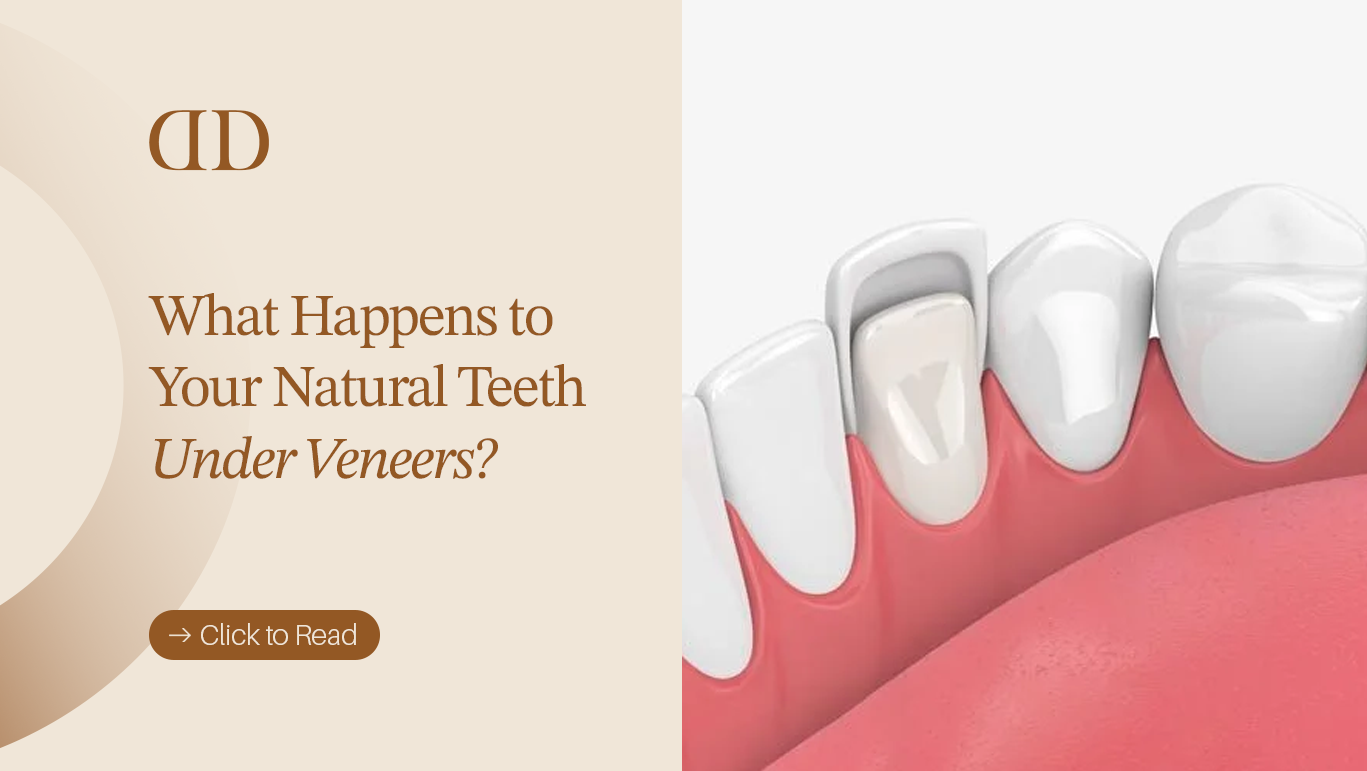

If you are wondering what happens to teeth under veneers, the natural tooth does not disappear or get replaced by the veneer. A veneer is a thin covering bonded to the front surface of the tooth. Depending on the type of veneer and the treatment plan, a dentist may remove a small amount of enamel first to create space and establish a suitable surface for bonding. The natural tooth remains underneath, but conventional veneer treatment can permanently change its structure because removed enamel does not grow back.
This distinction is important. Veneers are not simply removable covers that leave the tooth completely unchanged. At the same time, they are not the same as dental crowns, which cover much more of the tooth. Understanding what remains underneath, how the tooth is prepared, and how it must be maintained can help you make a more informed decision about treatment.
What Happens to Your Natural Teeth Under Veneers?
A veneer is bonded to the visible front surface of a natural tooth. The tooth itself remains present underneath the restoration, including its deeper structures such as dentin and the dental pulp, where the nerves and blood supply are located.
The amount of natural tooth structure that changes depends on the type of veneer and the individual tooth. With conventional porcelain veneers, the American Dental Association explains that a small amount of enamel may be removed from the front and sides of the tooth before bonding. Some veneers may require little or no preparation, while others need more space to achieve the desired fit and appearance.
In simple terms, the process can be thought of as:
Natural tooth → preparation when required → veneer bonded to the tooth → natural tooth remains underneath
The veneer changes the visible surface, but it does not make the underlying tooth immune to dental problems. Cavities can still develop under or around a veneer, which is why brushing, cleaning between the teeth, regular dental examinations and healthy gums remain important after treatment.
What Changes and What Doesn’t?
| What changes | What does not disappear |
| The visible front surface may be covered by the veneer | The natural tooth remains underneath |
| Some enamel may be removed during conventional preparation | The dentin and deeper tooth structures remain |
| The tooth’s shape, colour and surface appearance can change | The tooth can still develop decay |
| The tooth becomes bonded to a dental restoration | Oral hygiene and gum care are still necessary |
The key point is that teeth under veneers are still natural teeth. They continue to require the same attention to oral health as other teeth.
How Are Natural Teeth Prepared for Veneers?
Preparation depends on the material, design and position of the veneer, as well as the condition and shape of the individual tooth.
Premium Dental Care in Turkey
Expert treatments with high-end technology. Get your personalized quote today via WhatsApp.
For a conventional porcelain veneer, the dentist generally prepares the front surface by removing a small amount of enamel. This creates room for the veneer and helps establish an appropriate surface for bonding. The American Dental Association describes porcelain veneers as thin shells custom-made to fit the front surface of teeth.
The preparation is not intended to remove the entire tooth. Veneers differ from crowns because they cover the front surface rather than the whole tooth structure. NHS guidance similarly notes that some veneers require a small amount of the front tooth surface to be removed, while not all veneers require this type of preparation.

Want trusted dental advice in your Google AI answers?
Add Darya Dental Turkey as a Preferred Source on Google to make our dental guides easier to find in your search results and AI Overviews.
Before placing a veneer, the underlying tooth and surrounding tissues should also be assessed. Existing dental problems such as tooth decay or gum disease should be addressed rather than simply covered with a cosmetic restoration. The ADA specifically advises treating these problems before veneer placement.
This is one reason a clinical examination matters. The question is not simply whether a veneer can physically be placed over a tooth, but whether the tooth and gums are healthy enough to support the planned treatment.
How Much Enamel Is Removed?
There is no single amount of veneers enamel removal that applies to every patient.
The amount depends on factors such as:
- the existing shape and position of the tooth
- the desired final tooth shape
- the thickness and material of the veneer
- the amount of correction required
- the planned bonding approach
- whether the treatment is conventional, minimal-prep or no-prep
Conventional porcelain veneers generally involve removing some enamel from the front and, where necessary, the sides of the tooth. However, the exact amount should be determined during an individual dental assessment rather than assumed from a general number.
This is also why claims that veneers always require extensive tooth reduction or that every veneer is completely preparation-free can be misleading. Different cases require different approaches.
Does Enamel Grow Back?
No. Natural tooth enamel does not grow back once it has been removed.
Enamel is the hard outer layer of the tooth. Unlike some tissues in the body, mature enamel cannot regenerate itself because it does not contain living cells. The American Dental Association notes that once enamel is gone, it does not grow back.
For this reason, conventional veneer treatment should be considered an irreversible change to the tooth structure. The ADA specifically states that veneer treatment is not reversible because enamel is removed to place a veneer.
That does not mean every veneer treatment involves the same degree of tooth alteration. Minimal-prep and no-prep approaches are designed to preserve more natural tooth structure in appropriate cases. Whether they are suitable depends on the patient’s teeth, bite, desired result and other clinical factors.
The important distinction is therefore:
A veneer may be replaceable, but enamel removed during conventional preparation does not grow back.
That distinction becomes particularly relevant when considering what happens if a veneer later cracks, loosens or needs to be replaced a question that will be covered in the next part of this guide.
Can Teeth Decay Under Veneers?
Yes. Teeth can still develop decay under or around veneers. A veneer covers part of the visible tooth surface, but it does not make the natural tooth underneath resistant to cavities.
Decay may develop around the edges of a veneer or in areas of exposed natural tooth structure. This is why having a veneer does not remove the need for daily brushing, cleaning between the teeth and regular dental examinations.
The condition of the tooth before treatment also matters. Existing decay or gum disease should be addressed before veneers are placed rather than covered by the restoration. The American Dental Association specifically notes that cavities can still occur under or around veneers.
Why the Veneer Margin Matters
The veneer margin is the area where the edge of the restoration meets the natural tooth. It is an important area for long-term oral hygiene because plaque can accumulate around tooth-restoration boundaries.
A well-planned veneer should have an appropriate fit and a margin that can be maintained with normal oral hygiene. However, the presence of a veneer does not eliminate the biological interface between the restoration, tooth and surrounding tissues.
For the patient, this means that protecting teeth under veneers is partly about maintaining the areas around the restoration, not simply cleaning the visible ceramic surface.
Useful habits include:
- Brushing twice a day with fluoride toothpaste.
- Cleaning between the teeth regularly.
- Following the dentist’s recommended oral-hygiene routine.
- Attending regular dental examinations.
- Reporting persistent sensitivity, discomfort, bleeding or changes around a veneer.
A veneer should therefore be viewed as part of a tooth-restoration system rather than a protective shell that makes the underlying tooth maintenance-free.
Gum Health and Gum Recession
The gums surrounding veneered teeth also need to remain healthy. Gum inflammation can affect the tissues around the restoration and may make the veneer margin more difficult to keep clean.
Gum recession can expose additional natural tooth structure. Depending on the situation, this may affect the appearance of the veneer margin and can create areas that require particular attention during oral hygiene.
For this reason, healthy gums are an important part of veneer planning. If gum disease is already present, it should generally be assessed and managed before cosmetic treatment rather than ignored.
Do Veneers Damage or Weaken Natural Teeth?
The answer depends largely on how the teeth are prepared and the condition of the teeth before treatment.
Veneers do not automatically mean that natural teeth will be damaged or weakened. However, conventional veneers can require removal of some enamel, and that change is permanent. This is why the decision to place veneers should be based on an examination of the individual teeth rather than on the assumption that veneers are either universally harmful or completely risk-free.
A useful way to understand the issue is to separate the veneer itself from the preparation required to place it.
| Question | What it means |
| Does the natural tooth remain? | Yes. The veneer is bonded to the existing tooth. |
| Can enamel be removed? | Yes, conventional veneer treatment may involve enamel preparation. |
| Does removed enamel grow back? | No. |
| Can the tooth still decay? | Yes. Decay can occur under or around veneers. |
| Does every veneer require the same preparation? | No. Preparation varies by case and veneer approach. |
| Are veneers automatically harmful? | No. Their effect depends on treatment planning, preparation, fit and ongoing oral health. |
This is also why the phrase “do veneers ruin your teeth” does not have a simple yes-or-no answer. Veneers involve a permanent structural change when enamel is removed, but that is different from saying that appropriately planned veneer treatment inevitably ruins natural teeth.
The more useful question is: How much natural tooth structure needs to be changed for this particular patient, and is that change appropriate for the intended result?
That question can only be answered through an individual clinical assessment.
Can Veneers Cause Tooth Sensitivity?
Veneers can be associated with tooth sensitivity, particularly around the period following tooth preparation. Sensitivity may be more noticeable when a tooth has undergone enamel reduction or when the underlying tooth is already sensitive.
The degree and duration of sensitivity can vary between patients. It should not automatically be assumed that significant or persistent sensitivity is a normal consequence that needs to be ignored.
If sensitivity continues, becomes severe or is associated with pain, the tooth should be assessed by a dentist. A clinical examination may be needed to determine whether the symptoms are related to the veneer, the tooth underneath, the bite or another dental problem.
This is another reason the condition of the natural tooth matters before treatment. Veneers are cosmetic restorations; they should not be used simply to cover up an unresolved dental problem.
What Happens If a Veneer Cracks or Comes Off?
If a veneer cracks, chips or comes off, the natural tooth underneath does not necessarily become unusable. What happens next depends on the condition of both the veneer and the underlying tooth.
If a veneer comes off, keep the restoration rather than throwing it away and arrange a dental examination. The dentist can assess the veneer and the tooth and determine whether the restoration can be rebonded or whether a replacement is required.
If a veneer cracks or chips, the appropriate treatment depends on the extent of the damage. A minor cosmetic defect may be managed differently from a fracture that compromises the restoration or exposes the underlying tooth.
Do not attempt to permanently glue a veneer back onto the tooth yourself. A dentist needs to determine whether the tooth itself has been affected and whether the existing veneer remains suitable.
Symptoms that warrant dental assessment include:
- New or worsening tooth sensitivity
- Pain when biting
- Sharp edges that irritate the tongue or gums
- Bleeding or swelling around the tooth
- A visible crack or fracture
- A veneer that has become loose
- A veneer that has completely detached
A failed veneer is therefore not necessarily a failure of the natural tooth. The next step depends on what has happened to both the restoration and the tooth underneath.
What Happens to Teeth After Veneers Need Replacement?
Veneers may eventually need repair or replacement. When this happens, the underlying tooth needs to be assessed rather than simply assuming that another veneer can always be placed immediately.
If conventional veneer preparation has already removed enamel, that enamel will not grow back. As a result, replacing a conventional veneer does not return the tooth to its original pre-treatment state.
The dentist may evaluate:
- The amount and condition of remaining enamel
- The condition of the dentin
- The health of the gums
- Signs of tooth decay
- The integrity of the existing restoration
- Bite and grinding forces
- Whether the tooth remains suitable for another veneer
In some cases, the existing restoration can be replaced with another veneer. In other situations, a different restorative approach may be more appropriate. The correct choice depends on the condition of the tooth at that point in time.
This is an important part of understanding are veneers permanent. The veneer itself is not necessarily permanent in the sense that it will never need replacement. More importantly, conventional preparation can create a permanent change to the natural tooth because enamel removal is irreversible.
That distinction helps explain why veneer treatment should be approached as a long-term dental decision rather than simply a temporary cosmetic change.
Traditional, Minimal-Prep and No-Prep Veneers
Not all veneers involve the same amount of tooth preparation. The main differences between traditional, minimal-prep and no-prep approaches relate to how much natural tooth structure needs to be altered and whether preparation is clinically necessary for the individual tooth.
| Approach | Natural tooth preparation | Main consideration |
| Traditional veneers | Usually require some enamel preparation | More permanent alteration of the natural tooth |
| Minimal-prep veneers | Designed to reduce preparation where appropriate | Suitability depends on tooth shape, position and desired result |
| No-prep veneers | May require little or no enamel removal | Not suitable for every tooth or every cosmetic goal |
Minimal-prep veneers aim to preserve more natural tooth structure than conventional preparation where the case allows. However, “minimal” does not mean that preparation is always unnecessary.
No-prep veneers are designed to be placed with little or no removal of natural tooth structure in selected cases. They can therefore be relevant to patients who are particularly concerned about enamel preservation. However, they are not automatically a better choice for every patient.
The final decision depends on factors such as tooth position, existing tooth shape, bite, available space, colour changes and the desired aesthetic result. A dentist needs to assess the teeth before deciding whether a traditional, minimal-prep or no-prep approach is appropriate.
This distinction is important because preserving enamel can be beneficial, but a veneer also needs to be appropriately designed and positioned. Choosing a treatment solely because it involves less preparation does not guarantee that it will be suitable for a particular case.
Who May Not Be a Suitable Candidate for Veneers?
Veneers are not appropriate for everyone. Suitability depends on the condition of the teeth and gums, the patient’s bite and habits, and the cosmetic or restorative problem being addressed.
Treatment may need to be postponed or reconsidered when there is an unresolved dental problem. For example, existing tooth decay or gum disease should be evaluated and treated before veneer placement. The American Dental Association specifically recommends addressing these problems first.
A dental assessment may also consider:
- The amount and condition of remaining enamel
- Existing fillings or restorations
- Tooth decay or structural damage
- Gum health
- Tooth position and available space
- The patient’s bite
- Clenching or grinding habits
- The desired change in tooth shape or colour
- Whether enough healthy tooth structure is available for predictable bonding
A history of clenching or grinding can also be relevant because excessive forces may place additional stress on cosmetic restorations. This does not automatically rule out veneers, but it is something that should be discussed during treatment planning.
The key point is that veneers should not be selected simply because they are a popular cosmetic option. The natural teeth need to be assessed first, and the proposed preparation should be appropriate for their condition.
How to Protect Natural Teeth Under Veneers
Protecting teeth under veneers starts with treating the restoration and the natural tooth as one long-term dental system.
A veneer does not replace everyday oral hygiene. The natural tooth underneath remains susceptible to dental disease, while the areas around the veneer margins need to be kept clean.
Important habits include:
- Brush regularly with fluoride toothpaste.
Follow the brushing routine recommended by your dentist. - Clean between the teeth.
Plaque can accumulate in areas that a toothbrush cannot reach effectively. - Look after your gums.
Bleeding, persistent inflammation or gum recession should not be ignored. - Attend regular dental examinations.
A dentist can check both the veneer and the natural tooth underneath it. - Address sensitivity or pain promptly.
New or persistent symptoms may require assessment rather than simply waiting for them to disappear. - Tell your dentist if you clench or grind your teeth.
Excessive biting forces can be relevant when planning and maintaining veneers. - Do not assume a veneer protects the tooth from decay.
Cavities can still develop around or beneath a veneer, so prevention remains important.
The goal is not simply to maintain the appearance of the veneer. It is to preserve the health of the natural tooth and surrounding gums for as long as possible.
Frequently Asked Questions About Teeth Under Veneers
Do veneers cover the entire tooth?
No. Veneers generally cover the visible front surface of a tooth rather than the entire tooth. Conventional veneers may require some enamel preparation before they are bonded to the tooth.
What happens to the natural tooth underneath a veneer?
The natural tooth remains underneath the veneer. Depending on the treatment approach, some enamel may be removed before the veneer is bonded to the tooth. The underlying tooth remains biologically active and can still develop dental problems.
Does getting veneers remove enamel?
Conventional veneers can require removal of some enamel. The exact amount varies according to the tooth, veneer design and treatment plan. Some minimal-prep and no-prep approaches may require little or no enamel removal in appropriate cases.
Does enamel grow back after veneers?
No. Removed enamel does not grow back. This is why conventional veneer treatment is considered irreversible when enamel has been removed.
Can you get cavities under veneers?
Yes. Cavities can develop under or around veneers. The veneer does not make the underlying natural tooth immune to decay, so brushing, interdental cleaning and regular dental care remain important.
Can veneers cause tooth sensitivity?
Veneer treatment can be associated with tooth sensitivity, particularly after tooth preparation. The degree and duration can vary. Persistent, severe or worsening sensitivity should be assessed by a dentist rather than ignored.
Do veneers permanently change your teeth?
Conventional veneers can permanently change natural teeth when enamel is removed. The veneer itself may eventually need replacement, but removed enamel does not regenerate.
What happens if a veneer falls off?
A loose or detached veneer should be assessed by a dentist. Keep the veneer and arrange an examination so the tooth and restoration can be evaluated. Depending on their condition, the veneer may potentially be rebonded or may need replacement.
Can veneers be removed and replaced?
Veneers can be replaced, but removing a conventional veneer does not restore the tooth to its original condition if enamel was previously removed. The next treatment depends on the condition of the remaining tooth structure and surrounding tissues.
Are no-prep veneers better for preserving natural teeth?
No-prep veneers can preserve more natural tooth structure in suitable cases, but they are not automatically appropriate for everyone. Tooth shape, position, bite and the desired cosmetic result all affect whether a no-prep approach is suitable.
How do you keep natural teeth healthy under veneers?
Maintain normal oral hygiene and regular dental care. Brush with fluoride toothpaste, clean between your teeth, look after your gums and attend dental examinations. Veneers do not eliminate the risk of decay or gum disease.
When Should You Contact a Dentist?
A veneer should not prevent you from seeking dental care when something changes. Contact a dentist if you notice:
- Persistent or worsening tooth sensitivity
- Toothache or pain when biting
- A loose, chipped or cracked veneer
- A veneer that has fallen off
- Bleeding or swollen gums
- Changes around the veneer margin
- A suspected cavity or dark area around the restoration
These symptoms do not necessarily mean that the veneer has caused damage. They indicate that the tooth and restoration should be examined so the underlying cause can be identified.
Understanding what happens to teeth under veneers starts with one important fact: the natural tooth remains underneath the restoration. Conventional veneers may require removal of some enamel, and because enamel does not grow back, that part of treatment is irreversible.
At the same time, a veneer does not make the underlying tooth immune to decay, sensitivity or gum-related problems. Long-term care depends on appropriate treatment planning, healthy teeth and gums before placement, good oral hygiene and regular dental assessment.
Traditional, minimal-prep and no-prep veneers involve different approaches to tooth preparation, and the most appropriate option depends on the individual clinical situation. If you are considering veneers, a dental examination can determine how much natural tooth structure needs to be changed and which approach is appropriate for your teeth.
