E-Max vs Zirconia: Which Material Is Right for Your Smile?
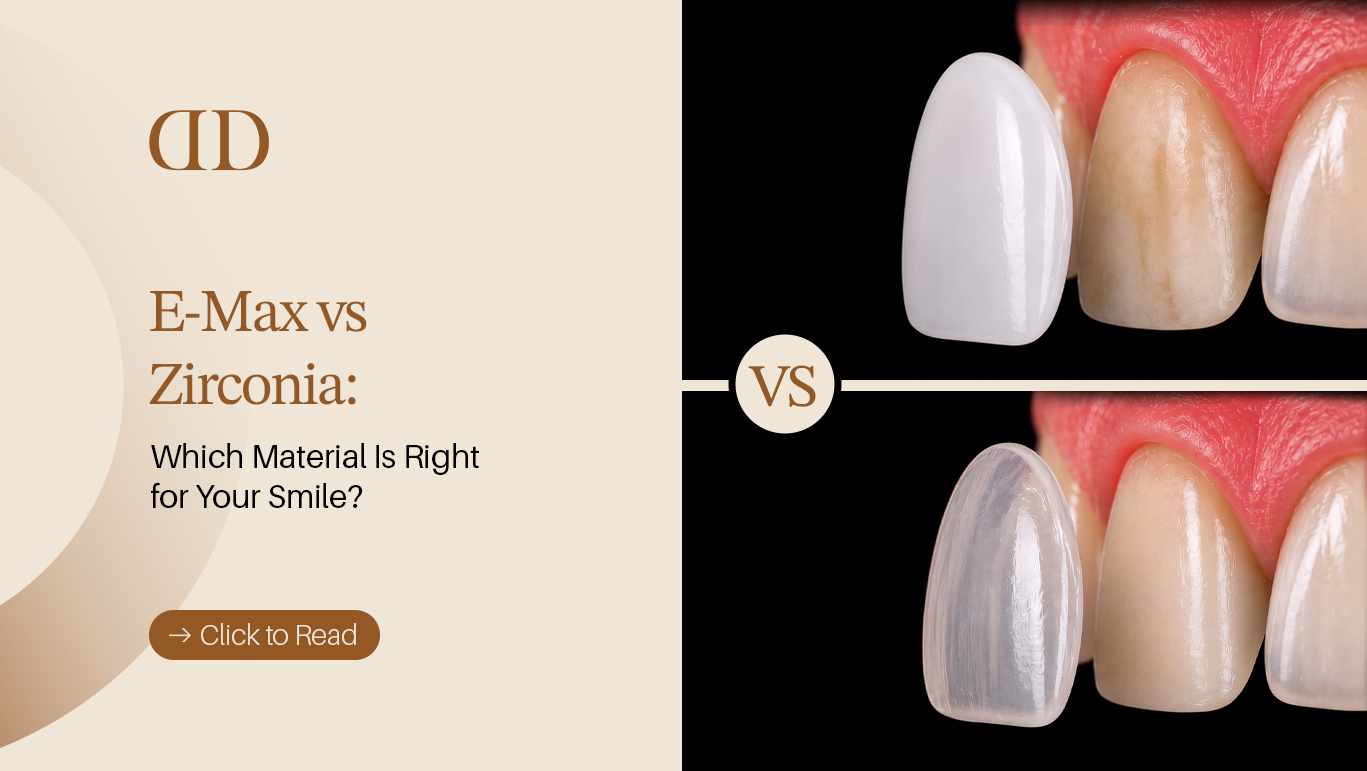

There is no single material that is better for every smile. The right choice between E-Max and zirconia depends on factors such as tooth position, aesthetic expectations, bite forces, remaining tooth structure, bruxism and whether the restoration is a crown or veneer.
E-Max is widely associated with high translucency and natural-looking aesthetics, while zirconia is known for its strength and suitability for restorations exposed to higher functional loads. However, choosing between them is more complex than simply comparing beauty with strength. The type of restoration, the location of the tooth and the patient’s individual clinical situation all influence the decision.
E-Max and Zirconia: What Is the Difference?
E-Max and zirconia are both ceramic materials used in restorative dentistry, but they have different material characteristics.
What Is E-Max?
E-Max is a lithium disilicate ceramic used for dental restorations such as crowns and, in selected cases, veneers. One of its best-known characteristics is its optical performance. Its translucency can help restorations interact with light in a way that resembles natural tooth structure.
This makes lithium disilicate particularly relevant when aesthetics and a natural appearance are important considerations, especially in visible areas of the smile.
However, E-Max should not simply be described as an “aesthetic material.” Its suitability depends on the restoration design, tooth position, functional demands and the amount of remaining tooth structure.
For patients considering a full-coverage restoration, the E-Max Crown treatment page provides information about this specific restoration.
What Is Zirconia?
Zirconia is a ceramic material based on zirconium dioxide. It is widely used for dental crowns and other restorations where mechanical performance is an important consideration.
Modern zirconia materials can also offer improved optical properties compared with earlier generations of zirconia. Therefore, the traditional idea that zirconia is only about strength and E-Max is only about aesthetics is too simplistic.
Premium Dental Care in Turkey
Expert treatments with high-end technology. Get your personalized quote today via WhatsApp.
The specific zirconia formulation, restoration design, thickness, manufacturing process and clinical situation can all influence the final result.
For more information about zirconia restorations, see the Zirconia Crown treatment page.

Want trusted dental advice in your Google AI answers?
Add Darya Dental Turkey as a Preferred Source on Google to make our dental guides easier to find in your search results and AI Overviews.
E-Max vs Zirconia at a Glance
The following comparison provides a general overview. It should not be interpreted as a universal treatment recommendation because material selection depends on the individual case.
| Feature | E-Max | Zirconia |
| Material type | Lithium disilicate ceramic | Zirconium dioxide ceramic |
| Aesthetics | High aesthetic potential | Modern zirconia can provide strong aesthetic results |
| Translucency | Generally high | Varies according to zirconia type |
| Strength | High, depending on material and design | Generally high, particularly in high-load applications |
| Typical applications | Crowns and selected veneers | Crowns and other high-load restorations |
| Front teeth | Often considered when translucency is important | Can be considered depending on aesthetics and clinical demands |
| Back teeth | Can be suitable in selected cases | Often considered where functional load is high |
| Bruxism | Requires careful clinical assessment | May be considered depending on occlusion and restoration design |
| Tooth preparation | Depends on restoration and clinical situation | Depends on restoration and clinical situation |
| Veneers | Commonly associated with aesthetic ceramic veneers | Possible in selected situations, but indication depends on the case |
| Crowns | Widely used | Widely used |
The most important point is that these characteristics should be evaluated together rather than in isolation.
E-Max vs Zirconia: Aesthetics and Natural Appearance
Aesthetic expectations are often one of the first reasons patients compare E-Max and zirconia.
Why E-Max Is Known for Translucency
E-Max lithium disilicate is known for its translucency, which can contribute to a natural appearance by allowing light to interact with the restoration in a way that resembles natural enamel.
This characteristic can be particularly relevant for visible anterior teeth where subtle optical properties matter. Shade, thickness, preparation, cementation and the underlying tooth can still influence the final appearance.
For that reason, saying that E-Max “always looks more natural” would be too broad. The clinical result depends on more than the ceramic material itself.
How Modern Zirconia Has Improved Aesthetics
Zirconia has evolved considerably. Modern zirconia materials can provide improved translucency and more sophisticated aesthetic outcomes than traditional highly opaque zirconia.
This means zirconia should not automatically be excluded from consideration for visible teeth simply because aesthetics are important.
The choice may depend on the balance between optical requirements and functional demands. In some cases, the clinician may prioritize translucency. In others, strength, masking ability or functional performance may have greater importance.
E-Max vs Zirconia: Strength and Durability
Strength is another major factor when comparing E-Max and zirconia, but strength alone does not determine how long a dental restoration will function successfully.
Restoration design, material thickness, bonding or cementation, occlusion, tooth preparation and patient-specific factors can all influence clinical performance.
Which Material Handles Higher Bite Forces?
Zirconia is commonly considered when a restoration needs to withstand significant functional loading. This is particularly relevant for posterior teeth and situations where chewing forces are an important consideration.
E-Max also has substantial mechanical performance and can be used successfully for many crown indications. Its suitability should be assessed according to the specific restoration design and clinical conditions rather than judged solely by material category.
A material with high strength does not automatically guarantee better clinical longevity. The restoration itself must be appropriately designed and placed.
What Changes When Bruxism Is Present?
Bruxism can change the way a restoration is evaluated because repeated clenching or grinding can increase mechanical stress.
When bruxism is present, the dentist may need to assess:
- The patient’s bite and occlusion
- The location of the restoration
- The amount of functional loading
- The condition of the opposing teeth
- The restoration design
- The available tooth structure
- Whether protective measures are appropriate
Zirconia may be considered in some high-load situations, but bruxism alone does not automatically make zirconia the correct choice. Similarly, E-Max should not automatically be excluded without evaluating the complete clinical situation.
Clinical evidence also does not support reducing the comparison to a simple statement that one material always lasts longer. Research comparing zirconia and lithium disilicate restorations suggests that clinical performance can be comparable, while the types of technical or aesthetic complications may differ according to the restoration and clinical circumstances.
Which Is Better for Front Teeth?
For front teeth, aesthetics often become particularly important because the restorations are highly visible during speech and smiling.
When E-Max May Be Preferred
E-Max may be considered when high translucency and an enamel-like optical appearance are important priorities.
It can be particularly relevant for anterior restorations where the clinician is trying to reproduce the appearance of natural tooth structure.
The final decision can still be affected by the underlying tooth colour, available enamel, restoration thickness, bite and the type of restoration being planned.
When Zirconia May Be Considered
Zirconia can also be considered for anterior teeth. Modern translucent zirconia can provide attractive aesthetic results, while its mechanical properties may make it useful in cases where additional strength is an important consideration.
The question is therefore not simply whether E-Max or zirconia is “better” for front teeth. The more useful question is which material can provide the required optical and functional properties for the specific tooth.
Which Is Better for Back Teeth?
Posterior teeth are exposed to substantial chewing forces, particularly the molars.
Posterior Bite Forces
When restoring a posterior tooth, the dentist must consider the forces generated during chewing as well as the patient’s bite.
The restoration needs to function within the patient’s occlusion rather than simply look attractive.
Molars and High-Load Restorations
Zirconia may be considered for posterior restorations where high functional load is an important concern.
E-Max can also be suitable in selected posterior cases. The decision depends on factors such as restoration design, material thickness, tooth structure, occlusion and the specific type of lithium disilicate restoration being used.
Therefore, E-Max should not be described as unsuitable for all molars, just as zirconia should not automatically be considered necessary for every posterior tooth.
E-Max vs Zirconia for Veneers
Comparing E-Max veneers and zirconia veneers requires a slightly different approach from comparing crowns.
A veneer is generally a more conservative restoration than a full crown, and material selection is influenced by factors such as available enamel, tooth colour, aesthetic objectives, preparation requirements and bonding.
E-Max is commonly considered for aesthetic ceramic veneers because of its optical properties. Zirconia can also be used in selected veneer situations, but whether it is appropriate depends on the clinical indication and restoration design.
This distinction is important because a material that performs well as a crown is not automatically the best choice for a veneer.
Patients should therefore avoid treating “E-Max vs zirconia” as one universal comparison. The restoration type must be identified first.
E-Max vs Zirconia for Crowns
Both E-Max and zirconia can be used for dental crowns, but they can serve different clinical priorities.
An E-Max crown may be considered when optical properties and a natural appearance are important. A zirconia crown may be considered when mechanical performance and functional loading are major considerations.
The underlying tooth colour is another important factor. A severely discoloured or dark underlying tooth can affect the choice of ceramic and restoration design because masking requirements may influence the optical result.
The final choice can also depend on whether the restoration is monolithic or layered. Different designs can have different optical and mechanical characteristics, so the material name alone does not describe the entire restoration.
Can E-Max and Zirconia Be Used Together?
Yes, E-Max and zirconia can both have a role within the same overall smile design when different teeth have different clinical requirements.
For example, a patient may have anterior teeth where optical properties are a major consideration and posterior teeth where functional loading is more important. In such a situation, material selection can be made tooth by tooth rather than applying one material to every restoration.
This is one reason why a smile makeover should not necessarily be viewed as a choice between “all E-Max” and “all zirconia.”
The final plan can depend on:
- Tooth position
- Restoration type
- Functional load
- Aesthetic expectations
- Existing restorations
- Tooth colour
- Remaining tooth structure
- Occlusion
Material selection should therefore be part of the overall restorative plan.
How Dentists Decide Between E-Max and Zirconia
A dentist does not usually choose a ceramic material based on one characteristic alone. The decision involves several clinical factors.
1. Tooth Location
Anterior and posterior teeth have different aesthetic and functional requirements. A visible front tooth may place greater emphasis on optical properties, while a molar may require particular attention to functional loading.
2. Remaining Tooth Structure
The amount and condition of the remaining natural tooth structure can influence restoration design and preparation.
3. Bite and Occlusion
The way the upper and lower teeth contact each other can affect the forces placed on a restoration.
4. Bruxism
Grinding and clenching can increase mechanical demands and should be considered during treatment planning.
5. Tooth Colour
The underlying colour of the tooth can influence the final appearance of a ceramic restoration and may affect material selection.
6. Aesthetic Expectations
Patients may have different expectations regarding translucency, brightness, opacity and the overall appearance of their smile.
7. Restoration Type
A crown and a veneer are different restorations. Material selection should therefore be evaluated in the context of the restoration being planned.
8. Functional Load
The amount of force expected on the restoration can affect which materials and designs are considered.
9. Existing Restorations
Existing crowns, bridges, veneers or other restorations may influence the treatment plan and the desired visual consistency.
10. Overall Smile Design
The final result should be considered as part of the patient’s overall smile rather than as an isolated tooth.
For restorations involving multiple missing or adjacent teeth, material selection can also be relevant when planning a Dental Bridge.
So, Which Material Is Right for Your Smile?
There is no universal winner between E-Max and zirconia. The more useful way to approach the decision is to match the material with the tooth, restoration and clinical requirements.
| Patient priority | Material to discuss |
| Maximum translucency for visible anterior teeth | E-Max |
| High functional load | Zirconia |
| Posterior crown | Zirconia may be considered |
| Highly aesthetic anterior restoration | E-Max may be considered |
| Bruxism | Zirconia may be considered depending on the case |
| Dark underlying tooth | Material selection requires clinical assessment |
| Mixed smile restoration | E-Max and zirconia may both have a role |
This table is a decision framework, not a prescription. A clinical examination is needed before determining which restoration and material are appropriate.
A useful way to summarize the decision is:
Tooth + Restoration Type + Bite + Aesthetic Goal + Existing Tooth Structure = Material Selection
The strongest material is not automatically the best material for every tooth, and the most translucent material is not automatically the best choice for every restoration.
Frequently Asked Questions
Is E-Max better than zirconia?
Neither material is universally better. E-Max may be considered when translucency and aesthetics are important, while zirconia may be considered when strength and functional loading are major considerations. The appropriate choice depends on the individual restoration and clinical situation.
Which is more natural looking, E-Max or zirconia?
E-Max is known for its high translucency and can provide a highly natural optical appearance. Modern zirconia can also offer strong aesthetic results. The final appearance depends on the material, restoration design, tooth colour, thickness, preparation and clinical technique.
Is zirconia stronger than E-Max?
Zirconia is generally associated with higher mechanical strength, but material strength alone does not determine restoration durability. Restoration design, occlusion, preparation, cementation and patient factors also affect clinical performance.
Which is better for front teeth, E-Max or zirconia?
E-Max may be considered when translucency and natural aesthetics are major priorities. Zirconia can also be appropriate for selected anterior restorations. The decision depends on the tooth, aesthetic requirements and functional conditions.
Which is better for back teeth, E-Max or zirconia?
Zirconia is often considered for posterior restorations where functional loading is significant. E-Max can also be suitable in selected cases. The restoration design and patient’s clinical circumstances should be evaluated before choosing the material.
Can E-Max and zirconia be used together?
Yes. Different teeth can have different restorative requirements, so E-Max and zirconia may both have a role within the same overall treatment plan.
Is E-Max suitable for people with bruxism?
E-Max may be suitable in selected cases, but bruxism requires careful assessment of occlusion, functional loading, restoration design and other clinical factors. Material selection should be made individually rather than based on bruxism alone.
Is zirconia suitable for veneers?
Zirconia can be used for selected veneer applications, but its suitability depends on the clinical indication, preparation, bonding requirements, aesthetics and restoration design. E-Max is also commonly considered for aesthetic ceramic veneers.
E-Max and zirconia should not be treated as competing materials with one permanent winner. E-Max is often attractive when translucency and anterior aesthetics are important, while zirconia can be particularly relevant when strength and functional loading are major considerations.
The more meaningful comparison is not simply “E-Max vs zirconia.” It is which material, restoration design and clinical approach best fit the specific tooth and the patient’s overall smile goals.
Tooth position, restoration type, bite, bruxism, tooth colour, remaining tooth structure and aesthetic expectations should all be considered before making the final decision.
Author and Medical Review
Written by: Dt. Sedat, Dental Director
Medically Reviewed by: Darya Ozcan, Founder
