
What Dental Records Should You Send Before Travelling to Turkey?
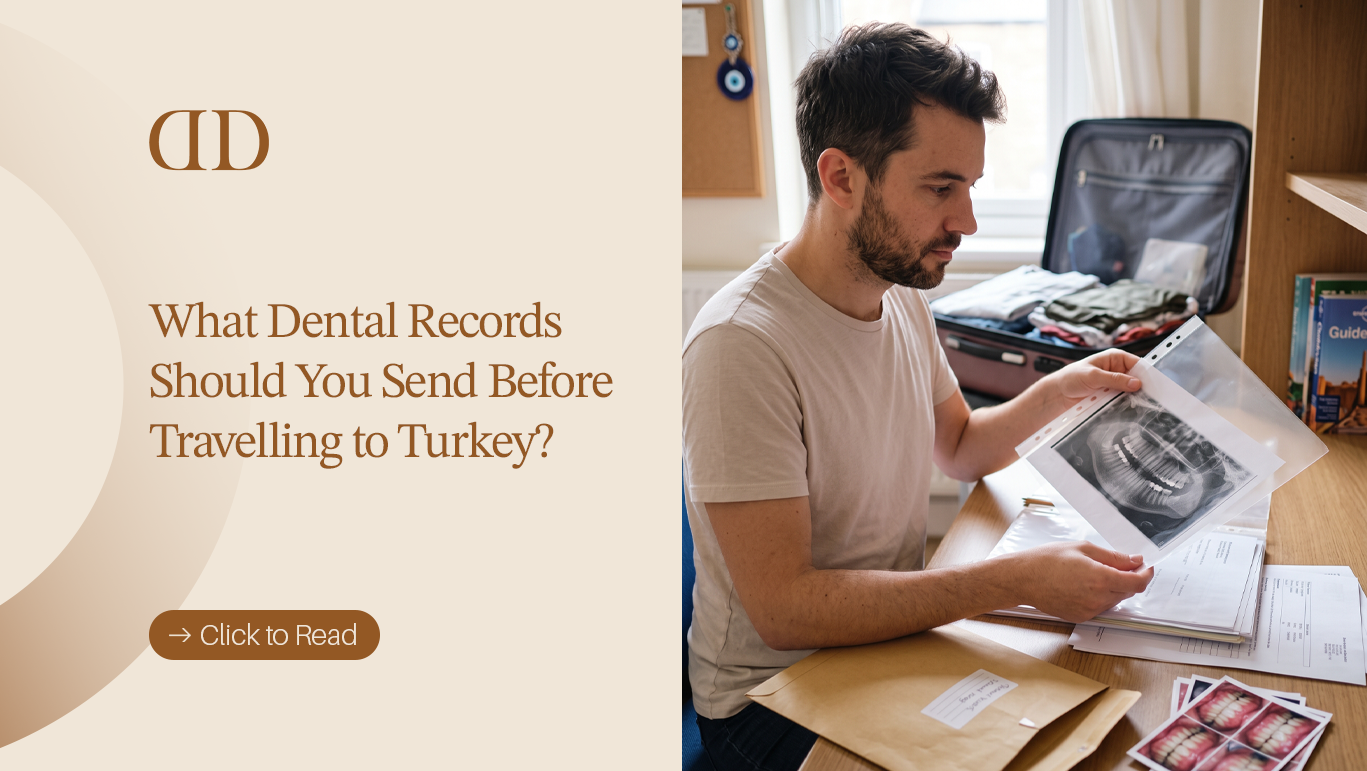

If you are travelling to Turkey for dental treatment, it is useful to send your available dental records before travelling to Turkey, especially recent X-rays, panoramic images, relevant CBCT scans, previous treatment records, dental photographs, and information about your medical history, medications, and allergies. These records can help the dental team understand your case before your arrival and prepare for an initial consultation.
The exact records needed depend on the treatment you are considering. A panoramic X-ray may be useful for some implant or restorative cases, while a CBCT scan may be relevant when three-dimensional imaging is clinically indicated. Existing records are generally preferable to having new imaging taken solely for administrative purposes. The American Dental Association recommends that dental imaging be based on individual clinical need and that existing images be considered where appropriate.
Why Should You Send Your Dental Records Before Travelling?
Sending your records in advance can make the pre-arrival consultation more useful. Instead of discussing your dental history without supporting information, the dental team may be able to review your previous records, images and photographs alongside the concerns you describe.
For international dental patients, this can help with several parts of the planning process:
- Understanding your previous dental treatment
- Reviewing available diagnostic images
- Identifying information that may still be needed
- Discussing possible treatment options
- Preparing questions for your consultation
- Planning what may need to be assessed after you arrive
- Giving you a clearer idea of how your dental consultation may proceed
It is important to understand the distinction between a preliminary remote assessment and a final clinical assessment. Records sent online can provide useful information, but they do not replace an examination of your teeth, gums, bite and overall oral condition in person. Dental X-rays alone are also not sufficient to establish a complete diagnosis or treatment plan.
For this reason, sending your records before travelling should be viewed as part of dental tourism preparation in Turkey, rather than as a substitute for an in-person dental examination.
What Dental Records Should You Send?
There is no single set of dental records for international dental patients that applies to everyone. The most useful documents depend on your treatment needs and what records you already have.
As a general checklist, consider sending:
| Record | Why it helps | When especially relevant |
| Recent dental X-rays | Provides diagnostic information that may not be visible in photographs | General assessment, restorative or dental problems |
| Panoramic X-ray (OPG) | Shows a broad view of the teeth and jaws | Implant, extraction and broader treatment assessment |
| CBCT or 3D scan | Provides three-dimensional imaging when clinically indicated | Certain implant, surgical or complex cases |
| Previous dental treatment records | Gives information about earlier procedures and findings | Patients with extensive dental history |
| Implant or restoration details | Helps identify existing treatment and materials where known | Implant, crown, bridge or veneer cases |
| Dental photographs | Shows visible tooth and smile characteristics | Cosmetic concerns and online consultation |
| Medical history | Helps the dental team understand relevant health factors | Patients with medical conditions or ongoing treatment |
| Medication and allergy information | Identifies medicines and relevant allergies | Particularly important when planning treatment |
You do not necessarily need to obtain every item on this list before contacting a clinic. If you already have records, send what is relevant and ask which additional information may be required for your particular treatment.
Premium Dental Care in Turkey
Expert treatments with high-end technology. Get your personalized quote today via WhatsApp.
Recent Dental X-Rays and Panoramic X-Rays
If you have recent dental X-rays before travelling to Turkey, include the actual image files where possible rather than sending only a written report. The image can provide information that may not be fully represented in a summary.
A panoramic X-ray, often called an OPG, provides a broad view of the teeth and jaws. Depending on the clinical situation, it may be useful when discussing multiple teeth, missing teeth, implant-related treatment or other dental concerns.

Want trusted dental advice in your Google AI answers?
Add Darya Dental Turkey as a Preferred Source on Google to make our dental guides easier to find in your search results and AI Overviews.
However, a panoramic X-ray is not automatically required for every patient. The appropriate type of dental imaging depends on the individual case and the information needed for diagnosis and treatment planning. Current ADA recommendations emphasise that dental X-rays should be selected according to clinical need rather than a universal schedule.
If you have an existing panoramic X-ray, send it with the date it was taken. If you only have an older image, it can still provide useful background information, although the dental team may determine after reviewing your case that newer imaging is needed.
CBCT or 3D Dental Scans When Relevant
A CBCT scan for dental implants in Turkey may be relevant in some cases because CBCT provides three-dimensional information about the teeth and surrounding structures. It can be useful for certain implant, surgical, endodontic or other complex assessments.
That does not mean every patient travelling to Turkey for dental treatment needs a CBCT scan before travelling.
The decision to obtain dental imaging should be based on clinical need. The ADA’s current recommendations specifically address both two-dimensional dental radiography and CBCT and emphasise selecting imaging according to the patient’s clinical circumstances.
If you already have a recent CBCT scan, you can ask the clinic whether it would be useful for the preliminary assessment. If you do not have one, do not assume that you need to arrange a new scan simply because you are travelling abroad. The treating dental professional can determine whether additional imaging is appropriate.
When sending a CBCT, ask whether the clinic wants the complete scan, a particular digital format, or selected images. A written radiology report can also be useful, but it should not automatically be treated as a substitute for the underlying imaging.
The same principle applies to other dental X-rays: existing clinically relevant records can be valuable, while unnecessary repeat imaging should be avoided.
Previous Dental Treatment Records
Your previous dental treatment records can be particularly useful if you have already had fillings, root canal treatment, extractions, implants, crowns, veneers or other restorative procedures.
If available, consider sending:
- Previous dental examination notes or treatment summaries
- Earlier X-rays or scans
- Root canal treatment records
- Implant records or implant identification details
- Information about previous crowns, bridges or veneers
- Records showing previous extractions or oral surgery
- A brief timeline of significant dental treatment
If you know the manufacturer or model of an existing dental implant, include those details. An implant passport or documentation provided after implant treatment can also be useful.
Older records should not automatically be discarded. They can provide background about previous treatment even when newer clinical information is also required. Their usefulness depends on what they show, when they were created and what treatment is now being considered.
Implant, Crown, Veneer and Root Canal Records
The type of previous treatment you have can determine which records are most useful.
For dental implants, existing implant documentation may include the implant manufacturer, implant system or other identification information. If you have this information, include it rather than trying to identify the implant yourself.
For crowns, bridges and veneers, previous treatment notes or photographs can help explain what has already been done. If you know when the restoration was placed or which teeth were treated, include that information.
For root canal treatment, previous X-rays and treatment records can provide useful background, particularly when the same tooth is being considered for further treatment.
You do not need to reconstruct your entire dental history if you do not have complete records. Send the relevant information you have and clearly indicate what is missing.
Dental and Smile Photographs
Dental photos for online consultation can complement X-rays and scans because photographs show the visible condition of the teeth and smile.
If a clinic asks for photographs, useful images may include:
- A relaxed front view of your smile
- Front teeth with the teeth together
- Upper teeth where visible
- Lower teeth where visible
- Right and left side views
- Close-up photographs of teeth that are causing concern
Take photographs in good lighting and keep the images reasonably clear and focused. Avoid heavy filters or editing.
Photographs are particularly useful for visible concerns such as chipped, discoloured, missing or uneven teeth and for discussing cosmetic objectives. They cannot, however, show everything that an X-ray, CBCT or clinical examination can reveal.
For this reason, dental photos cannot automatically replace X-rays. They are complementary sources of information, and the records needed for a preliminary assessment depend on the individual case.
What Medical Information Should You Share?
Dental treatment planning can involve information beyond your teeth and previous dental procedures. Relevant medical history for a dentist can help the dental team understand factors that may affect assessment or treatment.
You do not need to send an unrelated medical file containing every health record you have ever received. Instead, focus on information that is relevant to your dental care and tell the clinic if you are unsure whether something is important.
Current Medications and Allergies
Provide a current list of medications you take regularly, including the medication name and, where known, the dose and frequency.
Also mention known allergies, particularly medication allergies or previous reactions to dental or medical treatment.
This information should be kept up to date. If your medication changes before you travel, update the clinic rather than relying on an older record.
Relevant information can include:
- Prescription medications
- Regular over-the-counter medicines where relevant
- Known medication allergies
- Previous significant reactions to medicines or dental treatment
- Other information your treating clinician has specifically advised you to disclose
The purpose is not to determine your treatment remotely. It is to ensure that potentially relevant medical information is available when your dental care is assessed.
Relevant Medical Conditions and Previous Dental Problems
Tell the clinic about medical conditions that may be relevant to dental treatment, particularly where they affect medication use, healing, bleeding, infection risk or other aspects of clinical care.
Also describe important previous dental problems in your own words. For example, you might explain that a particular tooth has previously had root canal treatment, that an implant has been placed elsewhere, or that you have experienced recurring problems in a particular area.
If you have documentation from your doctor or dentist relating to a relevant condition, include it when appropriate.
The CDC also advises travellers receiving medical care abroad to carry copies of relevant medical records and information about their medications and medical history. Keeping your own copies can be useful during travel and when arranging follow-up care. (cdc.gov)
What If You Do Not Have Recent Dental Records?
Not having a recent dental X-ray does not necessarily prevent you from contacting a dental clinic in Turkey.
Send the records you already have and explain what is unavailable. The clinic can then tell you whether additional information would be useful before travel or whether it is more appropriate to assess the situation after you arrive.
For example, you may have:
| What you have | What it can provide | What may still be needed |
| Recent panoramic X-ray | A broad view of the teeth and jaws | Clinical examination and potentially additional imaging |
| Older X-ray | Background information about previous dental conditions | Updated assessment if clinically necessary |
| CBCT scan | 3D information from an existing examination | Assessment of whether it is still relevant to the planned treatment |
| Dental photographs only | Information about visible teeth and smile | X-rays or examination where clinically indicated |
| Previous treatment records | History of procedures and previous findings | Current clinical assessment |
| No dental records | Basic information can still be discussed | The dental team may request appropriate records or assessment |
If you have no imaging at all, do not arrange a specific X-ray or CBCT simply because a checklist says that one is required. Tell the clinic what treatment you are considering and ask what information would be appropriate for your case.
This distinction is important for international patients: records that are available can support preliminary planning, but missing records do not automatically mean that you need every possible diagnostic test before travelling.
How Should You Organise and Send Your Dental Records?
A well-organised submission makes it easier to understand your dental history and reduces the chance that an important file is overlooked.
Before sending your records, consider creating one folder containing:
- Dental X-rays and scans — preferably with the date each image was taken.
- Previous treatment records — examination notes, treatment summaries or relevant reports.
- Implant and restoration information — manufacturer or treatment details if available.
- Dental photographs — clearly labelled according to the view.
- Medical information — relevant conditions, medications and allergies.
- A short treatment summary — explain what you want to improve or what dental problem you are experiencing.
Send the Actual Image When Possible
If you have both an X-ray image and a written report, ask the clinic whether it would like both.
A report can summarise findings, while the original image may provide additional information for the clinician’s review. For scans, ask the clinic which digital format it accepts before sending large files.
Do not assume that a screenshot, compressed messaging-app image or photograph of a computer screen is equivalent to the original diagnostic file. If the clinic needs a particular format, follow its instructions.
Keep Your Own Copies
Do not send your only copy of an X-ray, scan, medical document or treatment record.
Keep a backup that you can access while travelling. The CDC recommends that medical tourists carry copies of relevant medical records, and keeping your records available can also help if you need follow-up care or treatment while abroad. (cdc.gov)
Because dental and medical records contain personal health information, use the clinic’s designated secure communication or upload method where available rather than sharing sensitive documents through an unsecured public channel.
How Should Dental Records Be Translated?
If your existing dental records are not in English, ask the clinic whether a translation is necessary before sending them.
Do not assume that every document needs professional translation. Simple records such as X-rays and photographs may communicate useful information without a translated report, while detailed clinical notes may be easier to review when the relevant findings are understandable to the treating team.
If a translation is needed, clarify:
- Which documents require translation
- Whether English is the preferred language
- Whether the original document should also be supplied
- Whether the clinic accepts translated copies
Where possible, send the original record together with the translation rather than replacing the original with a translated summary.
What Can Be Assessed Before You Travel?
A pre-arrival dental consultation can help the dental team review the information you provide and discuss possible next steps.
Depending on your records and the treatment you are considering, the preliminary assessment may help with:
- Understanding your main dental concerns
- Reviewing existing X-rays, scans and photographs
- Discussing potential treatment options
- Identifying information that may be missing
- Discussing whether an in-person examination or additional imaging may be required
- Planning the consultation after arrival
- Discussing practical aspects of your treatment visit
For international patients, this can make the pre-travel planning process more structured. Darya Dental’s consultation process also allows patients to share relevant photographs and scans for discussion before travelling.
However, a remote review has clear limitations. A dentist cannot examine your tissues, test tooth sensitivity, assess every aspect of your bite or carry out all diagnostic procedures through an online consultation. The information available before travel may therefore support preliminary treatment planning rather than constitute a final diagnosis or definitive treatment plan.
If the clinical findings after arrival differ from the information provided remotely, the treatment plan may need to be reconsidered.
What Still Needs to Be Confirmed After You Arrive?
Records sent before travelling can support an initial assessment, but some aspects of your dental care can only be confirmed after an in-person examination.
After you arrive in Turkey, the dental team may need to assess:
- Your teeth and gums clinically
- Your bite and functional relationship between the teeth
- The condition of existing restorations
- Areas that cannot be adequately assessed from photographs or existing records
- Whether additional diagnostic imaging is clinically appropriate
- Whether the proposed treatment remains suitable based on current findings
This is particularly important when treatment involves multiple teeth, implants, extensive restorative work or other complex procedures.
A preliminary assessment should therefore help you understand the possible treatment pathway, not create the expectation that every detail is fixed before your appointment.
If new clinical information becomes available during your examination, the treatment plan may be adjusted accordingly. This is a normal part of clinical decision-making and is one reason why patients should allow appropriate flexibility when planning dental treatment abroad.
Questions to Ask the Clinic Before Sending Your Records
Before sharing your dental and medical information, it is reasonable to ask the clinic how it wants the records to be submitted and what it needs for your particular case.
Useful questions include:
- Which dental records should I send for my planned treatment?
- Do you need the original X-ray or scan files, or is a report sufficient?
- Is my existing panoramic X-ray recent enough to be useful?
- If I already have a CBCT scan, which files or format should I send?
- Do you need photographs, and which views are most useful?
- Which medical conditions, medications or allergies should I include?
- Do my records need to be translated into English?
- Should I send my previous treatment records even if they are several years old?
- What information can be reviewed before I travel?
- Which parts of the treatment plan can only be confirmed after an in-person examination?
- What additional records or examinations might be requested after I arrive?
- How should I securely send documents containing personal health information?
Asking these questions can prevent unnecessary tests, incomplete submissions and confusion about what can realistically be assessed before your trip.
For the next step, you can use Darya Dental’s consultation planning information to understand how to prepare for an online consultation before travelling. You can also review the available dental treatments if you are still comparing treatment options.
If your travel arrangements are already taking shape, information about visa requirements for dental patients travelling to Turkey can be considered separately as part of your wider travel planning.
Frequently Asked Questions
What dental records should I send before travelling to Turkey?
Send the relevant records you already have, particularly recent dental X-rays or panoramic X-rays, relevant CBCT scans, previous dental treatment records, dental photographs and information about medications, allergies and relevant medical conditions. The exact records needed depend on your treatment and clinical circumstances.
Do I need to send a panoramic X-ray before travelling to Turkey?
A panoramic X-ray can be useful for some patients, but it is not universally required. Whether it is appropriate depends on the clinical question and the treatment being considered. If you already have a recent panoramic X-ray, you can ask the clinic whether it would be useful for the preliminary assessment.
Dental imaging should be based on clinical need rather than simply being obtained because a patient is travelling for treatment. Current ADA recommendations emphasise patient-specific selection of both 2-D dental radiographs and CBCT.
Should I send a CBCT scan to a dental clinic in Turkey?
If you already have a CBCT scan that is relevant to your dental problem or planned treatment, it may be useful to send it for review. You do not necessarily need to obtain a new CBCT before travelling.
CBCT provides three-dimensional information, but it involves ionising radiation. The ADA recommends that dental imaging, including CBCT, be used when there is a clear clinical benefit and according to the patient’s individual needs.
Can I send dental photos instead of X-rays?
Dental photographs can complement X-rays and scans, but they cannot automatically replace them. Photographs can show visible features such as tooth shape, colour, alignment, missing teeth and aspects of the smile, while imaging may provide information that cannot be seen in a photograph.
The records required depend on the treatment being considered and what the dental team needs to assess.
What previous dental treatment records should I provide?
Provide relevant records for previous fillings, root canal treatment, extractions, implants, crowns, bridges, veneers and other significant procedures if they are available. Previous X-rays, treatment summaries, implant documentation and restoration details can also be useful.
You do not need to have a complete historical file. Send the relevant records you have and explain what information is unavailable.
What medical information should I share with a dentist before travelling?
Share relevant medical conditions, current medications, medication allergies and significant previous reactions to medicines or dental treatment. If a condition or medication may affect dental care, it is better to disclose it rather than assume that it is unrelated.
The CDC advises travellers receiving medical care abroad to carry copies of relevant medical records and information about allergies and medications.
What if I do not have a recent dental X-ray?
You can still contact a dental clinic and explain that you do not have recent imaging. Send the records you do have and ask whether additional information is needed.
A new X-ray or CBCT should not be obtained simply to complete a checklist. Current ADA guidance recommends considering previous radiographs and basing new imaging on the patient’s individual clinical needs.
Are old dental records still useful?
Yes, old records can still provide useful background, particularly when they document previous treatment or show the history of a particular tooth. However, an older X-ray may not provide sufficient current information for a new diagnosis or treatment plan.
The dental team can determine whether an older record remains relevant and whether updated assessment or imaging is necessary.
Do my dental records need to be translated into English?
Not necessarily. Ask the clinic which documents need translation and whether it accepts records in their original language.
For detailed clinical reports, translation may make the information easier to review. If translation is required, it is generally useful to keep the original document as well as the translated version.
The CDC also notes that medical tourists may need to obtain or maintain translated copies of overseas medical records for subsequent care.
Can a dentist confirm my final treatment plan from records sent online?
Usually, records sent online can support a preliminary assessment, but they do not replace an in-person examination. The final treatment plan may depend on clinical findings, additional diagnostic information and the condition of your teeth and gums when you are examined.
For this reason, information provided before travelling should be understood as part of the consultation and planning process rather than a guarantee that every aspect of treatment will be confirmed remotely.
Before Sending Your Dental Records: A Quick Checklist
Before you send your information to a dental clinic in Turkey, check that you have:
- Recent dental X-rays, if available
- A panoramic X-ray/OPG, if you already have one
- A relevant CBCT or 3D scan, if already available
- Previous dental treatment records
- Implant or restoration information
- Clear dental and smile photographs
- A current medication list
- Information about relevant allergies
- Relevant medical history
- A short description of your dental concerns
- Dates for important X-rays, scans or previous procedures
- Original records alongside translations where applicable
- A personal backup of all important documents
Keeping your own copies is especially important when travelling for healthcare. The CDC recommends carrying copies of relevant medical records and retaining documentation of care received abroad for follow-up.
The most useful dental records before travelling to Turkey are the relevant records you already have: recent X-rays or panoramic images, applicable CBCT scans, previous treatment records, dental photographs and relevant medical information. You do not necessarily need every type of document or a new scan before travelling.
The key is to provide enough accurate information for a preliminary assessment while understanding its limitations. Additional examination or imaging may still be appropriate after you arrive, depending on your individual dental needs.
If you are considering treatment with Darya Dental Turkey, organising your records before the consultation can make the pre-arrival planning process clearer and help the dental team understand your case before your visit.
