
Hiossen vs MegaGen vs DTI: Korean Dental Implants Comparison Guide
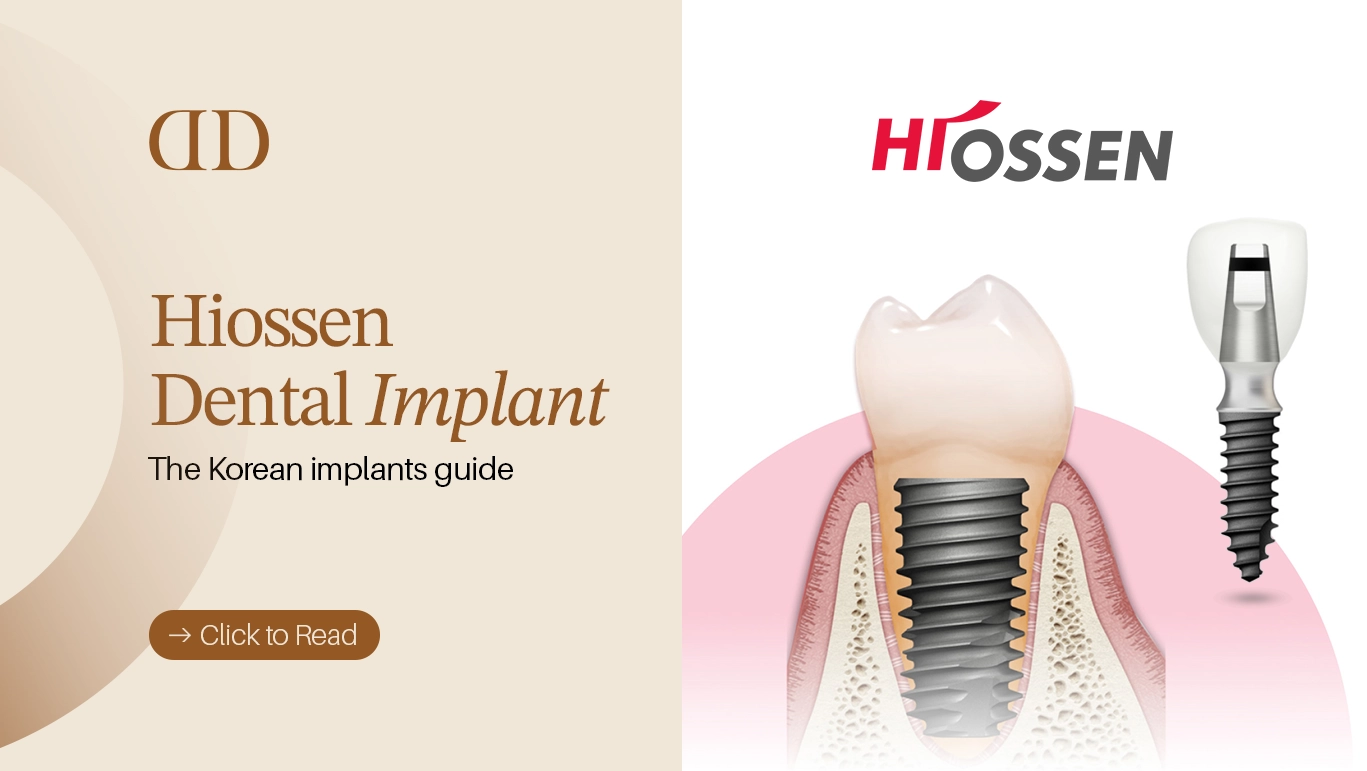

Korean dental implant systems have become established alternatives to long-standing European brands, with Hiossen, MegaGen, and other Korean manufacturers offering a range of implant designs and treatment options. However, comparing implant brands based only on price or country of origin can be misleading.
Hiossen, MegaGen, and DTI differ in product design, clinical documentation, availability, pricing, and the amount of published evidence supporting their systems. The right choice also depends on the patient’s bone quality, implant position, treatment plan, restoration, and the clinician’s experience.
This comparison focuses on the main differences between Hiossen, MegaGen, and DTI, including design characteristics, available clinical evidence, pricing considerations, and how these systems compare with premium European alternatives.
For readers comparing brand-specific systems with the broader treatment pathway, our dental implant treatment options explain candidacy, planning, costs, and restoration stages in more detail.
The Rise of Korean Dental Implants: Quality vs Reputation
How South Korea Became a Major Player
South Korea developed a significant dental implant industry during the late 1990s and 2000s. Companies such as Osstem, MegaGen, and Dentis expanded their implant portfolios and international distribution networks, helping Korean systems become more widely used in global implant dentistry. Hiossen itself was established in the United States by its parent company Osstem in 2006.
What Does the Clinical Evidence Show?
The reputation gap between European and Korean implants persists mainly because of brand awareness, not clinical outcomes. A seven-year study of Osstem implants (Hiossen’s parent company) involving 467 implants showed a 95.37% survival rate statistically comparable to premium European systems.
A comprehensive 20-year meta-analysis examining multiple implant brands found that approximately 4 out of 5 implants survive after two decades, regardless of whether they’re Swiss, German, or Korean manufactured. These findings suggest that implant outcomes should be interpreted in the context of implant design, patient factors, treatment planning, follow-up, and surgical technique rather than brand name alone.
The Implantium system (manufactured by Dentium, another Korean brand) demonstrated a 94.8% ten-year survival rate in a retrospective study of 370 implants. That’s within the expected range for any modern implant system with proper surface treatment.
Hiossen Implants: Overview, Cost, and Success Rates
What Makes Hiossen Different
Hiossen operates under the Osstem umbrella, South Korea’s largest dental implant manufacturer. The company produces multiple implant lines designed for different clinical situations, but they all share certain characteristics:
Premium Dental Care in Turkey
Expert treatments with high-end technology. Get your personalized quote today via WhatsApp.
ET (Emerging Tissue) Implant System: The flagship Hiossen line features an external hex connection and rough-surface treatment. The RBM (resorbable blasting media) surface creates microscopic texture that encourages bone cell attachment.
Design Philosophy: Hiossen implants use a tapered body design that compresses bone during placement, potentially increasing initial stability in softer bone. The threading pattern distributes biting forces across a larger bone surface area.

Want trusted dental advice in your Google AI answers?
Add Darya Dental Turkey as a Preferred Source on Google to make our dental guides easier to find in your search results and AI Overviews.
Hiossen’s current portfolio includes multiple implant systems and prosthetic components, so the exact implant model and treatment protocol matter when evaluating a case. Hiossen describes its ET systems as tapered implants designed to support primary stability across different bone conditions.
Success Rates: What The Studies Show
The more revealing data comes from longer follow-up periods. Osstem implants (Hiossen’s manufacturing parent) showed these survival rates across 467 implants:
- 1 year: 97.34%
- 2 years: 95.90%
- 7 years: 95.37%
MegaGen AnyRidge: What You Need to Know
The “Knife-Thread” Design (In Simple Terms)
MegaGen’s AnyRidge system gets attention for its distinctive thread design. Instead of standard V-shaped threads, AnyRidge uses sharp, aggressive threads that cut into bone during placement.
AnyRidge uses a distinctive knife-edge thread design intended to improve primary stability during implant placement. Clinical studies have evaluated the system in different bone conditions, including immediate loading and posterior maxillary cases.
The claimed benefit: Better initial stability in softer bone types. When bone quality is poor, aggressive threads theoretically provide more grip during the critical healing period.
The reality: Initial stability helps, but long-term success depends more on osseointegration the biological process of bone cells attaching to the implant surface. Thread design influences initial stability but doesn’t guarantee better long-term outcomes.
Does the Special Design Make a Difference?
Some clinicians report that AnyRidge implants feel more stable immediately after placement, especially in poor-quality posterior maxillary bone. But converting that anecdotal observation into measurable clinical benefit is tricky.
A multi-center study of MegaGen implants in poor-quality bone (Type IV) reported success rates above 93%, which is respectable but not dramatically superior to other systems in the same bone conditions.
The available evidence supports the clinical use of the design in selected cases, but implant thread geometry should be considered alongside bone quality, surgical technique, implant position, and overall treatment planning.
DTI Implants: The Budget-Friendly Korean Option
DTI (Dentis) Market Position
DTI represents the more cost-oriented segment of Korean implant manufacturing. The company focuses on emerging markets and cost-sensitive patients while maintaining Korean manufacturing standards.
DTI implants feature a straightforward design tapered body, internal hex connection, sandblasted and acid-etched surface. Nothing revolutionary, but solid fundamentals executed at a lower price point.
Clinical Performance
Published clinical documentation for DTI is less extensive than the evidence base available for more widely studied systems such as Hiossen and MegaGen. This does not by itself mean that DTI implants are ineffective, but it does make the depth and duration of available evidence an important consideration when comparing systems.
That doesn’t mean DTI implants fail frequently. It means the margin for error is smaller. Success depends heavily on surgeon experience and proper case selection.
The performance differences are modest. The price differences are substantial.
Hiossen vs MegaGen vs DTI
Hiossen, MegaGen, and DTI occupy different positions within the Korean implant market. The most useful comparison is not simply which brand is “best”, but how their available evidence, implant design, product positioning, and availability differ.
| Feature | Hiossen | MegaGen | DTI |
|---|---|---|---|
| Manufacturer | Hiossen / Osstem | MegaGen | Dentis |
| Country associated with brand | South Korea / US operations | South Korea | South Korea |
| Notable systems | ET, ET III and other systems | AnyRidge | Multiple implant systems |
| Design focus | Tapered implant systems and primary stability | Knife-edge thread design and primary stability | Tapered implant designs |
| Clinical documentation | Broad | Growing clinical evidence | More limited published evidence |
| Price positioning | Mid-range Korean option | Mid-range Korean option | More cost-oriented |
| Darya availability | Offered | Not currently offered | Not currently offered |
These differences do not establish that one system is universally superior. Implant selection should be based on the clinical situation, available components, evidence, clinician experience, and the overall treatment plan.
Read more: Top 10 Dental Implant Brands – Comparison and Cost Analysis
What Does the Clinical Evidence Say About Korean Implants?
The Seven-Year Osstem Study
A retrospective analysis of 467 Osstem implants (Hiossen’s parent brand) placed at Seoul National University Bundang Hospital tracked outcomes from 2003 to 2015. This wasn’t a cherry-picked study of ideal cases it included smokers, diabetics, and patients who needed bone grafting.
Key findings:
- 7-year survival rate: 95.37%
- Early failures (within 2 months): 1 implant
- First-year failures: 11 implants total
- Failures after first year: Minimal
Risk factors that increased failure rates:
- Wider diameter implants (paradoxically, because they’re often used in poor bone)
- Bone grafting procedures (not because grafting is bad, but because it indicates compromised anatomy)
- Early loading (placing crowns too soon after surgery)
The study confirmed what clinicians already suspected: Korean implants fail for the same reasons European implants fail inadequate bone, premature loading, or patient-specific complications like smoking.
The Ten-Year Implantium Study
Another Korean system (Implantium/Dentium) showed 94.8% survival at 10 years across 370 implants. Smoking and maxillary placement (upper jaw) were significant risk factors, consistent with findings from European implant studies.
The 20-Year Meta-Analysis Context
When researchers analyzed implant survival across all brands over 20 years, they found that approximately 78-92% of implants survive two decades, depending on patient compliance and follow-up quality.
The clinical conclusion: Modern implant systems, regardless of country of origin, perform similarly when fundamental principles are followed:
- Adequate bone volume and quality
- Proper surgical technique
- Appropriate healing time
- Regular maintenance visits
Brand selection is only one part of the overall treatment equation.
Korean Dental Implant Costs: What Should Patients Compare?
Implant pricing varies according to the implant system, number of implants, abutment, crown, imaging, surgical complexity, bone grafting when required, and the services included in the treatment package. For this reason, a fixture-only price should not be compared directly with an all-inclusive implant treatment price.
When comparing Hiossen, MegaGen, or other implant systems, patients should ask whether the quotation includes the implant fixture, abutment, crown, CBCT or other imaging, surgery, temporary restoration, follow-up appointments, and any additional procedures.
Which Korean Brand Does Darya Dental Use and Why?
Our Implant Philosophy
At Darya Dental Clinic Istanbul, we offer Hiossen implants as our Korean option alongside BEGO (German) and Straumann systems. We don’t offer MegaGen or DTI despite their availability in Turkey.
Why Hiossen?
Clinical track record: Hiossen has a substantial clinical and commercial history, with published evidence available for Osstem-related systems.
Osstem Group backing: Hiossen was established under Osstem and operates as part of the wider Osstem group.
Surface treatment reliability: Hiossen offers implant systems using established surface-treatment approaches.
Cost-performance balance: Hiossen provides Darya with a Korean option positioned between cost-focused and premium systems.
When We Recommend Hiossen
Hiossen may be considered when the implant system is compatible with the patient’s anatomy, treatment plan, restorative requirements, and the clinician’s preferred surgical workflow. The decision should not be based on budget alone.
When we recommend BEGO or Straumann instead:
- Immediate placement after extraction
- Significant bone grafting procedures
- Aesthetic zone (front teeth)
- Patients with compromised healing (smokers, uncontrolled diabetes)
- Patients requesting maximum-documented longevity data
We’re transparent about these recommendations because our goal isn’t pushing our most expensive option it’s matching the right solution to each patient’s situation.
Read our full guide on Straumann Dental Implants.
Frequently Asked Questions
Are Korean implants as good as Swiss implants?
Korean implant systems can provide successful clinical outcomes, but it is not accurate to treat all Korean or Swiss systems as identical. The evidence available, implant design, clinical experience, treatment planning, and patient factors all need to be considered.
Why are Korean implants cheaper?
Pricing can be influenced by manufacturing costs, distribution, brand positioning, marketing, and the services included in the treatment package. A lower price does not by itself establish lower clinical quality.
How long do Hiossen implants last?
Available clinical evidence supports multi-year survival for Osstem-related systems, but implant longevity varies according to patient factors, implant position, oral hygiene, maintenance, bone conditions, and treatment quality.
Is the thread design on MegaGen really better?
AnyRidge’s thread design is intended to provide high primary stability. Clinical studies have reported positive outcomes, but there is not enough evidence to conclude that the design is universally superior to all competing implant geometries.
Should I choose the cheapest Korean implant?
Price should not be the only selection criterion. Consider clinical evidence, the specific implant system, component availability, clinician experience, treatment plan, and long-term follow-up arrangements.
Do Korean implants feel different than European implants?
No. Once osseointegrated, all quality implants feel identical because you’re perceiving the crown and gum tissue, not the titanium fixture.
How do I know if a clinic is using genuine Korean implants?
Request the implant card with serial number and manufacturer documentation. Darya Dental provides this automatically with photographs of sealed implant packaging.
