Nobel Biocare Implants: All-on-4 Pioneer vs Modern Alternatives
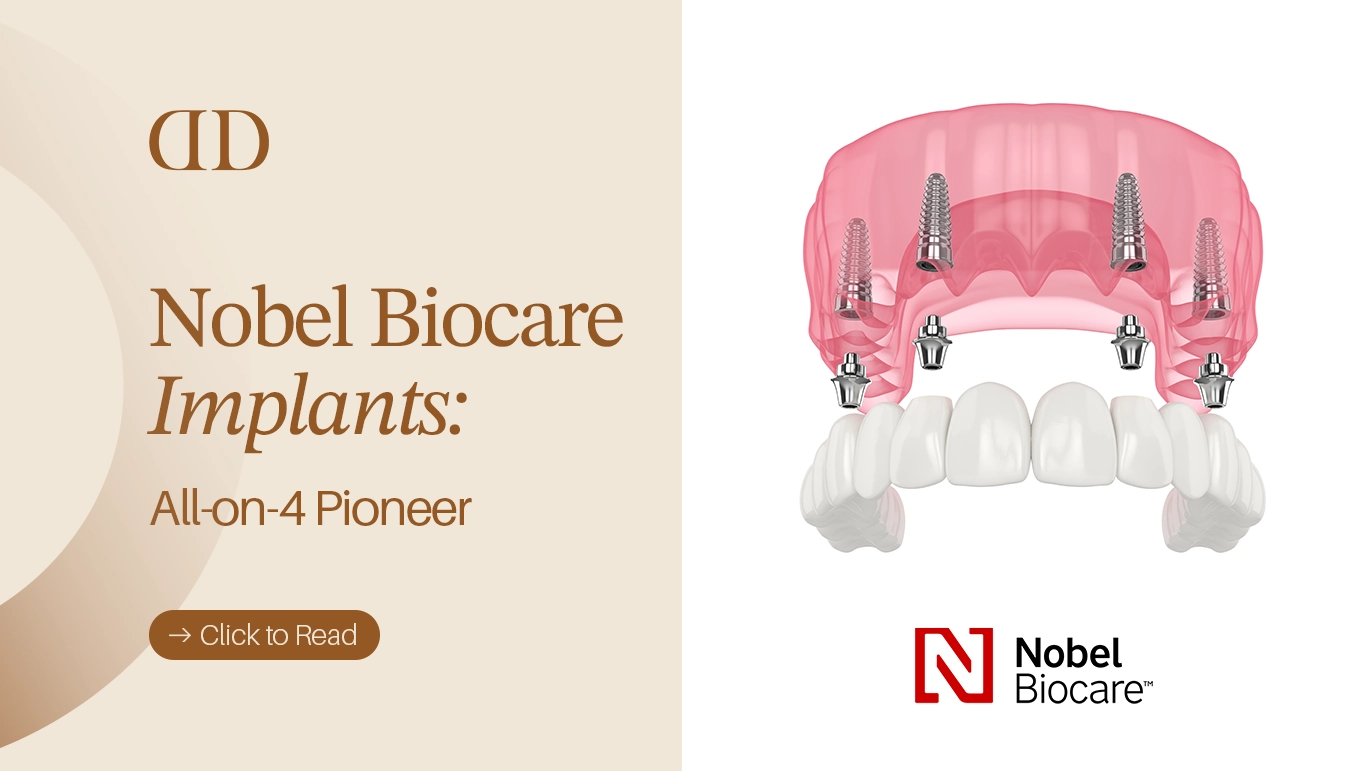

Nobel Biocare invented the All-on-4 technique in 1998 and remains the gold standard for full-arch restoration, with success rates exceeding 98% over 10 years according to longitudinal clinical studies. All-on-4 treatment costs $19,000–$30,000 per arch in the US, £12,000–£22,000 in the UK, and €2,800–€6,000 at Darya Dental Clinic in Istanbul, Turkey.
If you’re considering full-mouth dental implants, you’ve encountered Nobel Biocare. The Swedish company didn’t just participate in the implant revolution, they wrote the playbook. When Dr. Paulo Malo partnered with Nobel Biocare to develop the All-on-4 protocol in the late 1990s, he solved a problem that had plagued implant dentistry for decades: how to restore completely edentulous patients without extensive bone grafting, at a cost patients could actually afford, with predictable outcomes.
But nearly three decades later, the dental implant landscape has evolved. Straumann offers competitive full-arch solutions. Zimmer Biomet and BioHorizons have entered the premium market. Korean manufacturers promise similar outcomes at dramatically lower prices. The question facing patients in 2026 isn’t whether Nobel Biocare implants work; the clinical data settles that debate decisively; but whether the Nobel premium is still justified when alternatives exist.
This guide examines Nobel Biocare’s implant systems, the science behind their TiUnite surface technology, real-world All-on-4 success rates, and how their pricing compares globally. For patients researching dental implant brands, understanding what Nobel Biocare actually offers versus what competitors claim is essential.
Patients comparing implant brands can also review our dental implant treatment options to understand the clinical process, suitability factors, and available implant solutions.
Why Nobel Biocare Dominates Full-Arch Restorations
Nobel Biocare’s dominance in full-arch implant dentistry isn’t accidental. Three factors separate them from competitors:
1. The All-on-4 Protocol Is Theirs
Nobel Biocare doesn’t just manufacture implants suitable for full-arch restoration, they own the All-on-4 trademark and developed the surgical protocol, training curriculum, and prosthetic workflow. When a dentist completes Nobel Biocare’s All-on-4 certification, they’re learning a systematized approach refined over 25+ years across hundreds of thousands of cases.
This matters more than marketing suggests. The All-on-4 technique requires precise implant angulation (posterior implants placed at 30-45 degrees), specific AP spread (implant spacing to maximize polygonal support), and coordinated prosthetic design. Get the angles wrong by a few degrees and you compromise load distribution. Place implants too close together and you create mechanical failure risk.
Nobel Biocare provides detailed surgical guides, prosthetic conversion protocols for immediate loading, and extensive documentation on managing complications. Competitors offer “All-on-X” solutions, but most lack the comprehensive training infrastructure Nobel has built.
Premium Dental Care in Turkey
Expert treatments with high-end technology. Get your personalized quote today via WhatsApp.
2. 25 Years of All-on-4 Outcome Data
A longitudinal study published in the Journal of the American Dental Association tracked 245 patients who received 980 Nobel Biocare All-on-4 implants in the mandible. The results: cumulative patient-level success rates of 94.8% at 5 years and 93.8% with up to 10 years of follow-up. Implant-level success rates were even higher at 98.1% (5 years) and 94.8% (10 years). Prosthesis survival was 99.2% over 10 years.
These aren’t industry-sponsored promotional studies with carefully selected patients, this was real-world private practice data from a Portuguese clinic treating consecutive patients. Twenty-one implants failed in 13 patients, with most failures occurring during initial osseointegration (first 6 months).

Want trusted dental advice in your Google AI answers?
Add Darya Dental Turkey as a Preferred Source on Google to make our dental guides easier to find in your search results and AI Overviews.
Compare that track record to newer All-on-X protocols from competitors. Most have 3-5 year data at best. For a treatment that costs $20,000-$30,000 and patients expect to last 15-20 years, proven long-term outcomes matter.
3. TiUnite Surface Technology
Nobel Biocare’s TiUnite surface, created through anodic oxidation that generates a thick, porous titanium oxide layer, achieved something most implant surfaces don’t: demonstrated superiority in head-to-head clinical trials.
A systematic review and meta-analysis examining 106 peer-reviewed studies on TiUnite implants evaluated data from 12,803 implants in 4,694 patients. Key findings published in Dental Tribune: early implant survival exceeded 99% at one year, late survival was 95.1% at ten years, and peri-implantitis rates were remarkably low at just 1.36% across all patients. The review showed marginal bone level changes of only -0.4mm at one year and -0.9mm at five years.
TiUnite’s thick oxide layer (several micrometers versus nanometers for most surfaces) creates a highly crystalline structure with significantly greater surface area for bone integration. This isn’t just theoretical chemistry, it translates to faster osseointegration and more predictable outcomes in compromised bone.
All-on-4 vs All-on-6: Which Nobel Protocol Is Right for You?
Nobel Biocare offers two primary full-arch protocols. Understanding the distinction helps determine which your situation requires.
All-on-4: The Original Protocol
What it is: Four implants per arch, two straight anterior implants and two posterior implants placed at 30-45 degree angles to avoid the maxillary sinuses (upper jaw) or mental nerve (lower jaw).
Bone requirements: Designed specifically for patients with moderate to severe bone loss who want to avoid grafting. Minimum bone height: 10mm in the posterior maxilla, 8mm in the mandible.
Advantages:
- Avoids sinus lifts and grafting in most cases
- Lower cost (fewer implants)
- Shorter surgery time
- Immediate loading protocol well-established
Limitations:
- Less implant surface area supporting prosthesis (higher load per implant)
- Angled posterior implants create complex prosthetic mechanics
- Not ideal for patients with very tall prosthetic teeth (requires more retention)
Cost at Darya Dental Istanbul: €2,800–€4,500 per arch (complete treatment including temporary and final prosthetic)
All-on-6: Enhanced Stability Protocol
What it is: Six implants per arch, typically four anterior straight implants and two posterior at angles, or six straight implants if bone volume allows.
Bone requirements: Requires better bone quality/quantity than All-on-4. May still avoid grafting, but needs sufficient bone for six implant sites.
Advantages:
- Better load distribution (lower stress per implant)
- More retention for the prosthetic
- Reduced mechanical complications long-term
- Allows for implant failure without prosthesis compromise (5 remaining implants still sufficient)
Limitations:
- Higher cost
- Longer surgery
- May require grafting if bone insufficient for six implants
- Less extensive training infrastructure than All-on-4
Cost at Darya Dental Istanbul: €4,200–€6,000 per arch
When All-on-6 makes sense: Heavy bruxers (teeth grinders), patients with very tall prosthetic teeth, those wanting maximum long-term security, or cases where bone quality is borderline.
When All-on-4 is sufficient: Standard anatomy, moderate bone loss, cost-conscious patients, or those wanting fastest treatment timeline.
Most patients are appropriate candidates for All-on-4. The protocol was specifically designed for typical bone loss scenarios in edentulous patients. All-on-6 is an upgrade for specific clinical situations, not a necessity for everyone.
Nobel Biocare Implant Lines: NobelActive, NobelParallel, NobelReplace
Nobel Biocare doesn’t make “one implant.” Understanding which system your dentist recommends; and why; affects your long-term outcome.
NobelActive: The Versatile Workhorse
Design philosophy: Aggressive thread design with platform-switching connection, optimized for immediate placement and challenging bone.
Key features:
- Dual-function design (cutting apex can be used for under-preparation technique)
- Excellent primary stability even in soft bone (Type III/IV)
- Tapered body mimics natural tooth root shape
- Built-in platform switching reduces crestal bone loss
Best for: Immediate extraction-site placement, compromised bone quality, immediate loading protocols, aesthetic zone (front teeth).
Why it’s preferred for All-on-4: The aggressive threads and tapered design allow for the angled posterior placement All-on-4 requires, achieving high primary stability in less-than-ideal bone.
NobelParallel: The Straight-Wall Classic
Design philosophy: Cylindrical body with parallel walls, designed for maximum surface contact in good bone.
Key features:
- Straight walls provide maximum bone-to-implant contact
- Internal tri-channel connection (very strong abutment retention)
- Available in wide range of diameters (3.3mm to 6.0mm)
- Requires precise drilling; less forgiving than NobelActive
Best for: Dense bone (Type I/II), posterior regions with good bone volume, situations requiring maximum initial stability.
When it’s used in All-on-4: Primarily for the straight anterior implants when bone quality is excellent. Most All-on-4 cases use NobelActive for consistency.
NobelReplace: The Predecessor Platform
Design philosophy: External hex connection, the original Nobel Biocare replacement-tooth implant design.
Current status: Being phased out in favor of NobelActive and NobelParallel. Still widely used globally due to extensive component library and clinician familiarity.
Best for: Practitioners with extensive NobelReplace experience, situations requiring specific legacy components.
All-on-4 relevance: Older All-on-4 cases used NobelReplace. Current protocols favor NobelActive almost exclusively.
For All-on-4 specifically, NobelActive is the gold standard — its design characteristics align perfectly with the protocol’s requirements for angled placement and immediate loading in compromised bone.
TiUnite Surface: How It Differs from SLActive
Both Nobel Biocare’s TiUnite and Straumann’s SLActive represent premium implant surface technologies. Understanding the distinction helps explain performance differences and cost variations.
TiUnite: Anodic Oxidation Approach
Manufacturing process: Titanium implants are placed in an electrolyte solution and exposed to high voltage, causing anodic oxidation. This creates a thick titanium oxide layer (several micrometers) with a highly crystalline structure.
Surface characteristics:
- Thickness: ~2-4 micrometers of oxide
- Phosphorus incorporation (improves bone bonding)
- Moderately hydrophilic (water contact angle ~55-70°)
- High crystallinity (more stable oxide structure)
Osseointegration timeline: 6-8 weeks for predictable loading in standard bone, 8-12 weeks in compromised bone.
Clinical advantage: The thick oxide layer is highly resistant to bacterial colonization and shows superior performance in diabetic patients and smokers compared to conventional SLA surfaces.
SLActive: Hydrophilic Surface Modification
Manufacturing process: Standard SLA (sandblasted, large-grit, acid-etched) surface processed in nitrogen-protected atmosphere, then stored in saline to maintain chemical reactivity.
Surface characteristics:
- Thickness: Nanometer-scale texture on titanium
- Superhydrophilic (water contact angle <5°)
- Chemically reactive hydroxyl groups
- Must be protected from air exposure
Osseointegration timeline: 3-4 weeks for early loading in most cases.
Clinical advantage: Accelerated bone formation, achieves in 3-4 weeks what conventional surfaces need 8-12 weeks to accomplish.
Head-to-Head: Which Surface Is Better?
For single implants and small restorations where faster healing matters: SLActive’s accelerated osseointegration (3-4 weeks vs 6-8 weeks) provides real value. Patients can receive final crowns sooner.
For All-on-4 and full-arch cases: Both surfaces perform excellently with immediate loading protocols. TiUnite’s extensive clinical documentation in full-arch applications (25+ years) and superior bacterial resistance give it a slight edge.
For compromised patients (diabetics, smokers, osteoporosis): TiUnite’s thick oxide layer shows better performance in published studies, though SLActive’s superhydrophilic properties also demonstrate benefits.
The honest answer: Both are exceptional surfaces with >98% long-term success rates. The “better” choice depends on specific clinical circumstances and which system your surgeon has the most experience using. A Nobel Biocare All-on-4 specialist will achieve better results with TiUnite than with SLActive simply due to system familiarity. The inverse is true for Straumann specialists.
For comprehensive comparison of Straumann’s technology and pricing, see our detailed Straumann implants guide.
Nobel Biocare Cost Analysis: US vs UK vs Turkey
Let’s examine real numbers. Full-arch restoration pricing varies dramatically depending on location, implant count, and what’s included in quoted costs.
All-on-4 Single Arch Pricing
| Location | Treatment Cost | What’s Included |
|---|---|---|
| United States | $19,000–$30,000 | Implants + surgery + temporary prosthetic + final prosthetic (acrylic or basic composite) |
| United Kingdom | £12,000–£22,000 | Implants + surgery + temporary prosthetic + final prosthetic |
| Turkey (Darya Dental) | €2,800–€4,500 | Implants + surgery + temporary prosthetic + final zirconia hybrid prosthetic + 5-night hotel + VIP transfers + warranty |
Why the dramatic price difference?
It’s not implant quality; Darya Dental uses genuine Nobel Biocare NobelActive implants, the same products used in New York or London. The cost differential reflects:
- Labor costs: An oral surgeon in Istanbul earns €30,000-€50,000 annually versus $200,000-$400,000 in the US
- Dental lab fees: A zirconia prosthetic fabricated in Istanbul costs €800-€1,500 versus $5,000-$8,000 in the US
- Clinic overhead: Rent, utilities, and administrative costs are 60-70% lower in Turkey
- Market competition: Istanbul has over 300 dental tourism clinics competing for international patients
The implant itself represents only 15-20% of total treatment cost. The majority is labor and laboratory work, which is where geographic arbitrage creates dramatic savings.
All-on-6 Full Arch Pricing
| Location | Treatment Cost | What’s Included |
|---|---|---|
| United States | $24,000–$38,000 | Implants + surgery + temporary + final prosthetic |
| United Kingdom | £16,000–£28,000 | Implants + surgery + temporary + final prosthetic |
| Turkey (Darya Dental) | €4,200–€6,000 | Implants + surgery + temporary + final zirconia prosthetic + accommodation + transfers |
Upper + Lower Full Mouth (Both Arches)
| Location | Treatment Cost | Notes |
|---|---|---|
| United States | $38,000–$60,000 | Total for both arches, All-on-4 protocol |
| United Kingdom | £24,000–£44,000 | Total for both arches, All-on-4 protocol |
| Turkey (Darya Dental) | €5,600–€9,000 | Total for both arches, All-on-4 protocol, includes all accommodation and transfers |
For context on even more affordable implant options, see our analysis of budget implant providers offering $399 implants and how they compare to premium brands like Nobel Biocare.
Nobel Biocare vs Zimmer Biomet vs BioHorizons
When comparing premium full-arch implant systems, three brands dominate: Nobel Biocare, Zimmer Biomet (Trefoil system), and BioHorizons. Here’s an objective comparison:
| Feature | Nobel Biocare All-on-4 | Zimmer Biomet Trefoil | BioHorizons Teeth-in-a-Day |
|---|---|---|---|
| Primary Innovation | Angled implant placement to avoid anatomy | Pre-manufactured titanium bar for mandible only | Laser-Lok surface technology |
| Best Use Case | Both arches, any anatomy | Mandible only (lower jaw) | Maxilla preferred (upper jaw) |
| Prosthetic Approach | Custom prosthetic per patient | Standardized bar system | Custom prosthetic per patient |
| Surgical Flexibility | High (dentist determines implant positions) | Low (fixed implant positions) | Moderate |
| Training/Certification | Extensive (3-5 day courses) | Moderate (2-day course) | Moderate (2-3 day courses) |
| Long-term Data | 25+ years, tens of thousands of cases | ~8 years, limited case data | ~15 years, moderate case data |
| Cost (at Darya Dental) | €2,800–€4,500 per arch | €3,200–€4,800 (mandible only) | €3,000–€5,000 per arch |
| Implant Success Rate (10-year) | 94.8% (published data) | No 10-year data available | 92-96% (limited published data) |
Bottom line: Nobel Biocare’s extensive clinical documentation, comprehensive training, and true upper/lower arch capability make it the safest choice for most full-arch cases. Zimmer Trefoil offers a streamlined approach for lower jaw only, but limited flexibility. BioHorizons provides a solid alternative with competitive pricing and good short-to-medium term data.
For patients, the critical question isn’t which brand is “best” in abstract terms — it’s which system your surgeon has the most experience using. A Zimmer Trefoil specialist will achieve better results with that system than an inexperienced surgeon using Nobel Biocare, despite Nobel’s superior data. Choose your surgeon first, implant brand second.
Real Patient Results: Nobel All-on-4 at Darya Dental
Case Study 1: Patricia S., 61, Manchester
Situation: Complete upper and lower denture wearer for 12 years. Severe bone loss in both arches. Wanted fixed teeth but was told in UK she needed extensive bone grafting (estimated £45,000 total treatment cost, 18-month timeline).
Treatment at Darya Dental: All-on-4 both arches using Nobel Biocare NobelActive implants. No bone grafting required. Immediate temporary prosthetics placed same day as surgery. Final zirconia prosthetics delivered after 4 months.
Timeline: Two trips to Istanbul (initial surgery/7 days, final prosthetics/5 days).
Cost: €8,200 total (both arches, including flights, accommodation, all dental treatment) UK quote: £45,000
Case Study 2: David M., 58, Chicago
Situation: Upper arch with multiple failing implants from previous treatment. Chronic infections, bone loss, and failing bridge on inadequate implants.
Treatment at Darya Dental: Removal of 6 failed implants, immediate placement of 4 Nobel Biocare All-on-4 implants in healed sites, immediate temporary prosthetic. Final prosthetic after 5 months.
Timeline: One extended trip (14 days including recovery), second trip for final prosthetic (6 days).
Cost: USD $6,800 (including all flights, hotels, treatment) Chicago quote: $32,000 for same treatment
Case Study 3: Mohammed A., 52, Dubai
Situation: Lower jaw completely edentulous, upper jaw with failing teeth requiring extraction. Type 2 diabetic (controlled). Previous dentist suggested waiting 6 months after extractions before implants.
Treatment at Darya Dental: All teeth extracted, immediate All-on-4 placement both arches using Nobel Biocare NobelActive (chosen specifically for TiUnite surface’s performance in diabetics), immediate temporaries placed within 2 hours of surgery.
Timeline: Single trip (10 days), return for final prosthetics after 5 months (7 days).
Cost: €9,500 (both arches) Dubai quote: approximately AED 180,000 (USD $49,000)
For patients researching whether Turkey is safe for dental tourism, these case studies demonstrate the real-world outcomes achievable with proper planning and qualified surgeons.
FAQ: Nobel Biocare All-on-4 Implants — Direct Answers
How much does Nobel Biocare All-on-4 cost?
Nobel Biocare All-on-4 treatment costs $19,000–$30,000 per arch in the US, £12,000–£22,000 in the UK, and €2,800–€4,500 per arch at Darya Dental Clinic in Istanbul, Turkey. US and UK pricing typically covers implants, surgery, and prosthetics. Turkey pricing includes those plus accommodation, VIP transfers, and lifetime warranty on implants.
What is the success rate of Nobel Biocare All-on-4?
Clinical studies show Nobel Biocare All-on-4 achieves patient-level success rates of 94.8% at 5 years and 93.8% at 10 years. Implant-level success rates are 98.1% at 5 years and 94.8% at 10 years. Prosthesis survival is 99.2% over 10 years. Most failures occur during initial osseointegration in the first 6 months.
Is Nobel Biocare better than Straumann for full-arch implants?
Nobel Biocare invented All-on-4 and has 25+ years of specific full-arch clinical data with systematic training protocols. Straumann offers excellent implants with faster-healing SLActive surfaces but less comprehensive full-arch training infrastructure. For full-arch restoration specifically, Nobel Biocare’s extensive documentation and specialized training give them an advantage. For single implants, both brands are equally excellent. See our detailed Straumann comparison for specifics.
What is TiUnite surface technology?
TiUnite is Nobel Biocare’s proprietary implant surface created through anodic oxidation, which generates a 2-4 micrometer thick titanium oxide layer with phosphorus incorporation. This creates a highly crystalline, moderately hydrophilic surface with superior resistance to bacterial colonization. Clinical studies show osseointegration in 6-8 weeks, with 95.1% survival at 10 years and peri-implantitis rates of just 1.36%.
Can All-on-4 be done in one day?
Yes, Nobel Biocare All-on-4 is designed for immediate loading. Surgery and temporary prosthetic placement occur the same day. You leave with fixed teeth that allow immediate function (though soft diet recommended for 6-8 weeks). The final prosthetic is placed 4-6 months later after complete osseointegration. Total treatment requires two visits spaced 4-6 months apart.
Why is All-on-4 cheaper in Turkey?
Turkey’s lower labor costs (surgeons earn 70-80% less than US counterparts), dental laboratory fees (60-70% lower), clinic overhead expenses, and competitive dental tourism market create dramatic cost savings. The implants themselves are identical — Nobel Biocare NobelActive implants manufactured in Sweden and distributed globally. The treatment protocol and surgical expertise are equivalent to high-quality Western clinics. The cost difference is purely geographic economic factors, not quality.
Is All-on-4 better than All-on-6?
All-on-4 is sufficient for most patients and specifically designed for moderate to severe bone loss. All-on-6 provides better load distribution (lower stress per implant) and is recommended for heavy bruxers, very tall prosthetic teeth, or patients wanting maximum long-term security. All-on-6 costs €1,400-€1,500 more per arch. For standard anatomy and bone loss patterns, All-on-4 delivers excellent 10-year outcomes at lower cost.
Do Nobel Biocare implants work for diabetics?
Yes, Nobel Biocare’s TiUnite surface specifically demonstrates superior performance in diabetic patients compared to conventional surfaces. The thick crystalline oxide layer resists bacterial colonization and promotes bone integration even in compromised healing conditions. Controlled diabetes (HbA1c <7.5%) shows success rates comparable to non-diabetics. Uncontrolled diabetes increases failure risk regardless of implant brand.
How long do Nobel Biocare All-on-4 implants last?
Clinical data shows 93.8% of patients retain functional All-on-4 implants at 10 years. The titanium implant fixtures can last 20-30+ years with proper care. The prosthetic teeth (zirconia or acrylic) typically need replacement or refurbishment every 10-15 years due to normal wear, but this is routine maintenance, not implant failure. With good oral hygiene and regular professional maintenance, the implant foundations should last a lifetime.
