What Are the Pros and Cons of E-Max Veneers?
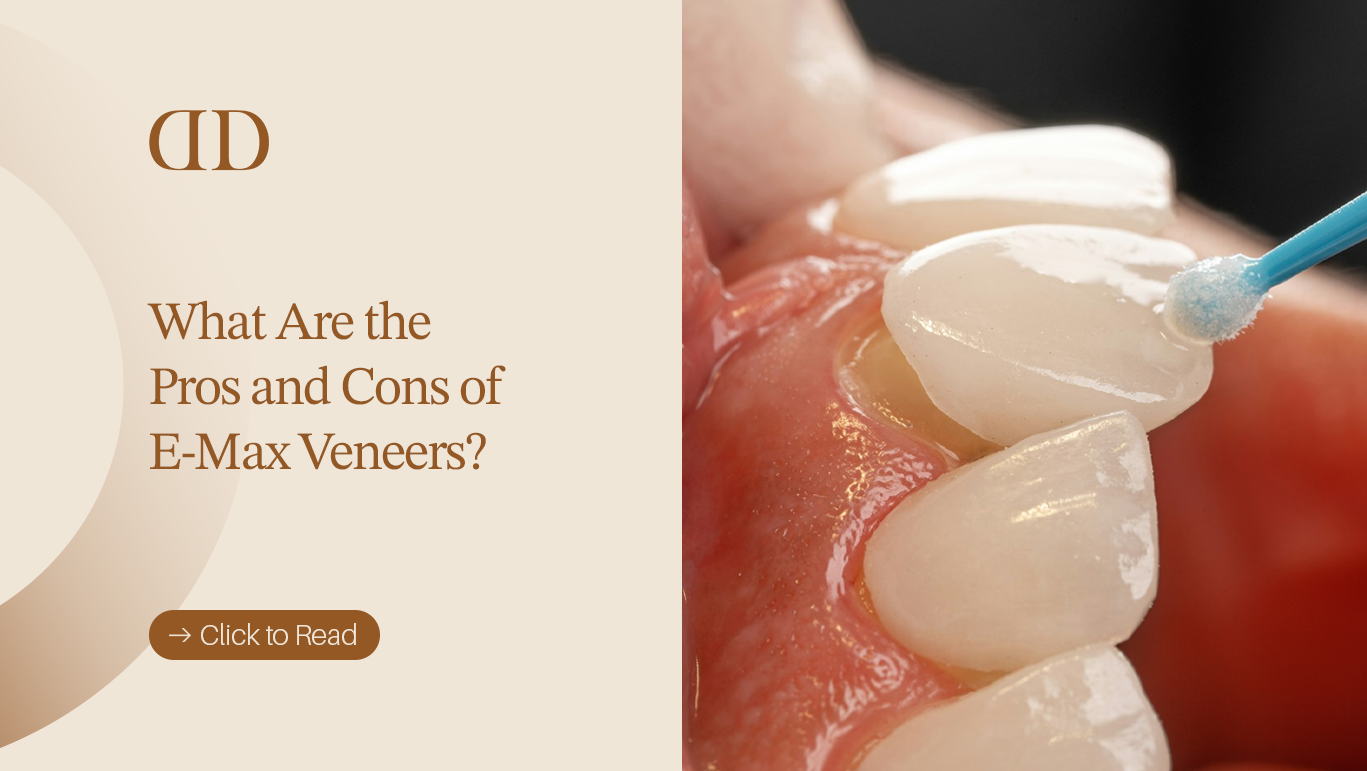

E-Max veneers are valued for their natural appearance, strength and conservative preparation, but they are not suitable for every patient. Made from lithium disilicate glass-ceramic, E-Max veneers can provide an attractive balance between aesthetics and function when the teeth, enamel, bite and treatment goals are appropriate.
The main advantages of E-Max veneers include high aesthetic potential, good strength, resistance to surface staining and the ability to preserve more natural tooth structure in appropriately planned cases. However, they also have limitations. Treatment usually involves some degree of tooth preparation, veneers are not simply interchangeable between patients, and problems such as severe discoloration, heavy bruxism or insufficient enamel can affect whether E-Max is the right choice.
The important question is therefore not simply whether E-Max veneers are good. It is whether their advantages match your particular dental condition and treatment objectives.
What Are E-Max Veneers?
E-Max veneers are ceramic dental veneers commonly made from lithium disilicate glass-ceramic. The material is known for its combination of optical properties and mechanical strength, making it suitable for many anterior aesthetic restorations.
Unlike the generic term “porcelain veneer,” E-Max refers to a specific lithium disilicate material system. Porcelain is a broader category that includes different ceramic materials with different properties.
E-Max veneers are bonded to the visible surfaces of teeth to alter their colour, shape, size or proportions. They may be considered for concerns such as discolouration, minor chips, small gaps and shape irregularities.
An important distinction is that an E-Max veneer is not the same restoration as an E-Max crown. Although lithium disilicate can be used for both, a crown covers substantially more of the tooth and generally requires a different level of tooth reduction and structural assessment.
The suitability of E-Max veneers depends on factors such as:
- The amount and condition of remaining enamel
- The existing tooth colour
- The shape and position of the teeth
- The patient’s bite and occlusion
- Signs of bruxism or excessive loading
- The desired aesthetic result
- The amount of tooth preparation required
- The condition of existing restorations
For patients comparing different veneer materials, the different types of veneers can provide additional context about how ceramic and composite options differ.
Premium Dental Care in Turkey
Expert treatments with high-end technology. Get your personalized quote today via WhatsApp.
What Are the Main Advantages of E-Max Veneers?
E-Max veneers have several characteristics that can make them attractive for carefully selected cases. However, each advantage has to be considered in relation to the patient’s individual dental condition.
Natural-Looking Aesthetics
One of the most important advantages of E-Max veneers is their aesthetic potential.

Want trusted dental advice in your Google AI answers?
Add Darya Dental Turkey as a Preferred Source on Google to make our dental guides easier to find in your search results and AI Overviews.
Lithium disilicate can provide a combination of translucency, light transmission and colour characteristics that can closely resemble natural tooth structure when the restoration is appropriately designed.
This can be particularly relevant for patients who want veneers that look natural rather than excessively opaque.
However, translucency is not automatically an advantage in every situation. A highly translucent ceramic may make it more difficult to completely mask a severely discoloured underlying tooth. The final shade therefore depends not only on the veneer material but also on the underlying tooth colour, ceramic thickness, preparation and shade selection.
This is an important example of why a material characteristic should not be considered independently from the clinical situation.
Strong and Durable Ceramic
E-Max veneers are made from lithium disilicate, a ceramic material with good mechanical properties for many veneer applications.
Clinical evidence supports the long-term use of lithium disilicate laminate veneers, although survival depends on more than material strength alone. A systematic review and meta-analysis published in 2025 reported a pooled survival rate of 96.81% at 10.4 years for lithium disilicate laminate veneers. Clinical technique, case selection, bonding, occlusion and maintenance remain important factors when interpreting long-term results.
This means that saying E-Max veneers “cannot break” would be inaccurate. Ceramic restorations can still chip or fracture when exposed to excessive forces or unfavourable conditions.
The practical advantage is that lithium disilicate provides a strong ceramic option for appropriately selected veneer cases, not that the material eliminates mechanical risk.
Conservative Tooth Preparation
Another potential advantage is the possibility of conservative tooth preparation.
Depending on the tooth condition, aesthetic objective and restorative design, an E-Max veneer may require relatively limited removal of natural tooth structure compared with a full-coverage crown.
Preserving enamel can also be important for adhesive bonding. The amount and quality of remaining enamel are therefore relevant when assessing veneer suitability.
However, “conservative preparation” does not mean “no preparation.” Some patients may require more tooth reduction than others because of tooth position, existing restorations, colour changes, shape or the thickness required to achieve the planned result.
The preparation should therefore be based on the actual tooth anatomy and restorative plan rather than a fixed reduction amount applied to every patient.
Resistance to Surface Staining
The ceramic surface of an E-Max veneer is relatively resistant to the type of staining commonly associated with porous or rough surfaces.
This can help maintain the appearance of the restoration over time when appropriate oral hygiene and professional maintenance are followed.
However, stain resistance does not mean that the entire smile will remain completely unchanged. Natural teeth can change colour over time, and staining can occur around restoration margins if oral hygiene is inadequate.
For this reason, the long-term appearance of a veneer should be considered as part of the overall dentition rather than as an isolated ceramic surface.
Predictable Adhesive Bonding
The success of a veneer depends partly on how well it is bonded to the tooth.
When adequate enamel is available and an appropriate adhesive protocol is followed, bonding can provide a strong connection between the ceramic restoration and the tooth structure.
This is another reason why enamel preservation and preparation planning matter. A veneer material cannot compensate for every limitation in the underlying tooth or bonding environment.
The quality of the final result therefore depends on a combination of material selection, tooth preparation, bonding protocol, occlusion and laboratory design.
What Are the Disadvantages of E-Max Veneers?
The disadvantages of E-Max veneers become more important when the patient’s dental condition does not match the characteristics of the material.
The Treatment Is Not Reversible
E-Max veneers should not automatically be described as reversible.
Because veneer placement may involve removal of some natural tooth structure, even conservative preparation can permanently alter the tooth. Once enamel has been prepared for a veneer, returning the tooth to its original untreated condition may not be possible.
This is why patients should understand the treatment before proceeding rather than viewing veneers as a temporary cosmetic accessory.
The extent of preparation varies according to the individual case. Some cases can be treated conservatively, while others require more preparation to achieve the planned aesthetic and functional result.
E-Max Veneers Can Still Chip or Fracture
Although lithium disilicate is a strong ceramic, E-Max veneers are not fracture-proof.
Chipping or fracture can occur as a result of excessive biting forces, unfavourable occlusion, trauma, inadequate design or other clinical factors. Bruxism can increase the mechanical demands placed on veneers.
This does not mean that patients with signs of grinding can never receive veneers. Instead, the bite and loading pattern need to be considered when selecting treatment and planning long-term protection.
If a veneer fractures, repair may not always provide an appropriate long-term solution. In some situations, replacement may be necessary.
They May Not Be Ideal for Severe Discoloration
The translucency that contributes to the natural appearance of E-Max can become a limitation when the underlying tooth is severely discoloured.
A very dark substrate may remain visible through a highly translucent ceramic, depending on the veneer thickness, shade, preparation and laboratory design.
This does not mean E-Max can never be used for a discoloured tooth. It means that masking requirements should be assessed before the material and final shade are selected.
In cases involving severe discoloration, another restorative strategy or a different ceramic design may provide more predictable masking.
They May Not Suit Heavy Bruxism
Bruxism can change the risk profile of veneer treatment.
Repeated clenching or grinding can expose ceramic restorations to forces that exceed normal functional loading. Patients with heavy bruxism may therefore require a more careful assessment of occlusion, tooth wear, restoration design and protective measures.
The presence of bruxism does not automatically determine that E-Max veneers are impossible. The important issue is whether the loading pattern can be appropriately managed and whether the expected benefits justify the potential mechanical risks.
The Initial Cost Can Be Higher Than Composite Veneers
E-Max veneers can have a higher initial cost than composite veneers because they involve a laboratory-fabricated ceramic restoration and a more complex restorative process.
However, cost should not be evaluated independently from material properties, expected maintenance, treatment planning and longevity.
A lower initial price does not automatically mean a restoration is more suitable, just as a higher price does not automatically mean a material is better for every patient.
The relevant question is whether the selected material is appropriate for the patient’s dental condition and expected outcome.
Who May Be a Good Candidate for E-Max Veneers?
A good candidate for E-Max veneers is generally someone whose teeth and treatment objectives are compatible with the characteristics of lithium disilicate ceramic.
Potentially suitable cases may include patients who have:
- Minor chips or shape irregularities
- Certain types of tooth discolouration
- Small gaps between teeth
- Aesthetic concerns involving tooth proportions or appearance
- Adequate tooth structure and enamel for predictable bonding
- A bite that does not place excessive stress on the restorations
- Realistic expectations about what veneers can achieve
Suitability cannot be determined from tooth colour or appearance alone.
A clinical assessment should consider enamel availability, tooth position, existing restorations, occlusion, signs of bruxism and the amount of correction required.
A patient who appears to be an ideal candidate from an aesthetic perspective may still require a different approach if there is insufficient enamel, severe tooth damage or significant functional loading.
When Might Another Veneer or Restoration Be More Appropriate?
E-Max is one material option rather than a universal solution. Another veneer material or restoration may be more appropriate depending on the patient’s priorities and dental condition.
E-Max vs Zirconia
E-Max and zirconia have different material characteristics.
E-Max is often valued for its optical qualities and natural-looking translucency, while zirconia can provide different strength and masking characteristics depending on the specific material and design.
Zirconia is therefore not automatically “better” than E-Max, and E-Max is not automatically “better” than zirconia.
The choice depends on factors such as aesthetics, tooth colour, location, functional demands, available tooth structure and the restorative design.
Patients who want a broader comparison can review E-Max vs other dental veneers for additional information.
E-Max vs Composite
Composite veneers are generally different from laboratory-fabricated ceramic veneers in terms of material, fabrication method, surface characteristics and maintenance considerations.
Composite can be useful in selected cases where a more conservative or different restorative approach is appropriate. E-Max may be considered when ceramic aesthetics and long-term material stability are important priorities.
Neither material should be considered universally superior. The appropriate choice depends on the clinical situation and the patient’s treatment objectives.
E-Max vs No-Prep Veneers
“No-prep” and “minimal preparation” should not be treated as interchangeable terms.
No-prep veneers aim to place a restoration with little or no intentional removal of tooth structure, but this approach is not appropriate for every tooth shape or position.
Minimal preparation means that some tooth reduction may still be required while preserving as much healthy structure as reasonably possible.
The correct approach depends on tooth anatomy, alignment, restorative thickness and the desired final appearance.
Are E-Max Veneers Worth It?
E-Max veneers may be worth considering when their aesthetic and functional advantages align with the patient’s dental condition.
Their value is not simply determined by their material name or initial cost. A suitable case, adequate enamel, appropriate preparation, reliable bonding, careful shade selection and proper occlusal planning all contribute to the long-term outcome.
Clinical evidence supports the durability of lithium disilicate laminate veneers, but survival statistics should not be interpreted as a guarantee for an individual patient.
The most useful way to evaluate whether E-Max veneers are worth the investment is to consider:
- Whether veneers are clinically appropriate for the teeth
- How much natural tooth structure can be preserved
- Whether the underlying colour can be adequately managed
- Whether the bite creates excessive loading
- Whether the desired aesthetic result is realistic
- What maintenance and future replacement may involve
- Whether another restorative material would better match the clinical requirements
For additional information about veneer longevity, see How Long Do Veneers Last?.
How Should You Weigh the Pros and Cons Before Treatment?
The most useful approach is to evaluate each advantage against the clinical situation in which it matters.
| E-Max characteristic | Potential advantage | When it may become a limitation |
| High translucency | Natural-looking appearance | May make severe underlying discoloration harder to mask |
| Lithium disilicate strength | Suitable strength for many veneer cases | Does not eliminate fracture risk, particularly under excessive loading |
| Conservative preparation | Can help preserve natural tooth structure | The same preparation cannot be used for every patient |
| Ceramic surface | Good resistance to surface staining | Natural teeth and surrounding structures can still change colour |
| Adhesive bonding | Can provide strong attachment when conditions are appropriate | Enamel availability and bonding protocol are important |
| Ceramic restoration | Stable aesthetic surface | Significant fracture may require replacement |
This illustrates an important principle: a feature can be an advantage in one clinical situation and a limitation in another.
High translucency is valuable when the underlying tooth colour is suitable for it. Conservative preparation is valuable when sufficient enamel and tooth anatomy allow it. Strength is beneficial under normal functional conditions, but it does not remove the effects of severe bruxism or unfavourable occlusion.
The material is therefore only one part of the treatment decision.
Frequently Asked Questions About E-Max Veneers
What are the main pros of E-Max veneers?
The main advantages of E-Max veneers include natural-looking aesthetics, good ceramic strength, potential for conservative preparation, surface stain resistance and predictable adhesive bonding when the clinical conditions are appropriate.
What are the disadvantages of E-Max veneers?
The main disadvantages include the irreversible nature of tooth preparation, the possibility of chipping or fracture, limitations in masking severe discoloration, potential concerns in heavy bruxism and a higher initial cost than some composite alternatives.
Are E-Max veneers durable?
Yes, E-Max veneers can provide long-term clinical durability when appropriately selected, designed, bonded and maintained. A 2025 systematic review and meta-analysis reported a 96.81% pooled survival rate at 10.4 years for lithium disilicate laminate veneers. This is a population-level finding rather than a guarantee for an individual patient.
Do E-Max veneers stain?
E-Max ceramic surfaces are resistant to surface staining, but this does not mean the entire smile remains permanently unchanged. Natural teeth, restoration margins and surrounding structures can change colour over time, making oral hygiene and professional maintenance important.
Are E-Max veneers suitable for people with bruxism?
They may be suitable in selected cases, but heavy bruxism can increase the mechanical demands placed on veneers. Bite, tooth wear, loading patterns and protective measures should be considered before treatment.
Are E-Max veneers reversible?
No, E-Max veneers should not generally be considered reversible because placing veneers may involve permanent removal of natural tooth structure. The amount of preparation varies between cases, but patients should understand this before treatment.
Are E-Max veneers better than zirconia veneers?
Not necessarily. E-Max and zirconia have different optical and mechanical characteristics. E-Max may be attractive when natural translucency is a priority, while zirconia may offer different strength or masking characteristics depending on the material and design. The appropriate choice depends on the individual case.
Are E-Max veneers worth it?
E-Max veneers may be worth the investment when their aesthetic and functional characteristics match the patient’s dental condition and expectations. Suitability, preparation, bonding, occlusion, maintenance and material selection all influence the long-term value of treatment.
Is E-Max Right for You?
E-Max veneers can offer an effective balance of aesthetics, strength and conservative treatment, but their advantages are not universal.
The most important factors are the condition of the teeth, available enamel, underlying tooth colour, bite, presence of bruxism and the patient’s aesthetic expectations. A material should be selected because it fits the clinical situation, not simply because it has a strong reputation.
For patients considering E-Max veneers, the next step is a professional assessment of the teeth and treatment objectives. This allows the restorative approach, material and preparation strategy to be considered together rather than separately.
Author and Medical Review
Written by: Dt. Sedat, Dental Director
Medically Reviewed by: Darya Ozcan, Founder
Medical review should confirm the material properties, suitability criteria, preparation principles, bruxism considerations, fracture risks and longevity claims before publication.
Sources
- PubMed, systematic review and meta-analysis of lithium disilicate laminate veneer survival: https://pubmed.ncbi.nlm.nih.gov/39523553/
- PubMed, clinical literature review on laminate veneer performance: https://pubmed.ncbi.nlm.nih.gov/38220160/
