Dental Implant Cost Calculator 2026: US vs UK vs Turkey Price Breakdown
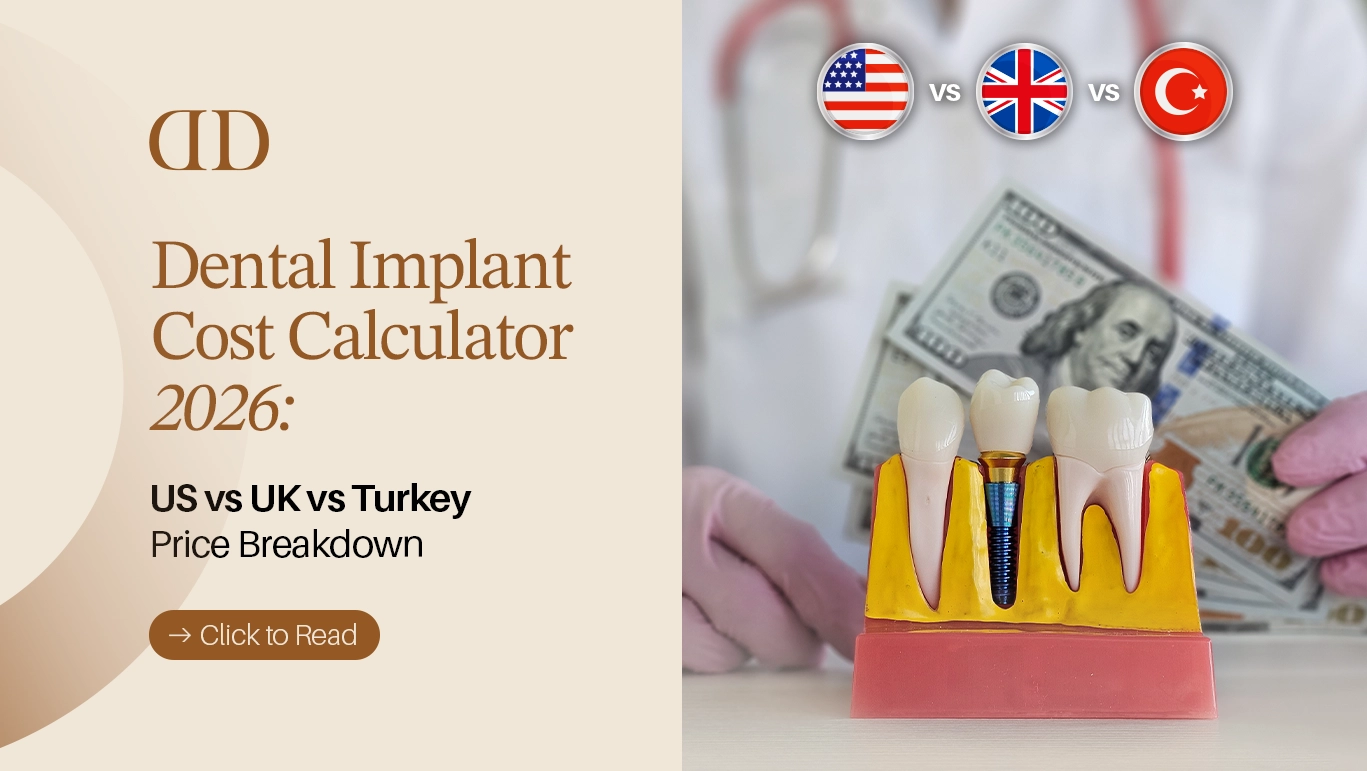

A single dental implant costs $3,000–$5,000 in the US, £2,000–£2,500 in the UK, and €300–€800 in Turkey, a savings of 60-75% without compromising quality.
If you’re researching dental implants, you’ve probably discovered something frustrating: getting a straight answer about costs is nearly impossible. Every clinic website says “contact us for pricing.” Your dentist quotes one number, then mentions “additional procedures” might be needed. Online forums share wildly different experiences.
This guide cuts through the confusion. We’ll break down exactly what dental implants cost in 2026 across the US, UK, and Turkey, what’s included in each price, which hidden costs catch people by surprise, and whether traveling to Turkey actually saves money once you factor in flights and accommodation.
By the end, you’ll understand not just what implants cost, but why prices vary so dramatically and how to calculate whether dental tourism makes financial sense for your specific situation.
How Much Do Dental Implants Really Cost in 2026?
The Short Answer (That Nobody Wants to Hear)
“It depends” isn’t a cop-out; it’s genuinely the accurate answer. But let’s make it useful by breaking down what it depends on.
Three factors drive 90% of price variation:
Location: A dental implant placed in Manhattan costs 300-400% more than an identical implant placed in Istanbul, using the same titanium, same surface treatment, same clinical protocol.
Brand: Straumann implants cost roughly double what Hiossen implants cost, despite comparable 10-year survival rates (96-98% vs 95-97%).
Complexity: A straightforward single molar replacement is cheaper than a front tooth requiring bone grafting and custom gum shaping for aesthetics.
Typical All-Inclusive Costs by Country
When we say “all-inclusive,” we mean implant fixture, abutment, crown, surgery, follow-up visits — the complete treatment for a straightforward case with adequate bone.
| Country | Single Implant (All-Inclusive) | Full-Arch (All-on-4/6) | Premium Brand Premium |
|---|---|---|---|
| United States | $3,000–$5,000 | $20,000–$35,000 | +40-60% |
| United Kingdom | £2,000–£2,500 | £12,000–£22,000 | +35-50% |
| Turkey | €300–€800 | €2,800–€9,000 | +20-30% |
| Australia | AU$3,500–$6,000 | AU$22,000–$40,000 | +40-55% |
| Germany | €1,800–€3,200 | €12,000–€18,000 | +30-45% |
The price differences are real and substantial. A patient needing six implants pays $18,000–$30,000 in the US, £12,000–£15,000 in the UK, or €1,800–€4,800 in Turkey.
What These Numbers Actually Mean
Let’s translate the ranges into specific scenarios:
Low end ($3,000 US / £2,000 UK / €300 Turkey):
- Posterior tooth (back molar)
- Good bone quality, no grafting
- Korean or value-tier brand (Hiossen, DTI)
- Standard abutment and crown
- Efficient clinic with lean overhead
High end ($5,000 US / £2,500 UK / €800 Turkey):
- Anterior tooth (front tooth aesthetic zone)
- Custom zirconia abutment for gum color
- Premium brand (Straumann, Nobel)
- High-cost-of-living city location
- Specialist with extensive training
The “average” patient lands somewhere in the middle: $3,800 US, £2,200 UK, €550 Turkey for a well-executed implant treatment.
Cost Breakdown by Country: The Interactive Comparison
United States Pricing Structure
Components of the $3,000–$5,000 total:
- Initial consultation + CBCT scan: $200–$400
- Implant fixture (titanium post): $1,000–$2,500
- Abutment (connector piece): $400–$800
- Crown (visible tooth): $1,000–$1,500
- Surgery fee: $600–$1,200
Regional variations within the US:
- New York/San Francisco/Los Angeles: $4,500–$6,000
- Chicago/Boston/Seattle: $3,500–$5,000
- Dallas/Phoenix/Denver: $3,000–$4,500
- Rural areas/smaller cities: $2,500–$3,800
Insurance coverage in the US typically provides $1,000–$1,500 maximum annual benefit for implants, covering roughly 25-40% of a single implant cost.
United Kingdom Pricing Structure
NHS vs Private:
The NHS doesn’t typically cover dental implants except in cases of trauma, cancer treatment, or congenital absence. Private treatment is the standard route.
Components of the £2,000–£2,500 total:
- Initial consultation + imaging: £100–£200
- Implant fixture: £800–£1,500
- Abutment: £300–£500
- Crown: £600–£900
- Surgical placement: £400–£700
Regional UK pricing:
- London: £2,400–£3,000
- Southeast England: £2,200–£2,700
- Midlands/North: £2,000–£2,400
- Scotland/Wales: £1,800–£2,300
The NHS “dental crisis” has driven more UK patients abroad. Waiting lists for NHS-funded implants (when available) can exceed 18-24 months.
Turkey Pricing Structure (Darya Dental Clinic Istanbul)
Components of the €300–€800 total:
- Consultation + CBCT + planning: Included (no separate fee)
- Implant fixture (BEGO/Hiossen): €120–€300
- Abutment: €80–€150
- Crown (zirconia): €100–€200
- Surgery + follow-up visits: €150–€300
- VIP airport transfer: Included
- Treatment coordinator: Included
Brand-specific pricing at Darya Dental:
- Hiossen (Korean): €300–€550
- BEGO (German): €450–€650
- Straumann (Swiss): €700–€1,000
The lower Turkish prices don’t indicate lower quality. They reflect:
- Lower labor costs (dentist salaries 60-70% lower than US/UK)
- Lower facility overhead (rent, utilities 70-80% lower)
- More efficient business models (higher patient volume)
- Direct manufacturer relationships (no distributor markups)
- Government support for medical tourism infrastructure
What’s Included in Dental Implant Cost?
The Three-Part Anatomy of an Implant
Most people don’t realize a “dental implant” actually consists of three separate components, each with its own cost:
1. The Fixture (Titanium Post)
This is what most people mean when they say “implant” — the screw-shaped titanium post surgically placed into your jawbone.
- Material: Grade 4 or 5 titanium or titanium alloy
- Surface treatment: Sandblasted, acid-etched, or both (creates microscopic texture for bone attachment)
- Manufacturer cost to clinic: $50–$400 depending on brand
- Patient cost (US): $1,000–$2,500
- Patient cost (UK): £800–£1,500
- Patient cost (Turkey): €120–€400
The fixture alone accounts for 30-50% of total implant cost in Western countries, but only 20-35% in Turkey.
2. The Abutment (Connector)
The abutment connects the buried fixture to the visible crown. It can be:
- Stock abutment: Pre-made titanium connector (cheaper, adequate for most cases)
- Custom abutment: Milled specifically for your case (better for front teeth aesthetics)
- Zirconia abutment: White ceramic instead of gray titanium (prevents dark lines at gum)
Cost breakdown:
- Stock titanium abutment: $150–$400 (US), £150–£300 (UK), €50–€100 (Turkey)
- Custom titanium abutment: $300–$600 (US), £300–£500 (UK), €100–€180 (Turkey)
- Custom zirconia abutment: $400–$800 (US), £350–$600 (UK), €130–€220 (Turkey)
3. The Crown (Visible Tooth)
The crown is the part you actually see and use for chewing.
Material options:
- Porcelain-fused-to-metal (PFM): Traditional, reliable, slightly opaque
- Full zirconia: Strongest, opaque white (good for molars)
- Layered zirconia: Zirconia core with porcelain coating (best aesthetics for front teeth)
- E-Max: Lithium disilicate ceramic (excellent aesthetics, less strong than zirconia)
Crown costs:
- PFM crown: $800–$1,200 (US), £600–£800 (UK), €100–€180 (Turkey)
- Zirconia crown: $1,000–$1,500 (US), £700–£1,000 (UK), €150–€250 (Turkey)
- Layered zirconia/E-Max: $1,200–$1,800 (US), £800–£1,200 (UK), €180–€280 (Turkey)
What “All-Inclusive” Should Include
A complete implant treatment package should cover:
✅ Initial consultation and treatment planning
✅ CBCT 3D imaging and diagnostic models
✅ Implant fixture placement surgery
✅ Healing abutment (temporary component during osseointegration)
✅ Permanent abutment
✅ Final crown fabrication and placement
✅ Follow-up visits for the first 6-12 months
✅ Adjustment visits if needed
What’s typically NOT included:
❌ Tooth extraction (if needed before implant): $150–$400
❌ Bone grafting: $300–$3,000 depending on complexity
❌ Sinus lift: $1,500–$3,000
❌ Temporary crown during healing: $200–$500
❌ Sedation options beyond local anesthesia: $300–$800
❌ Treatment of gum disease before implant: $500–$2,000
Always ask for an itemized quote specifying exactly what’s included and what could add to the cost.
Why Are Implants Cheaper in Turkey?
The Economics Explained (Without the Scary Stories)
The internet is full of warnings: “Too cheap to be real!” and “You get what you pay for!” But the price difference between Turkey and Western countries isn’t about quality, it’s about economics.
Cost Structure Comparison: Same Implant, Different Price
Let’s track a BEGO Semados RSX implant from manufacturer to patient:
United States (Total: $4,200)
- Manufacturer cost to distributor: $180
- Distributor markup to clinic: $420 (133% markup)
- Clinic’s cost: $600
- Clinic overhead (rent, staff, insurance, marketing): $1,800
- Dentist professional fee: $1,400
- Lab fees for crown: $700
- Clinic profit margin (20%): $700
- Patient pays: $4,200
Turkey (Total: €550 / $610)
- Direct manufacturer cost (no distributor): €110
- Clinic overhead (rent, staff, utilities): €120
- Dentist professional fee: €150
- Lab fees for crown (in-house lab): €120
- Clinic profit margin (15%): €50
- Patient pays: €550
The same BEGO implant. The same 98.2% success rate. 690% price difference.
The Seven Factors Behind Turkish Pricing
1. Labor Costs
A specialist oral surgeon in Istanbul earns €35,000–€55,000 annually. In New York, the same specialist earns $180,000–$280,000. The Turkish surgeon isn’t less skilled, they’re working in an economy where €50,000 provides upper-middle-class lifestyle.
2. Facility Overhead
Dental clinic rent in Manhattan: $15,000–$40,000/month for 2,000 sq ft. Dental clinic rent in Ümraniye, Istanbul: €2,000–€4,000/month for same space.
3. No Distributor Markups
US/UK clinics buy implants from distributors who add 60-150% markup. Turkish clinics often buy direct from manufacturers (especially Korean and European brands with Turkish offices) at wholesale prices.
4. Higher Patient Volume
A typical US dental implant clinic places 80-150 implants/year. Darya Dental places 450-600 implants/year. Higher volume = lower per-unit overhead costs.
5. In-House Laboratories
Most Western clinics outsource crown fabrication to commercial labs (adding $300–$700 per crown). Darya Dental has an in-house lab with salaried technicians, cutting crown costs by 60-70%.
6. No Insurance Company Overhead
US/UK clinics spend 15-25% of revenue on insurance billing, claim management, and dealing with coverage denials. Turkish medical tourism clinics work on direct payment, eliminating this overhead.
7. Government Support
Turkey’s Ministry of Health actively supports medical tourism with streamlined licensing, infrastructure investment, and promotional support. This reduces regulatory compliance costs for clinics.
Quality Control: How Turkish Clinics Maintain Standards
The lower price doesn’t mean lower standards. Here’s how reputable Turkish clinics maintain quality:
✅ Same implant brands: Straumann, Nobel, BEGO manufactured in Switzerland/Germany/US
✅ JCI accreditation: International hospital standards
✅ European-trained dentists: Many Turkish dentists complete residencies in Germany, UK, or US
✅ Modern equipment: Same CBCT scanners, surgical tools, sterilization as Western clinics
✅ Published success rates: According to a 2024 Journal of Clinical Periodontology study, Turkish dental clinics maintain success rates of 97.3%, comparable to the 95% reported by the American Academy of Implant Dentistry
Cost-effectiveness research demonstrates that implant success depends primarily on surgical technique and patient factors (smoking, bone quality, oral hygiene) not on the country where treatment occurs or the price paid. Patient willingness-to-pay studies show that 67% of surveyed patients are willing to pay median market prices when they understand the functional and aesthetic benefits of implant treatment.
Hidden Costs to Watch Out For
The $3,000 Implant That Became $8,500
Real case study: James, 52, went to a US clinic advertising “$2,999 implants.” Here’s what actually happened:
- Advertised implant price: $2,999
- Extraction of failing tooth: $350
- Socket preservation bone graft: $800
- Sinus lift procedure: $2,200
- Temporary crown during healing: $400
- Upgraded to zirconia crown: $850 (vs standard PFM)
- Two extra follow-up visits: $200
- Sedation during surgery: $500
- CBCT scan (not included in quote): $250
- Abutment upgrade for aesthetics: $350
- Final cost: $8,899
James’s case isn’t unusual. The “hidden costs” aren’t necessarily deceptive, they’re procedures many patients need but don’t know about when comparing initial quotes.
The Six Most Common Add-On Procedures
1. Bone Grafting ($300–$3,000)
When your natural tooth is lost, the surrounding bone starts to deteriorate. After 12-18 months, there may not be enough bone to support an implant securely.
Minor bone grafting (socket preservation): $300–$800
- Done at time of extraction
- Fills the empty socket to prevent bone loss
- Allows implant placement after 3-4 months
Major bone grafting (block graft or guided bone regeneration): $1,200–$3,000
- Required when significant bone loss has occurred
- May use your own bone, cadaver bone, or synthetic material
- Delays implant placement 4-6 months
Who needs it: 35-45% of implant patients require some form of bone grafting
2. Sinus Lift ($1,500–$5,000)
When replacing upper back teeth (molars and premolars), the maxillary sinus often sits too close to the jaw for implant placement.
Lateral window sinus lift: $2,500–$5,000
- More invasive approach through side of jaw
- Used when substantial lift is needed (5mm+)
Osteotome (internal) sinus lift: $1,500–$2,500
- Less invasive, done through implant site
- Used for smaller lifts (2-4mm)
Who needs it: 20-30% of upper posterior implant cases
3. Tooth Extraction ($150–$500)
If the tooth you’re replacing is still present (even if damaged), extraction costs are separate from implant costs.
- Simple extraction: $150–$300
- Surgical extraction: $250–$500 (impacted or broken tooth)
4. Temporary Prosthetics ($200–$800)
During the 3-6 month healing period, you’ll likely want something to fill the gap:
- Essix retainer with false tooth: $200–$400 (removable, most affordable)
- Temporary partial denture: $300–$600
- Temporary bridge bonded to adjacent teeth: $500–$800
5. Treatment of Existing Gum Disease ($500–$3,000)
Implants placed in diseased gums have dramatically higher failure rates. If you have periodontal disease, it must be treated first.
- Deep cleaning (scaling and root planing): $500–$1,500
- Gum surgery: $1,000–$3,000
6. Sedation Options ($300–$1,200)
Local anesthesia is standard and usually included. Additional sedation costs extra:
- Nitrous oxide (laughing gas): $100–$200
- Oral sedation (pills): $200–$400
- IV conscious sedation: $600–$1,200
- General anesthesia: $1,000–$2,500
How to Avoid Hidden Cost Surprises
Before accepting any quote, ask these specific questions:
- “Does this price include the CBCT scan?”
- “If I need bone grafting, how much would that add?”
- “Is extraction included if my tooth can’t be saved?”
- “Does the crown price include custom abutment if needed?”
- “How many follow-up visits are included, and what do additional visits cost?”
- “Is the quote for a stock crown or custom-designed crown?”
- “If complications occur during healing, what additional costs might I face?”
Get it in writing. A detailed treatment plan should itemize every component with individual costs, not just a single “implant package” number.
Dental Implant Cost by Brand
Brand choice significantly impacts cost. Here’s how the major implant manufacturers price globally:
Premium Tier: Swiss & Swedish Brands
Straumann (Switzerland)
- US pricing: $1,800–$3,000 (fixture only) | $4,000–$6,000 (complete)
- UK pricing: £1,500–£2,200 (fixture only) | £2,800–£3,500 (complete)
- Turkey : €300–€450 (fixture only) | €700–€1,000 (complete)
- 10-year survival rate: 96-98%
- Notable features: SLActive surface, fastest osseointegration (6-8 weeks)
Nobel Biocare (Sweden/Switzerland)
- US pricing: $1,700–$2,800 (fixture only) | $3,800–$5,800 (complete)
- UK pricing: £1,400–£2,000 (fixture only) | £2,600–£3,400 (complete)
- Turkey : €280–€400 (fixture only) | €650–€950 (complete)
- 10-year survival rate: 95-98%
- Notable features: All-on-4 originators, TiUnite surface
Mid-Tier: German & American Brands
BEGO (Germany)
- US pricing: $1,200–$2,000 (fixture only) | $3,200–$4,800 (complete)
- UK pricing: £900–£1,500 (fixture only) | £2,200–£3,000 (complete)
- Turkey: €180–€300 (fixture only) | €450–€750 (complete)
- 10-year survival rate: 96-98%
- Notable features: Best price-performance balance, TiPure surface
Zimmer Biomet (USA)
- US pricing: $1,300–$2,200 (fixture only) | $3,400–$5,000 (complete)
- UK pricing: £1,000–£1,600 (fixture only) | £2,300–£3,100 (complete)
- Turkey pricing: €200–€350 (fixture only) | €500–€800 (complete)
- 10-year survival rate: 94-97%
Value Tier: Korean & Budget Brands
Hiossen (South Korea – Osstem Group)
- US pricing: $600–$1,200 (fixture only) | $2,400–$3,800 (complete)
- UK pricing: £450–£900 (fixture only) | £1,800–£2,600 (complete)
- Turkey: €110–€200 (fixture only) | €300–€550 (complete)
- 7-year survival rate: 95-96%
- Notable features: RBM surface, excellent value
MegaGen (South Korea)
- US pricing: $650–$1,300 (fixture only) | $2,500–$3,900 (complete)
- UK pricing: £500–£950 (fixture only) | £1,900–£2,700 (complete)
- Turkey: €120–€220 (fixture only) | €320–€600 (complete)
- 10-year survival rate: 93-96%
- Notable features: AnyRidge knife-thread design
Is Premium Worth the Premium?
The clinical evidence suggests modest differences:
That 2-3% difference is statistically significant but clinically modest. For perspective:
- Smoking reduces success rates by 8-12%
- Poor oral hygiene reduces success by 10-15%
- Surgeon experience impacts success by 5-8%
The surgeon’s skill and your post-operative care matter more than brand choice. A Hiossen implant placed by an experienced surgeon with good technique will outperform a Straumann implant placed poorly.
When premium brands make sense:
- Immediate placement (same day as extraction)
- Aesthetic zone with challenging soft tissue
- Compromised bone requiring maximum osseointegration support
- Patient preference for longest-documented brand history
When mid-tier or value brands make sense:
- Straightforward posterior single tooth
- Good bone quality, no grafting needed
- Multiple implants where cost difference multiplies significantly
- Patient prioritizing cost savings over brand prestige
Read our full guide on the top 10 dental implants brands to look into: Top 10 Dental Implant Brands – Comparison and Cost Analysis
Is Dental Tourism to Turkey Worth It?
The ROI Calculation Framework
Step 1: Calculate Your Treatment Cost
Number of implants needed × local price per implant = Total local cost
Example: 4 implants × $4,200 = $16,800 (US)
Step 2: Calculate Turkey Treatment + Travel Cost
- Treatment: 4 implants × €600 = €2,400 ($2,640)
- Flights: €350
- Accommodation: €500 (8 nights) (5 nights are inlcluded in almost all full-packages, so no added cost)
- Food/transport: €200 (transport is also included from airport-hotel-clinic)
- Total: €3,450 ($3,795)
Step 3: Calculate Net Savings
$16,800 – $3,795 = $13,005 saved (77% less)
Step 4: Factor in Opportunity Costs
- Time off work: 10 days (if using vacation days – no monetary cost)
- Return visit for final crowns (if needed): €800 additional
- Risk premium for treating abroad: Subjective personal value
Step 5: Calculate ROI
Even with a second trip: $16,800 – $4,675 = $12,125 saved (72% less)
That $12,000 saved could fund:
- 6 years of maximum dental insurance premiums
- Emergency fund for future dental needs
- Retirement account contribution
- Children’s education expenses
When Turkey Treatment Makes Financial Sense
✅ Strong financial case:
- Needing 3+ implants
- No dental insurance or poor implant coverage
- Live near major airport hub
- Flexible schedule (can travel during off-peak season)
- Research-oriented personality comfortable with medical tourism
✅ Moderate financial case:
- Needing 2 implants
- Some vacation time available
- Enjoy travel and can combine with tourism
- Comfortable with international healthcare
⚠️ Weak financial case:
- Only need 1 implant
- Excellent dental insurance with high implant coverage
- Limited vacation time
- Strong preference for local provider relationship
- Anxious about traveling for medical treatment
Questions to Ask Before Booking
About the clinic:
- “What are your actual success rates (not industry averages)?”
- “Who will perform my surgery, and what’s their experience level?”
- “What warranty do you provide on implants and crown work?”
- “If complications occur after I return home, what support do you provide?”
- “Can I speak with patients from my country who’ve been treated here?”
About the treatment plan:
- “Will I need bone grafting, and is that cost included?”
- “How many trips will be required, and what’s the timeline?”
- “What implant brand will you use, and can I choose?”
- “What happens if my bone density is insufficient after imaging?”
About logistics:
- “Do you provide airport transfer and hotel booking assistance?”
- “Is there a treatment coordinator who speaks my language?”
- “What documentation will I receive for my home dentist?”
- “How do I schedule the procedure and what deposit is required?”
Learn more: Is Turkey Safe for Dental Tourism?
Frequently Asked Questions
How much does a single dental implant cost in the US in 2026?
A complete dental implant (fixture, abutment, crown) costs $3,000–$5,000 in the US, with significant regional variation. New York and San Francisco average $4,500–$6,000, while smaller cities average $3,000–$4,500.
Does dental insurance cover implants?
Most US dental insurance plans classify implants as “major” procedures with 50% coverage up to annual maximum ($1,000–$1,500 typically). UK private insurance varies by plan. Many patients pay out-of-pocket or use medical tourism.
Why are dental implants so expensive?
The cost reflects surgeon training and time (7+ years education, $300–$500/hour fees), materials and lab work ($800–$1,500), facility overhead (rent, equipment, staff), and liability insurance. In Western countries, these factors compound to create high prices.
Are cheap implants in Turkey safe?
Price doesn’t determine safety; clinic quality does. Accredited Turkish clinics like Darya Dental use the same implant brands (Straumann, Nobel, BEGO) and achieve comparable 96-98% success rates to Western clinics. Lower prices reflect economic factors, not quality.
How long do dental implants last?
Studies show 95-98% of implants survive 10 years with proper care. Many last 20-30+ years. Success depends on oral hygiene, regular dental visits, not smoking, and adequate bone support.
What’s the difference between a $1,000 implant and a $3,000 implant?
Price differences reflect brand (Straumann vs Hiossen), location (Manhattan vs Istanbul), and procedure complexity (simple vs bone grafting). The titanium implants themselves cost manufacturers $50–$200 regardless of final price.
Can I get implants on the NHS?
NHS dental implants are only available for specific medical conditions (cancer treatment, trauma, congenital absence). Wait times can exceed 18-24 months. Most patients use private treatment or dental tourism.
How much does All-on-4 cost?
Full-arch All-on-4 restoration costs $20,000–$35,000 per arch in the US, £12,000–£22,000 in the UK, and €2,800–€6,000 in Turkey. Both arches cost $40,000–$70,000 (US), £24,000–£44,000 (UK), or €5,600–€12,000 (Turkey).
Read more: All on 4 Dental Implants Cost in Istanbul Turkey 2025
What are hidden costs of dental implants?
Common add-ons include: tooth extraction ($150–$500), bone grafting ($300–$3,000), sinus lift ($1,500–$5,000), temporary crown ($200–$500), and sedation ($300–$1,200). Always request an itemized quote.
Is it worth traveling to Turkey for dental implants?
For multiple implants, yes; savings of 60-75% often exceed $10,000-$40,000. For single implants, it depends on personal factors (vacation time, comfort with travel, financial situation). The quality at reputable clinics equals Western standards.