Should You Get Titanium Or Zirconia Implants?
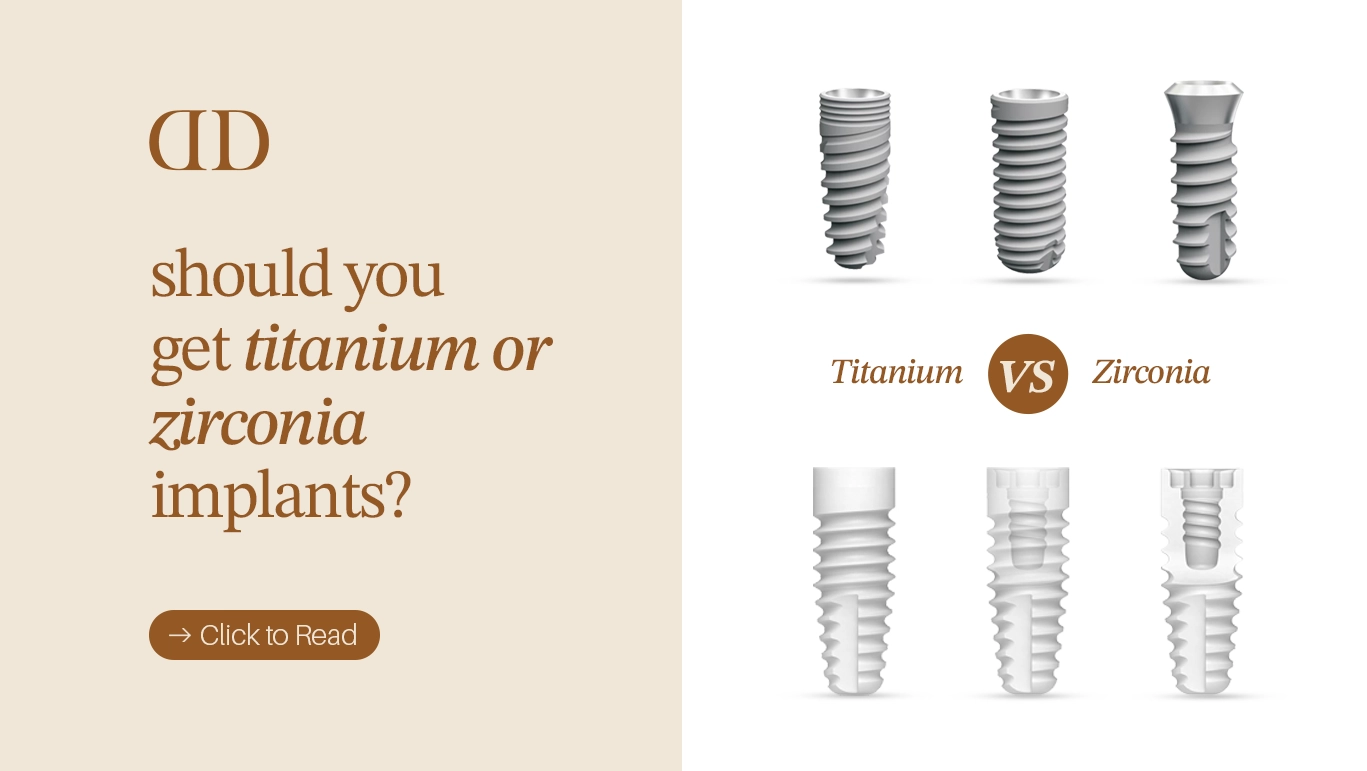

Choosing between titanium and zirconia dental implants feels like picking between experience and innovation. Titanium has decades of proven results. Zirconia promises better aesthetics and a metal-free option. Both work. Both have devoted supporters. Neither is universally superior.
Titanium implants have 50+ years of clinical data with 95%+ success rates, while zirconia implants offer metal-free aesthetics but limited long-term studies beyond 10 years. The material you choose depends on your specific clinical situation, aesthetic priorities, and how much you value established long-term data versus newer alternatives.
To compare implant materials within a broader treatment perspective, patients can also explore our dental implant treatment options.
Titanium Dental Implants: The Gold Standard Explained
Titanium has been the foundation of implant dentistry since the 1960s when Swedish orthopedic surgeon Per-Ingvar Brånemark accidentally discovered osseointegration. When titanium fuses with bone, it creates a bond strong enough to support artificial teeth for decades.
The numbers tell the story. Titanium Grade 4 and 5 represent 98% of all implants placed globally, while zirconia accounts for approximately 2% as of 2026. This isn’t just manufacturer preference. It reflects decades of clinical validation across millions of patients.
Commercially pure titanium (CP Ti) comes in four grades, with Grade 4 being the most common for dental implants due to its superior strength while maintaining excellent biocompatibility. The material is highly resistant to corrosion, even in the challenging oral environment with varying pH levels, bacteria, and temperature changes.
The titanium surface integrates with bone through direct bone-to-implant contact. No connective tissue layer forms between the implant and bone. The osseointegration process typically takes 3-6 months, during which bone cells grow onto and into the microscopically roughened titanium surface.
Recent innovations include titanium-zirconium alloy (Roxolid), developed by Straumann. This proprietary alloy combines approximately 85% titanium with 15% zirconium, creating a material roughly 50% stronger than pure titanium Grade 4. The increased strength allows for smaller diameter implants in situations where bone width is limited, which you can explore further in our comprehensive Straumann implant guide.
Titanium’s track record includes:
```html
```
Premium Dental Care in Turkey
Expert treatments with high-end technology. Get your personalized quote today via WhatsApp.
- Over 50 years of clinical use and research
- Success rates consistently above 95% in 10-year studies
- Predictable healing timelines across diverse patient populations
- Extensive documentation of long-term outcomes (20+ year studies available)
- Proven performance in challenging cases like bone grafts and immediate loading
The material’s biggest limitation? Aesthetics. Titanium’s gray color can show through thin gingival tissue, particularly in the anterior (front) region. When gum recession occurs, the metal may become visible.
Zirconia Dental Implants: Metal-Free Alternative
Zirconia entered implant dentistry in the early 2000s, marketed as a biocompatible, metal-free alternative for patients concerned about titanium sensitivity or seeking superior aesthetics.
```html  ```
```
Want trusted dental advice in your Google AI answers?
Add Darya Dental Turkey as a Preferred Source on Google to make our dental guides easier to find in your search results and AI Overviews.
Yttria-stabilized zirconia (Y-TZP) is the technical name for the ceramic material used in dental implants. The yttrium oxide stabilizes the zirconia’s crystal structure, preventing transformation from the tetragonal to monoclinic phase that would otherwise cause the material to crack.
Zirconia’s white, tooth-like color is its most compelling advantage. When placed in the aesthetic zone (front teeth), zirconia eliminates the risk of gray shadowing through thin tissue. Even if gum recession occurs years later, the white implant blends with the natural tooth root color.
The material demonstrates excellent biocompatibility. Laboratory and animal studies show that bone cells attach to zirconia surfaces similarly to titanium. Some research suggests zirconia may attract less bacterial plaque than titanium, potentially reducing peri-implantitis risk.
Straumann PURE Ceramic implants represent the most clinically validated one-piece zirconia system currently available. Unlike two-piece titanium systems with a separate implant body and abutment, most zirconia implants use a one-piece design where the implant and abutment are manufactured as a single unit.
The one-piece design offers advantages (no microgap for bacterial colonization) and disadvantages (no ability to adjust angulation after placement).
However, zirconia faces significant challenges. A 2024 meta-analysis of randomized controlled trials found that titanium implants demonstrated statistically better survival rates (77.6%) compared to zirconia (70.3%) after one year. The same study showed titanium implants had significantly less marginal bone loss (0.18mm) than zirconia implants (0.42mm) at 12 months.
The mechanical weakness of zirconia remains a concern. While the material has high compressive strength, it’s more brittle than titanium. Fractures, though rare, do occur, and unlike titanium implants which typically fail at the connection, zirconia implants can fracture at the implant body itself, making removal more complex.
Most troubling: limited long-term data. While some zirconia systems have 10-year follow-up studies, we lack the 20-30 year data that exists for titanium. The material’s behavior over multiple decades in function remains partially unknown.
Titanium vs Zirconia: Head-to-Head Comparison
| Factor | Titanium | Zirconia |
|---|---|---|
| Clinical Track Record | 50+ years, millions of implants | ~20 years, limited long-term data |
| Global Market Share | 98% of all implants placed | 2% of all implants placed |
| Survival Rate (1 year) | 77.6% (meta-analysis) | 70.3% (meta-analysis) |
| Survival Rate (long-term) | 90-100% (10+ years) | 65-100% (10 years max) |
| Marginal Bone Loss (12 months) | 0.18mm ± 0.47 | 0.42mm ± 0.40 |
| Osseointegration | Proven, predictable | Comparable in short-term |
| Mechanical Strength | Superior fracture resistance | Higher brittleness, fracture risk |
| Aesthetics | Gray color, visible through thin tissue | White, tooth-like appearance |
| Metal Sensitivity | Rare titanium allergy possible | Truly metal-free |
| Bacterial Adhesion | Moderate | Potentially lower (limited data) |
| Two-Piece Design | Standard, allows angulation correction | Rare, mostly one-piece |
| Cost | €300-€800 (Turkey), $3,000-$5,000 (US) | 20-40% premium over titanium |
| Fracture Pattern | Typically at connection | Can fracture at implant body |
| Surface Modification | Decades of research, multiple options | Limited techniques, harder material |
A 2025 overview of systematic reviews comparing zirconia and titanium in the anterior region concluded that while zirconia performed comparably to titanium aesthetically, titanium demonstrated superior mechanical performance. The review found no definitive evidence favoring one material over the other regarding marginal bone loss, but noted titanium’s longer duration of use and more advanced surface treatments as advantages.
Who Should Choose Zirconia Implants?
Zirconia makes sense for a specific subset of patients. Not everyone benefits from the metal-free option, despite marketing suggesting otherwise.
Strong candidates for zirconia:
Patients with thin gingival biotypes in the aesthetic zone benefit most. If you have naturally thin, translucent gum tissue and need an implant for an upper front tooth, zirconia eliminates the risk of gray shadowing that can occur with titanium. This is particularly relevant for patients with high smile lines where even minimal recession might expose the implant margin.
Confirmed titanium sensitivity qualifies you for zirconia, though this is rare. True titanium allergy affects less than 1% of the population. If you have documented titanium hypersensitivity (confirmed through patch testing, not just suspected), zirconia provides a validated alternative.
Patients with strong aesthetic demands and realistic expectations can consider zirconia for single anterior implants. The white color genuinely offers aesthetic advantages in select cases. However, this assumes you understand the trade-offs in mechanical properties and long-term data.
Poor candidates for zirconia:
Posterior (back) teeth experience significantly higher biting forces. The brittleness of zirconia makes fracture more likely under these loads. Multiple studies have reported higher mechanical complications with zirconia in molar regions.
Patients requiring angled abutments should avoid most zirconia systems. The one-piece design means the final restoration angle is determined at surgery. If bone anatomy requires a tilted abutment to achieve proper crown alignment, two-piece titanium systems offer more flexibility.
Bruxism (teeth grinding) patients face higher risk with zirconia. The repeated high-force impacts can propagate cracks in the ceramic material over time. Titanium’s ductility allows it to absorb these forces without fracturing.
Budget-conscious patients should typically choose titanium. Zirconia costs 20-40% more than comparable titanium implants. Unless the aesthetic benefit justifies the premium and the mechanical trade-offs, titanium offers better value.
Situations requiring immediate loading favor titanium. While some clinicians load zirconia immediately, the material’s brittle nature makes this riskier than with titanium. The established immediate loading protocols exist primarily for titanium.
Titanium Alloys: Roxolid vs Grade 4 vs Grade 5
Understanding titanium grades helps explain why different implant systems perform differently despite all being “titanium implants.”
Grade 4 Commercially Pure Titanium is the industry standard. It contains 99.2-99.7% titanium with trace amounts of oxygen, nitrogen, carbon, hydrogen, and iron. The material offers excellent biocompatibility with predictable osseointegration. Tensile strength ranges from 550-750 MPa, more than adequate for dental implants in normal situations.
Grade 5 Titanium Alloy (Ti-6Al-4V) adds approximately 6% aluminum and 4% vanadium to pure titanium, creating an alloy roughly twice as strong as Grade 4 (tensile strength 895-930 MPa). The increased strength allows manufacturers to create thinner implant walls and smaller diameters while maintaining fracture resistance.
However, Grade 5’s biocompatibility profile is slightly less favorable than Grade 4. The alloying elements can trigger inflammatory responses in rare cases. Most major manufacturers (Straumann, Nobel Biocare) have moved away from Grade 5 for implant bodies, though it remains common for abutment screws and other components where strength is critical.
Roxolid (Titanium-Zirconium Alloy) represents Straumann’s proprietary advancement. By alloying titanium with approximately 15% zirconium (not to be confused with zirconia ceramic), Straumann created a material with 50% greater tensile strength than Grade 4 titanium while maintaining comparable biocompatibility.
The strength advantage allows Roxolid implants to be placed in narrow bone ridges where traditional diameter implants won’t fit. A 3.3mm Roxolid implant provides similar fracture resistance to a 4.1mm Grade 4 implant, enabling treatment in cases that previously required bone grafting to widen the ridge.
Clinical studies show Roxolid performs comparably to Grade 4 titanium in osseointegration and long-term success rates. The material costs more than standard titanium but less than zirconia, positioning it as a middle ground for challenging anatomical situations.
When comparing implant brands, the titanium grade matters significantly. Not all “titanium implants” offer identical mechanical properties. Our detailed analysis of Bredent versus Straumann implants explores how these material differences translate to clinical outcomes.
Cost Comparison: Titanium vs Zirconia Implants
Material cost represents just one component of total implant treatment expenses, but the premium for zirconia varies significantly by location.
Turkey (Darya Dental):
- Titanium (Grade 4): €400-€800 all-inclusive
- Roxolid (Ti-Zr alloy): €600-€900 all-inclusive
- Zirconia: €700-€1,000 all-inclusive
United States:
- Titanium (Grade 4): $1,500-$2,200 fixture only, $3,000-$5,000 all-inclusive
- Roxolid (Ti-Zr alloy): $1,800-$2,500 fixture only, $3,500-$6,000 all-inclusive
- Zirconia: $2,000-$3,000 fixture only, $4,000-$7,000 all-inclusive
United Kingdom:
- Titanium (Grade 4): £1,200-£1,600 fixture only, £2,000-£3,000 all-inclusive
- Roxolid (Ti-Zr alloy): £1,400-£1,900 fixture only, £2,300-£3,500 all-inclusive
- Zirconia: £1,600-£2,200 fixture only, £2,600-£4,200 all-inclusive
The all-inclusive pricing includes the implant fixture, abutment, crown, surgical procedure, and follow-up appointments. Fixture-only pricing covers just the implant body placed in bone.
Zirconia’s premium stems from several factors. The material is harder to machine than titanium, increasing manufacturing costs. Surface modification techniques for zirconia remain less developed, limiting economies of scale. One-piece designs require more complex inventory management for clinics. Lower global demand means less competition among manufacturers.
The cost difference narrows when comparing to premium titanium systems. A zirconia implant costs roughly the same as a Straumann BLX with a ceramic abutment. At that price point, you’re choosing between proven long-term titanium performance with ceramic aesthetics versus newer zirconia technology with shorter track records.
For context on pricing across major implant brands, our comprehensive brand comparison guide breaks down how material choice affects total treatment investment.
Biocompatibility and Allergies: Separating Fact from Fiction
Marketing claims about titanium allergies and metal sensitivity deserve critical examination. The actual prevalence differs significantly from what some zirconia manufacturers suggest.
True titanium hypersensitivity exists but remains exceptionally rare. Research estimates less than 0.6% of the population shows any immune response to titanium. Even among patients with positive titanium patch tests, most successfully receive titanium implants without complications.
The confusion stems from conflating different types of reactions. Peri-implantitis (bone loss and inflammation around implants) occurs in 10-20% of patients over 10 years regardless of implant material. This is primarily a bacterial infection, not an allergic reaction to titanium.
Some patients blame vague symptoms like fatigue, joint pain, or brain fog on their titanium dental implants. No validated medical research supports these connections. Multiple studies examining thousands of titanium implant patients found no correlation between systemic symptoms and implant presence.
Titanium corrosion in the oral environment does occur at a microscopic level. The metal releases extremely small amounts of titanium particles and ions into surrounding tissue. However, even patients with multiple titanium implants show negligible systemic titanium levels. The amounts are far below what would trigger toxicity or meaningful biological effects.
Zirconia’s biocompatibility is excellent, but not superior to titanium in ways that matter clinically. Both materials are bioinert (they don’t react with body tissues). Both allow bone cells to attach and integrate. The 2015 review of zirconia properties confirmed that while zirconia showed favorable biocompatibility in laboratory studies, the clinical advantages over titanium remained minimal.
The “metal-free” marketing of zirconia appeals to patients concerned about systemic metal burden. This is reasonable for patients with documented metal allergies to nickel, chromium, or other metals. However, extrapolating from nickel allergy to titanium sensitivity lacks scientific basis. Titanium allergy and nickel allergy don’t correlate.
If you suspect titanium sensitivity, proper testing should precede implant placement. Patch testing can identify titanium reactivity, though false positives occur. MELISA (Memory Lymphocyte Immunostimulation Assay) blood testing offers another option, though its reliability for predicting implant complications remains debated.
The practical reality: if you have no documented metal allergies and no history of adverse reactions to titanium (orthopedic screws, joint replacements), choosing zirconia for allergy prevention is unnecessary. The aesthetic benefits might justify zirconia, but allergy prevention shouldn’t be the primary driver unless confirmed sensitivity exists.
Which Material Does Darya Dental Recommend and Why?
At Darya Dental, we place approximately 450-600 implants annually across a diverse international patient base. Our material selection follows evidence-based protocols, not manufacturer relationships or profit margins.
We primarily recommend titanium (Grade 4 or Roxolid) for most patients because:
The long-term data overwhelmingly supports titanium. When we place an implant, we’re making a 20-30 year commitment to that patient. Titanium has documented success over these timeframes. Zirconia does not yet.
Mechanical reliability matters more than theoretical advantages. Implant fractures are rare with quality titanium systems (less than 1% over 10 years). Zirconia fracture rates, while still low, trend higher in posterior applications. When fractures occur with zirconia, they’re often more complex to manage than titanium failures.
Two-piece versatility solves real clinical problems. Bone anatomy doesn’t always align perfectly with ideal restoration angles. Angled abutments compensate for these discrepancies. One-piece zirconia systems can’t make these adjustments after placement.
Surface modification technology for titanium is decades ahead of zirconia. SLA (sandblasted, large-grit, acid-etched) surfaces on Straumann implants, TiUnite surfaces on Nobel Biocare, and other proprietary treatments accelerate osseointegration and improve outcomes in challenging bone. Zirconia surface modification remains limited because the material’s hardness makes processing difficult.
We do recommend zirconia for specific situations:
Upper anterior single tooth replacements with thin gingival biotypes and high smile lines benefit most. A single lateral incisor or canine replacement in a patient with thin, translucent tissue represents zirconia’s ideal application. The aesthetic advantage outweighs the mechanical trade-offs in this low-load, high-visibility position.
Confirmed titanium allergy patients (rare) need a validated alternative. Zirconia provides this. However, we require documented patch testing before accepting patient self-diagnosis of titanium sensitivity.
Patients with extreme aesthetic demands who fully understand the trade-offs can opt for zirconia. We ensure they know they’re choosing a material with less long-term data and potentially higher complication rates in exchange for superior aesthetics.
We don’t recommend zirconia for:
Posterior implants in any circumstance. The biting forces on molars and premolars favor titanium’s superior fracture resistance.
Immediate loading protocols except in exceptional cases. The brittleness of zirconia makes delayed loading protocols safer.
Full-arch fixed prostheses. Four to six implants supporting a complete arch should be titanium. The consequences of a single implant fracture in a full-arch case are too significant to risk with a material that has higher fracture rates.
Budget-constrained patients who want the longest-lasting solution for the money. Titanium costs less and will likely last longer. That’s not opinion. That’s what the data shows.
The premium we charge for zirconia reflects actual material costs, not inflated profit margins. We price our all-inclusive packages transparently, with zirconia adding approximately €200-€400 to total treatment cost depending on the specific system selected.
Our approach: material selection serves the patient’s long-term outcome, not marketing trends or manufacturer incentives. When the evidence unambiguously favors titanium, we recommend titanium. When aesthetic concerns justify zirconia’s trade-offs, we present it as an option with full disclosure of limitations.
Frequently Asked Questions
Are zirconia implants better than titanium?
No single material is universally better. Titanium offers superior long-term clinical data, better mechanical properties, and more versatile two-piece designs. Zirconia provides better aesthetics and is metal-free. A 2024 meta-analysis found titanium had significantly better survival rates (77.6% vs 70.3%) and less bone loss (0.18mm vs 0.42mm) at one year compared to zirconia.
How long do zirconia dental implants last?
The longest clinical studies on zirconia implants extend approximately 10 years, showing survival rates between 65-100% depending on location and loading protocol. Titanium implants have documented success beyond 30 years. Zirconia may last equally long, but we lack the multi-decade data to confirm this.
Can zirconia implants break?
Yes. While zirconia is strong in compression, it’s more brittle than titanium. Fractures occur most commonly in posterior teeth under high biting forces or in bruxism patients. When zirconia implants fracture, the break typically occurs at the implant body, making removal more complex than titanium fractures.
Do zirconia implants cost more than titanium?
Zirconia implants typically cost 20-40% more than comparable titanium systems.
Can you be allergic to titanium implants?
True titanium allergy exists but affects less than 0.6% of the population. Documented cases of implant failure due to confirmed titanium hypersensitivity are extremely rare. Most “titanium allergy” concerns are based on internet research rather than medical testing. If you suspect titanium sensitivity, request proper patch testing before choosing zirconia based on unconfirmed allergy fears.
What is Roxolid and how is it different from standard titanium?
Roxolid is Straumann’s proprietary titanium-zirconium alloy containing approximately 85% titanium and 15% zirconium metal. It’s 50% stronger than Grade 4 pure titanium, allowing smaller diameter implants in narrow bone. Roxolid costs more than standard titanium but less than zirconia ceramic, and it maintains titanium’s biocompatibility while improving mechanical properties.
Why are most implants titanium instead of zirconia?
Titanium represents 98% of implants placed globally because it has 50+ years of clinical validation, superior mechanical properties, predictable osseointegration, and proven long-term success rates above 95%. Zirconia offers aesthetic advantages but lacks equivalent long-term data and shows higher complication rates in some studies.
Can zirconia implants get peri-implantitis?
Yes. While some research suggests zirconia may attract less bacterial plaque than titanium, peri-implantitis (bone loss around implants due to bacterial infection) occurs with both materials. Proper oral hygiene and regular professional maintenance matter more than implant material for preventing peri-implantitis.
Are zirconia implants safe?
Yes. Zirconia is biocompatible and safe for dental implant applications. The material is bioinert, non-toxic, and doesn’t trigger adverse systemic reactions. Safety isn’t the issue with zirconia. The questions center on long-term durability and mechanical performance compared to titanium’s established track record.
Which implant brand is best: titanium or zirconia?
Brand matters more than material in many cases. A premium titanium implant from Straumann, Nobel Biocare, or other research-driven manufacturers typically outperforms a low-quality zirconia implant from an unknown manufacturer. When comparing top-tier brands, material choice depends on specific clinical situations, aesthetic requirements, and patient preferences rather than universal superiority.
