
How Many Veneers Should I Get: 4, 6, 8, or 10?

There is no single number of veneers that is right for everyone. The appropriate number depends on how many teeth are visible when you smile, your aesthetic goals, the condition of your teeth, your bite, and how much of your natural smile you want to change.
For some people, 4 veneers may be enough to address a limited cosmetic concern. Others may benefit from 6, 8, 10, or more veneers when a wider area of the smile is visible or when several teeth need to be coordinated.
The goal is not simply to get more veneers. It is to treat enough teeth to create a balanced result without unnecessarily extending treatment to healthy teeth.
If you are comparing treatment options, Darya Dental Turkey’s porcelain veneer treatment page provides additional information about candidacy, preparation, materials and the treatment process.
Understanding Dental Veneers: The Foundation of Your Decision
Before deciding how many veneers you need, it helps to understand what dental veneers actually are and what they can change.
What Are Veneers?
Veneers are thin restorations made from materials such as porcelain or composite resin that are bonded to the front surfaces of teeth. They are individually designed to change characteristics such as tooth colour, shape, length and proportion.
Veneers can be used for several cosmetic concerns, including:
- Discoloration: Staining that does not respond adequately to whitening
- Chips and minor damage: Limited structural imperfections
- Gaps: Certain spaces between teeth
- Shape: Teeth that appear unusually short, worn or irregular
- Minor alignment concerns: Selected cases where the appearance of tooth position can be improved cosmetically
- Size differences: Teeth that appear disproportionately small or uneven
Long-term clinical research has reported favourable survival outcomes for porcelain veneers in appropriately selected and treated cases.
The Smile Zone: Where Veneers Matter Most
Your “smile zone” is the area of teeth that becomes visible when you smile naturally. It can include the upper front teeth and, depending on your smile width and lip position, extend toward the canines or premolars. Lower teeth may also become visible in some people.
```html
```
Premium Dental Care in Turkey
Expert treatments with high-end technology. Get your personalized quote today via WhatsApp.
This is one of the most important factors when deciding how many veneers you need.
If you naturally show only your front four teeth, treating those teeth may produce a different result from treating a person whose smile extends across eight or ten visible teeth.
```html  ```
```
Want trusted dental advice in your Google AI answers?
Add Darya Dental Turkey as a Preferred Source on Google to make our dental guides easier to find in your search results and AI Overviews.
How Many Teeth Should I Get Veneers On? The Key Factors
The answer depends on several factors rather than one universal veneer number.
Your Cosmetic Goals
If you want to correct one or two specific teeth, a limited number of veneers may be appropriate.
If you want a broader change in tooth colour, shape and symmetry, treating more of the visible smile can create greater consistency.
A useful starting point is:
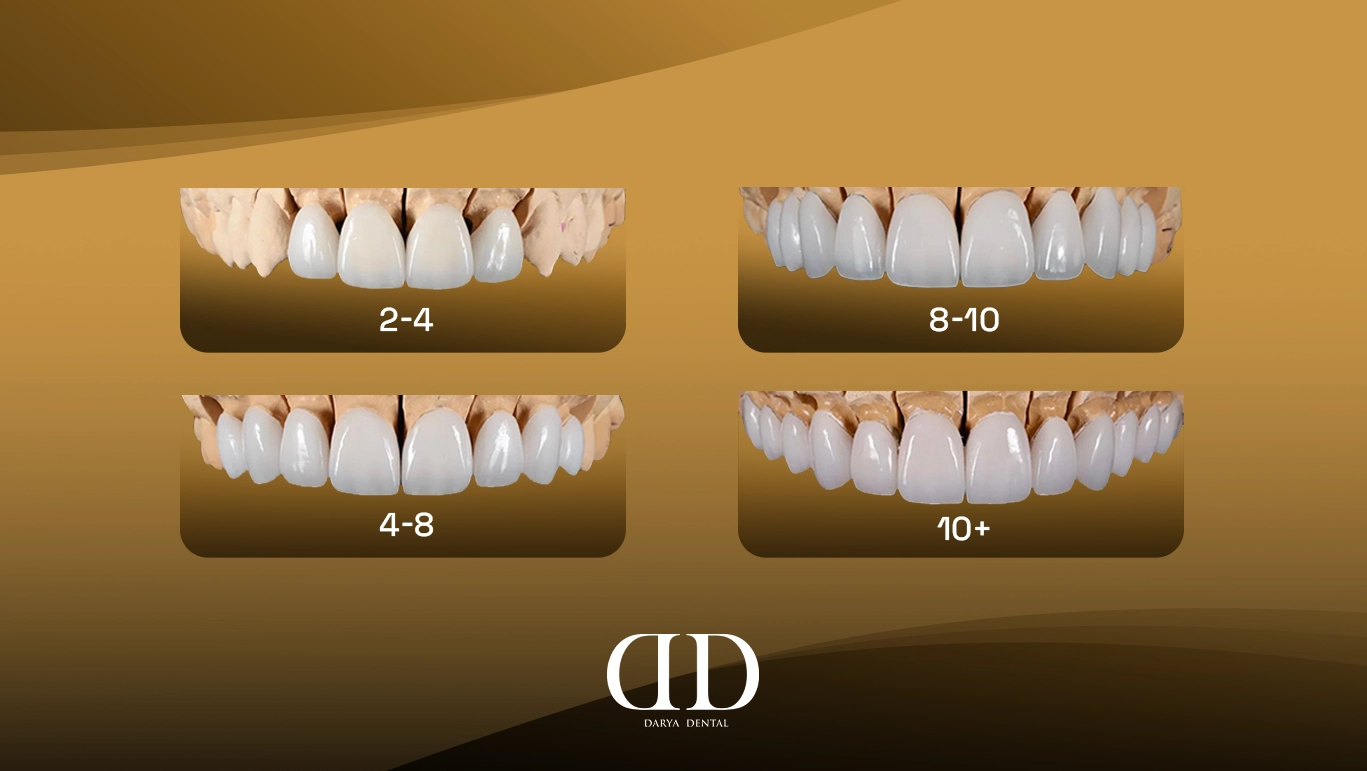
| Goal | Possible treatment range |
| Limited cosmetic correction | 2-4 veneers |
| Broader front-tooth improvement | 6 veneers |
| Wider smile coverage | 8 veneers |
| More extensive aesthetic treatment | 10+ veneers |
These are planning examples, not clinical prescriptions.
Your Natural Smile Characteristics
Your natural smile width can have a major effect on the number of veneers required.
Someone with a narrow smile may show mainly the upper front teeth. Someone with a broader smile may show teeth further toward the premolars.
Lip position also matters because it determines how much tooth structure is visible at rest and during smiling.
The basic principle is straightforward: the more teeth that are visible and need to match, the more teeth may need to be considered during treatment planning.
Your Existing Teeth Condition
The condition and colour of your natural teeth also influence the decision.
If one or two teeth are damaged while the surrounding teeth already have a compatible appearance, treating only those teeth may be possible.
If several visible teeth have different colours, shapes or structural concerns, a broader treatment area may provide better visual consistency.
Your Budget and Long-Term Plans
The number of veneers directly affects the initial treatment cost. It also affects future maintenance and potential replacement costs.
Budget can therefore be part of the discussion, but it should not be the only factor. A cheaper treatment involving too few veneers may not produce the desired aesthetic result, while treating more healthy teeth than necessary simply because a larger package is available is also difficult to justify.
The better approach is to determine the clinically appropriate treatment first and then discuss whether it should be completed at once or in stages.
What Is the 4-8-10 Rule for Veneers?
The 4-8-10 framework is a useful way to discuss different levels of veneer coverage, but it should not be treated as a universal dental rule. The original content presented these numbers as fixed treatment categories, but the actual number required varies according to the patient’s smile and clinical situation.
The 4-Veneer Option
Four veneers commonly focus on the upper front teeth.
This can be suitable when the main concern is limited to the most visible teeth and the neighbouring teeth already have a compatible colour and appearance.
Potential advantages include:
- More limited treatment
- Lower total cost than a larger veneer case
- Suitable for selected localised cosmetic concerns
- Less extensive treatment when broader coverage is unnecessary
The main limitation is that the transition between veneered and natural teeth can become noticeable if your smile exposes the neighbouring teeth.
The 6-Veneer Option
Six veneers provide broader anterior coverage than four. They may be considered when the desired aesthetic change extends beyond the central teeth and greater consistency is needed across the visible smile.
Whether six are sufficient depends on your natural smile width. Someone who shows teeth further back may need additional coverage.
The 8-Veneer Option
Eight veneers provide broader smile coverage and may include the canines depending on the individual treatment plan.
This can be useful when several visible teeth need to have a coordinated colour, shape and proportion. However, 8 veneers are not automatically the ideal number for every patient.
The fact that eight veneers are commonly discussed online does not mean every person needs eight.
The 10-Veneer Option
Ten veneers extend treatment further across the visible upper smile and may be considered when the patient’s smile exposes the premolar area or when broader aesthetic consistency is desired.
More veneers also mean a greater financial commitment and a larger treatment area. Therefore, the question should not be “Are 10 veneers better than 8?” but rather:
How many teeth need to be treated to achieve the intended result without unnecessarily treating healthy teeth?
Beyond the 4-8-10 Framework
Some patients consider treatment involving both upper and lower arches, sometimes reaching 16 or more veneers. This represents a substantially broader treatment plan and should not be assumed to be necessary simply because a patient wants a complete smile transformation.
The appropriate number should always be based on the teeth that actually require treatment and the appearance of the smile as a whole.
How Many eMax Veneers Do I Need?
eMax veneers follow the same basic principles when determining the number of restorations needed.
eMax veneers are made from lithium disilicate ceramic and are valued for their combination of strength and aesthetic properties. The material itself does not determine how many veneers a patient needs.
What Makes eMax Different?
eMax can offer high translucency and a natural-looking appearance when appropriately designed. It is used in different restorative situations, but choosing eMax does not automatically mean that a patient needs more or fewer veneers.
The number should still be based on:
- Smile width: How many teeth are visible naturally?
- Aesthetic goals: Is the goal a localised correction or broader smile change?
- Existing tooth condition: Which teeth actually require treatment?
- Colour matching: How will the restorations relate to untreated teeth?
- Bite and function: Can the planned restorations work comfortably within the existing bite?
Emax vs Other Veneers can also be reviewed when comparing veneer materials.
What’s the Minimum Number of Veneers to Have a Nice Smile?
There is no universal minimum number of veneers required to create an attractive smile. In some cases, two veneers may be appropriate for a very specific cosmetic concern, while 4, 6 or 8 veneers may be considered when a broader area of the smile needs to be coordinated.
Can I Get Only 2 Veneers?
Yes. Two veneers can be appropriate when the concern is limited to two teeth and the surrounding teeth already have a compatible appearance.
For example, two central incisors with significant discoloration, damage or an undesirable shape may sometimes be treated without placing veneers on every visible tooth.
The challenge is colour and proportion. If the neighbouring natural teeth differ noticeably from the new restorations, two veneers may look more obvious than expected.
Are 4 Veneers Enough?
Four veneers can be a practical option when the main aesthetic concerns involve the upper front teeth.
They may work particularly well when:
- The surrounding teeth are healthy and visually compatible
- The smile does not expose many additional teeth
- The desired change is relatively limited
- The patient wants to avoid unnecessarily treating healthy teeth
However, four veneers are not automatically enough for someone with a broad smile. If the canines or premolars are clearly visible, the difference between veneered and natural teeth may become more apparent.
Do I Need 6 or 8 Veneers?
Six or eight veneers may be considered when the desired result extends across a larger part of the visible smile.
Six veneers can provide broader anterior coverage, while eight can extend treatment further depending on which teeth are visible and need to be coordinated.
The important distinction is that 6 or 8 veneers should not be treated as a recommended minimum for everyone. The number should follow the patient’s anatomy and treatment objectives.
The Smile Design Process: Determining Your Optimal Number
The most reliable way to determine veneer quantity is through an individual smile assessment rather than choosing a number from a standard package.
Digital Smile Design
Digital photographs, scans and diagnostic models can help evaluate different treatment possibilities.
A digital smile design may allow the dentist and patient to compare how different numbers of veneers could affect:
- Tooth proportions
- Smile width
- Midline
- Tooth display
- Overall symmetry
- Relationship between the teeth and lips
This can make the decision between 4, 6, 8 or 10 veneers more visual and less dependent on assumptions.
Smile Analysis
A detailed assessment may consider:
Facial proportions: The relationship between the teeth, lips and face influences the appearance of the final smile.
Tooth display: The number of teeth visible while resting, speaking and smiling helps determine the treatment area.
Midline: The position of the dental midline should be assessed in relation to the facial midline.
Tooth proportions: Width, length and shape need to work together rather than being evaluated individually.
Phonetics: Certain sounds can help assess how the teeth interact with the lips and whether proposed changes affect speech.
The original article’s discussion of these factors is useful, but the previous wording around the “golden ratio” should not be presented as a universal formula for determining veneer quantity. Aesthetic dentistry involves several proportional relationships, and no single mathematical ratio determines the correct number of veneers.
Wax-Up and Mock-Up
A diagnostic wax-up or temporary mock-up can provide a preview of the proposed treatment.
This is particularly useful when deciding between different veneer counts. Instead of choosing between 6 and 8 veneers based only on photographs, you can evaluate how each proposed design affects the visible smile.
A mock-up can also reveal whether the planned tooth length, width and shape feel natural before definitive restorations are fabricated.
The Cost Reality: How Veneer Number Affects Your Investment
The number of veneers is directly related to treatment cost, but there is no universal price for 4, 6, 8 or 10 veneers.
Costs vary according to:
- Veneer material
- Number of teeth treated
- Laboratory work
- Preparation requirements
- Diagnostic planning
- Dentist and laboratory fees
- Location of treatment
The previous article included detailed US and UK price tables, but those figures should not remain as fixed 2026 pricing unless they are independently verified. They can quickly become outdated and may also create the impression that those prices apply to Darya Dental Turkey.
Instead, the useful takeaway is the relationship between quantity and cost:
| Number of veneers | General cost implication | Treatment scope |
| 2-4 | Lower total treatment cost | Localised cosmetic changes |
| 6 | Moderate | Wider front-tooth coverage |
| 8 | Higher | Broader visible smile |
| 10+ | Higher still | More extensive aesthetic coverage |
The number of veneers should therefore be decided according to treatment need first, with cost considered alongside the clinical plan.
Should I Get Veneers Abroad to Reduce the Cost?
International dental treatment can offer different pricing structures, but cost should not be the only factor when choosing where to receive veneers.
The original article devoted a very large section to comparing the US, UK, Turkey, Mexico and Thailand and included specific savings percentages, package prices, travel costs and claims about international clinic quality. That section is being substantially reduced because it pulls the article away from its primary search intent: how many veneers should I get?
If you are considering treatment abroad, evaluate the provider based on factors such as:
- Dentist qualifications and experience
- Treatment planning and examination
- Laboratory quality
- Material documentation
- Clear pricing and inclusions
- Follow-up arrangements
- What happens if a restoration needs adjustment or replacement
For international patients considering treatment in Turkey, Darya Dental Turkey can be mentioned naturally once, but this article should remain primarily educational rather than becoming a dental tourism sales page.
Special Considerations for Different Veneer Scenarios
The number of veneers can change depending on the specific problem being addressed.
Closing Gaps and Diastemas
A small gap affecting the front teeth may sometimes be treated with a limited number of veneers.
Multiple spaces or a broader spacing problem may require a more comprehensive treatment plan. However, veneers are not automatically the first choice for every gap. Orthodontic treatment or other conservative approaches may sometimes be more appropriate.
The important consideration is maintaining tooth proportions. Simply making teeth wider to close a space can create an unnatural result if the overall proportions are not considered.
Correcting Discoloration
If discoloration affects only one or two teeth, a limited treatment may be possible.
When several visible teeth have substantial colour differences, treating a wider area can make shade matching easier.
However, professional teeth whitening may be worth considering before veneers when natural teeth can be lightened sufficiently. This can help establish the desired shade before definitive restorations are fabricated.
Repairing Worn or Damaged Teeth
Localized chips or wear may require only a few restorations.
Generalized tooth wear is different. When many teeth have been affected by grinding, erosion or other causes, the dentist needs to evaluate the bite and underlying cause rather than simply adding veneers.
A broader restorative treatment may sometimes be necessary, but this should be determined clinically rather than by choosing a number such as 10 or 20.
Correcting Minor Misalignment
Veneers can sometimes improve the appearance of mildly irregular teeth, but they do not move teeth through the bone.
For significant crowding, rotation or bite problems, orthodontic treatment may be a more appropriate solution. Using veneers to create the appearance of straight teeth should not replace treatment of an underlying functional problem.
Should I Get Veneers on My Lower Teeth Too?
Not everyone who gets veneers on the upper teeth needs veneers on the lower teeth. The decision depends mainly on how much of the lower teeth are visible when you smile, their colour and condition, and how closely they need to coordinate with the upper veneers.
When Lower Veneers May Be Considered
Lower veneers may be discussed when:
- Lower teeth are clearly visible during a natural smile.
- There is a noticeable colour difference between the upper and lower teeth.
- Lower teeth have chips, wear or shape concerns.
- The treatment goal involves a broader change across the visible smile.
If upper veneers are significantly lighter than the natural lower teeth, the contrast may become more noticeable. In some cases, professional whitening of the lower natural teeth may provide an alternative to placing additional veneers.
When Lower Veneers May Not Be Necessary
Lower veneers may not add much value when the lower teeth are barely visible and already have a healthy, reasonably uniform appearance.
Treating only the upper teeth can therefore be a sensible approach when it provides the desired aesthetic improvement without unnecessarily extending treatment.
A full upper and lower smile makeover involving 16 or more veneers is a much more extensive treatment decision and should not be assumed to be necessary simply because a patient wants a complete smile transformation.
Making Your Decision: A Practical Framework
Once you understand the different veneer numbers, the next question is how to choose between them.
1. Define Your Goals
Start with what you actually want to change.
Are you trying to correct one or two problematic teeth? Do you want a brighter smile? Are you looking for a broader cosmetic transformation? Do you have specific concerns such as gaps, chips, tooth shape or discoloration?
A clear goal makes it easier to determine whether a limited or broader treatment plan makes sense.
2. Evaluate Your Natural Smile
Look at your smile naturally rather than relying only on posed photographs.
Consider:
- How many teeth are visible when you smile?
- Which teeth appear when you speak or laugh?
- Are the visible teeth similar in colour and shape?
- Are there teeth that specifically need treatment?
- Does your smile naturally extend toward the premolars?
These observations can help frame the discussion, but they cannot replace a professional examination.
3. Review Different Treatment Options
If you are deciding between 4, 6, 8 or 10 veneers, ask to see how each option would affect your smile.
Digital smile designs, diagnostic wax-ups and temporary mock-ups can help you compare different tooth lengths, shapes, proportions and treatment areas before definitive restorations are made.
4. Consider the Long Term
Veneers are a long-term restorative decision. Consider not only the initial appearance and cost but also future maintenance, possible repairs and eventual replacement.
You should also ask whether the proposed treatment involves unnecessary preparation of healthy teeth.
5. Get a Clear Treatment Plan
Before committing, make sure you understand:
- How many teeth are being treated
- Which teeth will receive veneers
- Which material will be used
- How much preparation is required
- What is included in the quoted cost
- What maintenance will be required
- What happens if a veneer is damaged or needs replacement
The goal is not to maximise the number of veneers. It is to understand why that particular number has been recommended.
The Veneer Maintenance Factor
The number of veneers you receive affects not only the initial treatment but also the number of restorations that may eventually require maintenance or replacement.
Porcelain veneers can provide long-term results when properly planned and maintained, but no veneer should be described as permanent for life. Longevity depends on factors including the material, bonding, bite, oral hygiene, tooth condition and habits such as grinding.
Composite veneers generally have different maintenance requirements from porcelain restorations and may require repair or replacement sooner in some situations.
For this reason, the decision between 4 and 10 veneers should also be viewed as a long-term restorative decision rather than simply a cosmetic one.
Common Mistakes to Avoid When Choosing Veneer Numbers
Choosing Too Few Veneers Only Because They Are Cheaper
A limited treatment can sometimes leave a visible difference between veneered and natural teeth if the smile extends beyond the treated area.
Budget is a legitimate consideration, but reducing the number should not automatically be the first solution. Discuss whether a smaller treatment can realistically achieve the result you want.
Choosing Too Many Veneers Because of Sales Pressure
The opposite problem also exists.
A patient should not feel that 8, 10 or 20 veneers are automatically necessary because a larger package is presented as producing a “better” smile.
Ask why each additional tooth needs treatment and whether the proposed number is clinically and aesthetically justified.
Ignoring Your Natural Smile Width
Your natural smile is one of the most useful guides when discussing veneer quantity.
Treating four teeth when ten are clearly visible can create an obvious transition. Conversely, treating ten teeth when only four are visible may extend treatment unnecessarily.
Choosing the Colour Without Considering Natural Teeth
Veneers do not respond to whitening in the same way as natural teeth. If the planned veneers are significantly lighter than the remaining teeth, the contrast can affect the overall appearance.
When whitening is part of the plan, it is generally better to establish the desired natural tooth shade before the final veneer colour is selected.
Rushing the Decision
Veneers involve a long-term change to the appearance of the teeth. Take time to review the proposed design, understand the treatment process and compare realistic alternatives before committing.
What About the “Perfect” Number of Veneers?
There is no universally perfect number.
Four veneers can be appropriate for one person and inadequate for another. Eight may provide the right coverage for one smile while being unnecessary for someone else. Ten or more veneers can create a broader aesthetic change, but greater coverage does not automatically mean a better result.
Social media can make extensive veneer treatment look like the standard approach, particularly when very white and uniform smiles are presented as the ideal. Those results may not reflect what every patient wants or what every smile requires.
The better question is:
How many teeth need to be treated to achieve the appearance I want while preserving appropriate function, proportions and healthy tooth structure?
That question is more useful than simply asking whether 6, 8 or 10 veneers are the most popular choice.
Frequently Asked Questions
How many veneers do I need for a full smile?
There is no fixed number. Some patients may achieve their desired result with 6 or 8 veneers, while others may need treatment extending further across the visible smile. The number depends on tooth visibility, smile width, tooth condition and aesthetic goals.
Are 4 veneers enough?
Four veneers can be enough when the main concerns are limited to the most visible front teeth and the surrounding teeth already have a compatible appearance. A wider smile may require additional treatment.
Is 6 or 8 veneers better?
Neither number is universally better. Six may provide sufficient anterior coverage for one patient, while eight may be more appropriate for someone whose smile exposes more teeth.
Do I need 10 veneers for a Hollywood smile?
No. A Hollywood-style smile does not automatically require 10 veneers. The appropriate number depends on your smile, facial proportions, tooth visibility and treatment goals.
Can I get veneers on only my top teeth?
Yes. Upper-only veneers can be appropriate when the lower teeth are not significantly visible or already have a suitable appearance. Lower treatment should only be considered when it provides a meaningful aesthetic or restorative benefit.
Can veneers be placed on crooked teeth?
Veneers can sometimes improve the appearance of mildly irregular teeth, but they do not physically move teeth. Significant crowding, rotation or bite problems may require orthodontic treatment instead.
Are porcelain veneers better than composite veneers?
Neither option is automatically better for every patient. Porcelain and composite have different properties, treatment approaches and maintenance requirements. The appropriate material depends on the condition of the teeth and the desired result.
Can veneers be replaced?
Yes. Veneers can eventually require repair or replacement because of damage, wear, changes in the underlying tooth or other clinical factors. The condition of the tooth beneath the restoration should be assessed before replacement.
Can veneers be whitened?
Porcelain veneers cannot be whitened like natural teeth. If whitening is planned, it is generally better to complete it before the final veneer shade is selected.
What is the 4-8-10 veneer rule?
The 4-8-10 framework is a simplified way of discussing different levels of veneer coverage, not a universal clinical rule. The correct number should be determined from the individual smile and treatment objectives.
Finding the Right Veneer Number
The right number of veneers is not necessarily 4, 6, 8 or 10. It is the number that addresses the teeth requiring treatment while creating a balanced relationship between the veneers, the natural teeth, the smile and the overall facial appearance.
A smaller treatment may be appropriate for a limited cosmetic concern. A broader treatment may make sense when several visible teeth need to be coordinated. Neither approach is automatically better.
Before choosing a number, consider your smile width, tooth condition, aesthetic goals, bite, budget and long-term maintenance. Digital planning and a professional assessment can help you compare different treatment options before making a permanent decision.
For patients considering veneers in Turkey, Darya Dental Turkey can discuss the available veneer options and help assess which treatment approach is appropriate for the individual smile. The focus should remain on selecting an appropriate treatment plan rather than simply choosing the largest number of veneers.
