
E-Max Veneers Before and After: What Results Can You Expect?
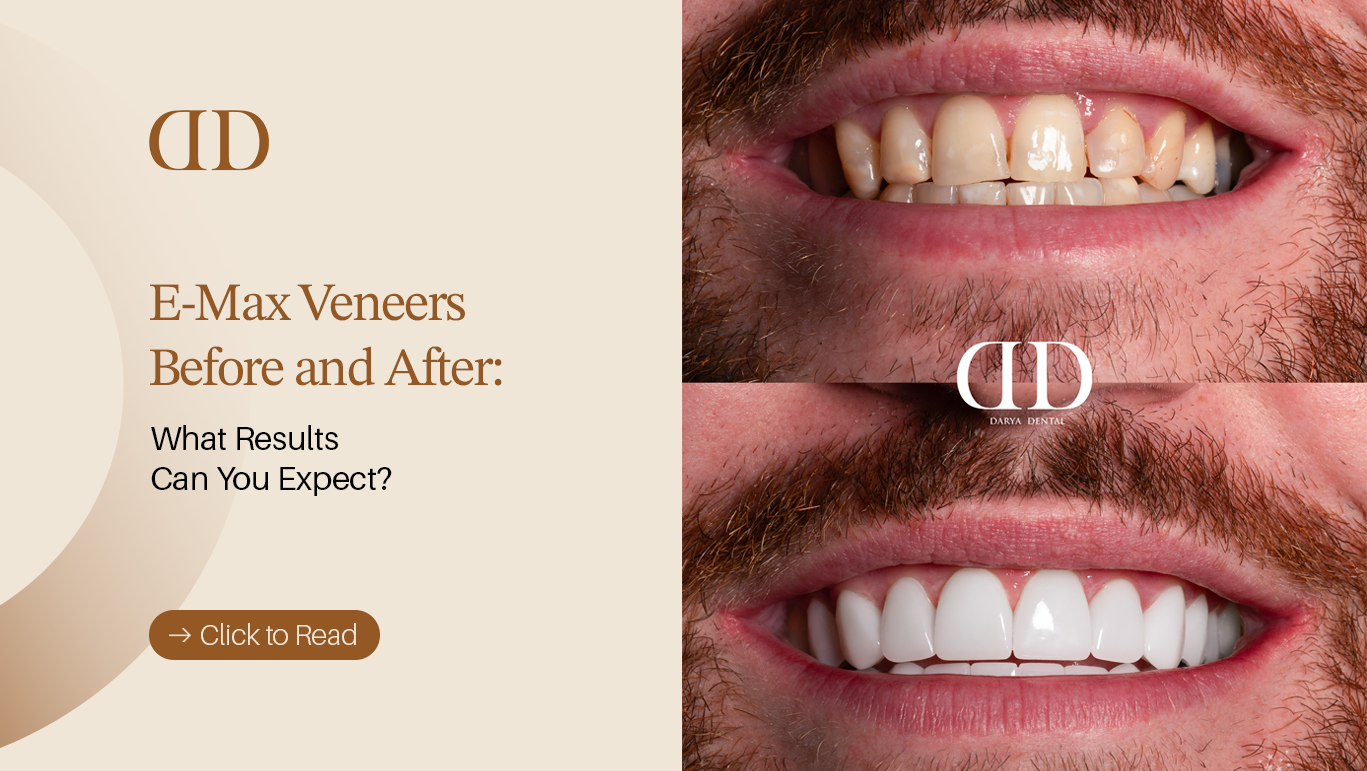

E-Max veneers before and after results can show noticeable changes in tooth colour, shape, proportions, symmetry and overall smile harmony. However, the final appearance depends on the starting condition of the teeth, bite, veneer design, shade selection and individual treatment planning.
Before-and-after photographs can make veneer treatment appear straightforward, but every smile has different characteristics. Two people receiving E-Max veneers made from the same material can have quite different results because the design must be adapted to the existing teeth, facial features and aesthetic goals.
The most useful way to evaluate e-max veneers before and after results is therefore not simply to ask whether the teeth look whiter. The important question is how the visible characteristics of the smile have changed and whether those changes look balanced and appropriate for that individual.
What Can E-Max Veneers Change About Your Smile?
E-Max veneers can modify several visible aspects of the teeth. Depending on the starting condition and treatment plan, they may create a more uniform tooth shade, alter tooth contours, improve apparent proportions, reduce the visual appearance of small gaps and restore chipped or uneven edges.
They are primarily an aesthetic restorative treatment. This means that the changes are focused on the visible appearance of the teeth rather than correcting significant orthodontic or functional problems.
| Before | Potential Change With E-Max Veneers |
| Discoloured teeth | More uniform shade |
| Uneven tooth shapes | More balanced proportions |
| Small gaps | Visually reduced or closed |
| Chipped edges | Restored tooth contour |
| Uneven smile | Improved visual symmetry |
The extent of the transformation depends on how much of the visible tooth structure needs to be changed and how the veneers are designed. A relatively small adjustment may produce a subtle result, while several veneers across the visible smile can create a more noticeable change.
Importantly, veneers should not be presented as a replacement for orthodontic treatment when teeth have significant positional problems. A veneer can sometimes make a minor alignment concern appear less noticeable, but it does not physically move the underlying tooth into a new position.
E-Max Veneers Before and After: The Main Visual Differences
When looking at e-max veneers results, several characteristics are particularly important. Colour is only one part of the transformation. The shape, length, width and relationship between neighbouring teeth can have an equally important influence on the final smile.
Tooth Colour and Brightness
One of the most immediately visible changes in E-Max teeth before and after photographs is tooth colour.
Premium Dental Care in Turkey
Expert treatments with high-end technology. Get your personalized quote today via WhatsApp.
Veneers can provide a more consistent shade across the treated teeth, particularly when the natural teeth have noticeable discolouration or differences in shade. The selected colour can range from relatively subtle to significantly brighter, depending on the individual’s aesthetic goals and the clinical situation.
However, a brighter result is not automatically a better result. A very opaque or excessively white appearance may look less natural if it does not correspond with the proportions, translucency and surface characteristics of the teeth.

Want trusted dental advice in your Google AI answers?
Add Darya Dental Turkey as a Preferred Source on Google to make our dental guides easier to find in your search results and AI Overviews.
A natural-looking result generally requires the shade to be considered together with the rest of the smile rather than selected in isolation.
Tooth Shape and Proportions
Shape can be just as important as colour when comparing emax veneers before and after images.
E-Max veneers may change the visible:
- Width of individual teeth
- Length of the crowns
- Shape of the incisal edges
- Contour of chipped areas
- Relationship between neighbouring teeth
- Overall proportions of the visible smile
For example, teeth that appear short or uneven before treatment may be designed with more consistent visible proportions. Similarly, small differences in tooth contour can sometimes be balanced through veneer design.
The objective is not necessarily to make every tooth identical. Natural smiles contain variation, and excessive uniformity can sometimes make restorations appear artificial.
Gaps and Minor Alignment Issues
Small spaces between teeth can sometimes be reduced or visually closed with veneers by changing the width and contour of the visible tooth surfaces.
This does not mean that veneers correct the underlying cause of every gap. The appropriate approach depends on why the space exists, how large it is and whether there are associated dental or functional concerns.
The same principle applies to mildly uneven tooth positions. Veneers may make a minor irregularity less noticeable in suitable cases, but significant crowding, rotation or malposition may require orthodontic assessment rather than cosmetic masking.
Smile Symmetry
Symmetry is another important part of an emax smile makeover.
When comparing before-and-after images, look at how the treated teeth relate to one another rather than examining each tooth separately. Differences in tooth length, edge position and visible proportions can affect how symmetrical the smile appears.
The relationship between the teeth and the smile line also matters. A veneer design that looks appropriate when one tooth is viewed alone may not produce the same visual effect when considered alongside the entire smile.
This is why the final result is influenced by the design of the complete group of restorations, not simply by the material used to manufacture them.
How Natural Can E-Max Veneers Look?
E-Max veneers are made from lithium disilicate ceramic, a material used in aesthetic dental restorations. However, the material itself does not guarantee a natural appearance. The final result depends on how the restoration is designed, fabricated and integrated with the surrounding teeth.
Several factors influence whether natural looking E-Max veneers blend convincingly with the smile:
- Translucency
- Shade selection
- Surface texture
- Tooth proportions
- Existing tooth colour
- Veneer thickness
- Laboratory fabrication
- Relationship with neighbouring teeth
Translucency is particularly relevant because natural teeth do not usually appear completely opaque. Light interacts with enamel and dentine in ways that contribute to their appearance. The restoration therefore needs to be considered in relation to the patient’s existing teeth and the desired aesthetic result.
The underlying tooth colour can also influence the final appearance. The same veneer shade may not produce an identical visual effect on different underlying tooth structures.
For this reason, E-Max veneers results should be considered patient-specific rather than as a fixed appearance associated with the material.
What Determines Your E-Max Veneers Before and After Result?
The final transformation is influenced by several factors before the veneers are even fabricated. This is one reason why comparing online before-and-after cases should be done carefully.
The main factors include:
- Starting condition of the teeth: Existing colour, shape, wear, chips and spacing affect the available treatment options.
- Number of veneers: Treating a limited number of teeth creates a different visual effect from treating a larger portion of the smile.
- Existing tooth colour: The colour underneath and around the restorations can influence the final appearance.
- Tooth position: Existing alignment affects what veneers can realistically change.
- Gum architecture: The visible relationship between teeth and gums contributes to smile proportions.
- Bite and occlusion: Functional factors need to be considered alongside aesthetic goals.
- Veneer design: Width, length, contour and incisal edge design all influence the result.
- Shade selection: The chosen shade needs to work with the overall smile rather than simply maximise whiteness.
- Dentist and laboratory planning: Clinical and laboratory decisions affect the final shape, colour and surface characteristics.
- Patient-specific aesthetic goals: A person seeking a subtle enhancement may have a very different result from someone seeking a more noticeable smile transformation.
This means there is no single standard e-max veneers transformation.
Two patients can receive E-Max veneers and still have substantially different before-and-after results. The material may be the same, but the starting teeth, facial proportions, smile characteristics and treatment objectives are not.
E-Max Veneers Before and After: The Main Visual Differences
What E-Max Veneers Cannot Fix
E-Max veneers are not automatically suitable for every dental concern. They can modify the visible appearance of teeth, but they do not correct every underlying structural, orthodontic or functional problem.
Significant tooth malposition, severe crowding, major bite problems or active oral disease may require a different treatment approach before veneers are considered. In these situations, simply covering the visible surface of a tooth may not address the underlying issue.
Veneers may also have limitations when a substantial amount of tooth structure is missing or when the available enamel and supporting structures are not suitable for the planned restoration.
This distinction is important when looking at realistic veneer results. A before-and-after photograph can show a dramatic visual improvement, but it does not necessarily show the clinical circumstances that made that result possible.
For example, a person with slightly uneven tooth edges may be able to achieve a more balanced appearance with veneers. Someone with significant orthodontic problems may need orthodontic treatment or another restorative approach instead.
The appropriate treatment therefore depends on an assessment of the teeth, gums, bite and overall oral condition rather than the desired appearance alone.
How to Read E-Max Veneers Before and After Photos
Before-and-after images can be useful for understanding possible outcomes, but they should not be treated as guarantees of what another patient will look like.
When reviewing e-max veneers before and after photographs, consider the following:
- Camera angle: The before and after photographs should ideally be taken from comparable angles.
- Lighting: Differences in lighting can significantly change how tooth colour and surface texture appear.
- Tooth proportions: Compare the width, length and shape of individual teeth.
- Gum line: Changes in the visible gum-to-tooth relationship can influence the perceived result.
- Surface texture: Natural-looking restorations have characteristics beyond simply being white.
- Shade: Consider whether the change is subtle, bright, opaque or translucent.
- Smile symmetry: Look at the relationship between neighbouring teeth and the overall smile.
- Number and type of restorations: Determine how many teeth were treated and what type of restoration was used.
- Veneers versus crowns: Confirm that the case actually involves veneers rather than crowns.
- Additional treatments: Other dental procedures may have contributed to the final appearance.
The distinction between veneers and crowns is particularly important. A gallery containing several types of restorations should not automatically be interpreted as evidence of E-Max veneer results.
For example, an E-Max crown transformation may look similar to an E-Max veneer case in a photograph, but the two restorations have different clinical indications and should not be presented as the same treatment.
This is especially relevant when evaluating clinic websites. The restoration used in each case should be clearly identified before using the image as a reference for potential E-Max teeth before and after results.
Are E-Max Veneers Results Permanent?
E-Max veneers can provide a long-term aesthetic change, but they should not be described as permanent restorations that will last for life.
They are dental restorations that can experience wear, fracture, debonding or other complications over time. Their longevity can be influenced by factors such as bite, oral hygiene, clinical planning, restoration design and maintenance.
Long-term evidence for lithium-disilicate laminate veneers is generally favourable. A 2024 systematic review reported a pooled long-term survival rate of 96.81% at approximately 10.4 years. However, this figure represents evidence across clinical studies and should not be interpreted as a guaranteed survival rate for an individual patient or as a Darya Dental success rate.
The practical point is that a successful aesthetic result should also be considered in terms of long-term maintenance. Regular dental examinations and appropriate oral care remain relevant after veneer treatment.
Can Your E-Max Veneer Result Be Predicted Before Treatment?
The final appearance can be planned to a certain degree, but it cannot be guaranteed with complete precision before treatment.
Clinical photographs, shade assessment, tooth measurements and aesthetic planning can help establish the intended direction of the treatment. Where applicable, digital planning or a mock-up can also help communicate proposed changes in tooth shape, proportions and overall smile appearance.
However, a preview should be regarded as a planning and communication tool rather than an exact promise of the final result.
The core principle is simple:
Previewing or planning a smile can help establish expectations, but it cannot guarantee an identical final outcome.
This is particularly important when patients compare their own teeth with highly edited or carefully selected online before-and-after photographs. The final appearance depends on individual anatomy and the specific clinical plan.
E-Max Veneers Before and After at Darya Dental Turkey
Before-and-after cases can provide useful visual context when the restoration used in the case is clearly identified.
Darya Dental Turkey has existing patient before-and-after material, including a case labelled as involving 12 E-Max veneers. Relevant E-Max veneer cases can be used to illustrate possible aesthetic changes, provided that the restoration type is accurately identified.
For each case, the most useful information is:
Before condition → Treatment → Number of veneers → Main aesthetic changes → After result
This gives readers more context than an image alone. It helps explain whether the primary change involved shade, tooth shape, proportions, spacing, symmetry or a combination of factors.
It is also important to distinguish E-Max veneers from E-Max crowns. Darya Dental’s existing before-and-after material includes cases explicitly labelled as E-Max Crowns, and these should not be presented as E-Max veneer transformations.
If relevant E-Max veneer cases are displayed, the accompanying descriptions should remain factual and should not imply that another patient will achieve the same outcome.
What Should You Consider Before Comparing E-Max Veneer Results?
An e-max veneers before and after comparison is most useful when the photographs show comparable conditions and the treatment details are clear. A dramatic visual difference does not necessarily mean that the same degree of change would be appropriate for another person.
The starting condition of the teeth is one of the most important variables. Existing tooth colour, tooth position, spacing, wear, chips, gum architecture and bite can all influence the treatment plan and final appearance.
The number of veneers also matters. A case involving a small number of front teeth may produce a more limited change, while treatment involving a larger portion of the visible smile can influence overall symmetry and colour consistency.
For this reason, before-and-after photographs should be viewed as examples of possible outcomes rather than predictions.
How Do E-Max Veneers Influence Overall Smile Harmony?
A successful aesthetic result is not simply about making individual teeth look better. The teeth need to work together as part of the entire smile.
Smile harmony can be influenced by:
- Tooth width and length
- Incisal edge position
- Tooth-to-tooth proportions
- Shade consistency
- Gum visibility
- Smile line
- Facial proportions
- Relationship between treated and untreated teeth
For example, making every tooth significantly longer may not necessarily create a more balanced smile. Similarly, choosing an extremely bright shade may create a stronger contrast with untreated teeth.
This is why emax smile makeover planning involves more than selecting a ceramic material. The shape, colour and proportions need to be considered together.
What Makes E-Max Veneers Look More Natural?
Natural-looking E-Max veneers depend on several elements working together. The ceramic material provides the foundation, but the final appearance also depends on design and fabrication.
Shade selection should account for the surrounding teeth and the intended appearance of the smile. Tooth contours should be proportionate rather than identical simply for the sake of uniformity. Surface texture and translucency can also influence how the restorations interact with light.
The underlying tooth colour is another consideration. Two people may receive veneers with the same nominal shade but see different visual results because the underlying teeth and surrounding structures are different.
Therefore, natural looking E-Max veneers are better understood as the result of coordinated clinical and laboratory planning rather than a guaranteed characteristic of E-Max ceramic itself.
What Do E-Max Veneers Look Like Before and After Treatment?
E-Max veneers can make teeth appear more uniform in colour, more balanced in shape and more consistent in proportion. Depending on the starting condition, they may also reduce the visible appearance of minor gaps, chipped edges or small aesthetic irregularities.
The degree of transformation varies considerably. Some cases may involve subtle refinements, while others may involve more noticeable changes across several visible teeth.
A useful before-and-after comparison should therefore focus on specific changes rather than simply asking whether the final smile looks better.
For example:
Before: Uneven tooth edges and differences in tooth shade
Treatment: E-Max veneers designed for the visible front teeth
After: More consistent colour, balanced contours and more uniform tooth proportions
This type of description gives the reader a clearer understanding of what the treatment actually changed.
Frequently Asked Questions
What do E-Max veneers look like before and after treatment?
E-Max veneers can create a more uniform tooth colour and modify visible tooth shape, proportions and symmetry. Depending on the starting condition, they may also reduce the appearance of small gaps or chipped edges. The final result varies according to individual anatomy and treatment planning.
How much can E-Max veneers change your smile?
E-Max veneers can produce anything from a relatively subtle aesthetic refinement to a more noticeable smile transformation. The degree of change depends on the number of veneers, starting tooth condition, shade, shape, proportions and overall treatment plan.
Do E-Max veneers look like natural teeth?
E-Max veneers can have a natural appearance when their shade, translucency, surface characteristics, proportions and contours are appropriately designed. However, E-Max ceramic alone does not guarantee a natural-looking result.
Can E-Max veneers fix gaps between teeth?
E-Max veneers can sometimes visually reduce or close small gaps by modifying the visible width and contour of the teeth. Larger or structurally significant spaces may require a different treatment approach.
Can E-Max veneers make crooked teeth look straighter?
E-Max veneers can sometimes make mildly uneven teeth appear visually straighter by changing their visible contours. They do not physically reposition teeth, so significant crowding, rotation or malposition may require orthodontic assessment.
Will my E-Max veneer results look exactly like before-and-after photos?
No. Before-and-after photographs demonstrate a particular patient’s outcome and cannot guarantee the same result for another person. Differences in tooth condition, position, colour, bite, gum architecture and treatment planning can significantly affect the final appearance.
What affects the final appearance of E-Max veneers?
The starting condition of the teeth, number of veneers, tooth colour, position, gum architecture, bite, veneer design, shade selection and clinical and laboratory planning can all influence the final appearance. Individual aesthetic preferences also play an important role.
How long do E-Max veneer results last?
E-Max veneers are designed as long-term dental restorations but should not be considered permanent for life. Research on lithium-disilicate laminate veneers has reported favourable long-term survival, although individual longevity depends on clinical and patient-specific factors.
E-Max veneers before and after results can involve much more than a change in tooth colour. Depending on the individual case, treatment may alter tooth shape, proportions, visible spacing, symmetry and the overall balance of the smile.
The most important point is that there is no universal E-Max veneer result. The same material can produce very different outcomes because each patient’s teeth, bite, gum architecture, facial proportions and aesthetic goals are different.
Before-and-after photographs can help demonstrate possible results, but they should be evaluated carefully. Look at the lighting, camera angle, number of treated teeth, restoration type and other treatments involved rather than assuming that every visible transformation is directly attributable to E-Max veneers.
For patients considering treatment, a personalised assessment provides a more meaningful basis for understanding what changes may be realistic than comparing their smile with an online photograph.
