
How Is a Dental Crown Shade Chosen to Match Natural Teeth?
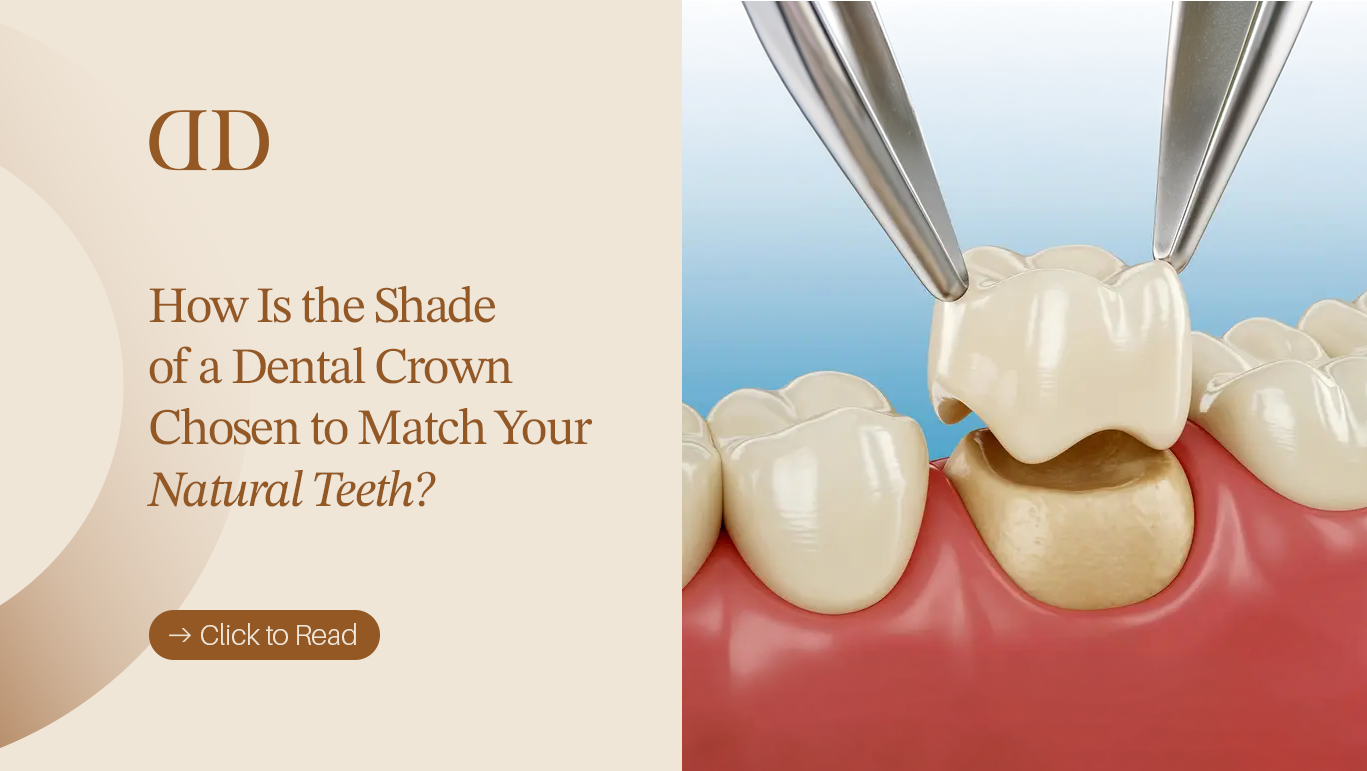

Dental crown shade matching is the process of selecting and reproducing a crown colour that fits naturally with the surrounding teeth. Dentists assess the neighbouring teeth using shade guides, appropriate lighting and, when useful, digital measurement. They consider not only how light or dark a tooth looks, but also its hue, chroma, translucency and natural colour variations.
The goal is not simply to choose the “whitest” available dental crown shade. Instead, the shade is selected in relation to the patient’s existing teeth and the optical characteristics of the planned restoration.
What Is Dental Crown Shade Matching?
Dental crown shade matching is the clinical and laboratory process used to determine how a tooth-coloured crown should look before it is fabricated.
Natural teeth are not a single uniform colour. Their appearance is influenced by several colour and optical characteristics, including:
- Value: how light or dark the tooth appears
- Hue: the basic colour family
- Chroma: the intensity or saturation of the colour
- Translucency: how much light passes through the tooth or restoration
- Surface characteristics: texture and gloss can affect how light is reflected
- Lighting: the same tooth can appear different under different light sources
This is why choosing a crown by simply comparing it with a single “white” sample can be misleading. A natural-looking dental crown needs to fit the visual characteristics of the adjacent teeth, particularly when it is placed in the visible part of the smile.
The surrounding teeth usually provide the most important visual reference for a single crown. However, the dentist also needs to consider the planned restorative material, the condition of the tooth underneath and how the crown will interact with light.
How Is the Shade of a Dental Crown Selected?
Although techniques vary between clinical situations, crown shade matching generally follows a sequence rather than relying on one quick colour comparison.
Using a VITA Shade Guide
One commonly used approach is a standardized shade guide. The VITA Classical A1–D4 system and VITA SYSTEM 3D-MASTER are examples of established tooth shade systems used to communicate tooth colour between dental practices and laboratories.
VITA Classical uses a set of standardized shade samples, while the 3D-MASTER system organizes shades more systematically according to characteristics such as lightness, chroma and hue.
Premium Dental Care in Turkey
Expert treatments with high-end technology. Get your personalized quote today via WhatsApp.
The dentist compares the shade samples with the patient’s natural teeth and identifies the combination that most closely represents the tooth colour being reproduced.
This distinction matters because two teeth can appear similarly bright while differing in their underlying hue or colour intensity. A shade guide therefore provides more information than simply asking whether a tooth looks “white enough.”

Want trusted dental advice in your Google AI answers?
Add Darya Dental Turkey as a Preferred Source on Google to make our dental guides easier to find in your search results and AI Overviews.
For a single visible crown, the adjacent natural teeth are particularly important. The selected shade should be considered in the context of the smile rather than in isolation.
Matching Shade Under Appropriate Lighting
Lighting can change how a dental crown shade and natural tooth colour are perceived.
For this reason, shade selection is not ideally performed under just any available light. Controlled or appropriate daylight conditions can help provide a more consistent visual environment. Research has also shown that the lighting and background used during shade selection can influence the consistency of visual colour matching.
This is one reason a shade that appears suitable under one light source may look noticeably different under another.
The dentist may therefore evaluate the tooth and shade guide under suitable lighting and avoid relying on a single visual impression. This is particularly relevant for anterior crowns, where even relatively subtle colour differences can be visible.
Why Tooth Hydration Matters
The condition of the natural tooth surface can also affect shade perception.
When a tooth becomes dehydrated, its appearance can change. Because of this, tooth shade selection is generally performed before the tooth has been significantly dehydrated during treatment.
This is especially important when preparing a tooth for a crown. The preparation process can alter the tooth’s moisture state, so taking the shade beforehand helps the dentist use the natural tooth as a more reliable reference.
The timing of tooth shade selection therefore matters. Shade matching is not simply a final step after the tooth has been prepared; it is part of the planning process.
Looking at Hue, Value, Chroma and Translucency
A natural tooth is optically more complex than a flat colour sample.
Value describes relative lightness or darkness. If the value is noticeably different, a crown may look too bright or too dark compared with neighbouring teeth.
Hue refers to the basic colour family. Teeth can contain subtle variations rather than appearing as a completely neutral white.
Chroma describes colour intensity. Two teeth can have a similar value while one appears more saturated or warmer than the other.
Translucency is different again. It describes how light interacts with and passes through the tooth or restoration. Natural teeth often have different optical characteristics in different areas, with the incisal portion of an anterior tooth, for example, potentially appearing more translucent than the cervical area.
| Factor | What it affects |
| Value | Lightness or darkness |
| Hue | Basic colour family |
| Chroma | Colour intensity |
| Translucency | How light passes through the restoration |
| Lighting | How the shade is perceived |
| Tooth hydration | Can alter the apparent appearance of the natural tooth |
| Material | Influences the final optical behaviour |
| Underlying tooth | Can influence the appearance of the completed restoration |
Considering these factors helps explain why dental crown colour matching is more than selecting the closest-looking tab from a shade guide.
The dentist and dental laboratory also need to communicate the selected shade clearly. When the restoration is fabricated, the laboratory uses the shade information together with the chosen material and restoration design to reproduce the intended appearance.
For patients, the practical takeaway is simple: a crown does not need to be the brightest possible shade to look natural. It needs to be appropriate for the surrounding teeth and the optical properties of the restoration.
A final visual assessment can then help determine whether the completed crown integrates appropriately with the rest of the smile before definitive placement.
How Do Digital Tools Help Match a Crown Shade?
Visual shade guides remain an important part of dental crown shade matching, but digital tools can provide additional information when a more detailed colour assessment is needed.
Digital Shade Measurement and Photography
Digital shade measurement systems can assess tooth colour using electronic imaging or spectrophotometric methods. These technologies can help record colour information in a more standardized way than relying entirely on visual comparison.
Digital photography can also be useful for documenting the appearance of the natural teeth and communicating information to the dental laboratory. A properly controlled photograph can show details that may be difficult to describe in writing alone, including colour variation, translucency and differences between different areas of the tooth.
However, digital tools should be viewed as supplementary tools rather than a replacement for clinical judgement. The final appearance of a crown depends on several interacting factors, including the tooth itself, the restorative material, restoration thickness and the lighting under which it is viewed.
For this reason, digital dental shade matching works best as part of a broader workflow that combines clinical assessment, standardized shade information and communication with the laboratory.
How Does Crown Material Affect the Final Colour?
The selected restorative material can influence how the final crown colour looks.
Ceramic materials differ in their composition, translucency and optical behaviour. This means that the same nominal shade does not necessarily produce an identical visual result in every material.
The thickness of the restoration can also influence its appearance. A thin translucent restoration may interact with the underlying tooth differently from a thicker restoration. Similarly, the colour of the underlying tooth can influence the final appearance, particularly when a restoration allows some light to pass through.
This is one reason the shade selection process should not be separated completely from material selection.
For visible anterior restorations, translucency can be particularly relevant to achieving a natural-looking dental crown. A restoration that has an appropriate basic shade but very different optical behaviour from the surrounding teeth may still look different when viewed in the mouth.
The dental laboratory therefore needs information not only about the selected shade but also about the planned restoration and material.
A simplified way to understand the relationship is:
Natural tooth colour + shade selection + material + thickness + underlying tooth + lighting → final perceived crown colour
The result is not determined by the shade-guide number alone.
This is also why material selection should be individualized rather than based on a universal rule that one type of crown is always preferable. E-Max, zirconia and porcelain-based restorations have different optical and mechanical characteristics, and the appropriate choice depends on the clinical situation.
For more information about the broader crown treatment process, see Darya Dental’s Dental Crown treatment page.
Should Teeth Be Whitened Before Choosing a Crown Shade?
If a patient is considering dental crown whitening or professional teeth whitening, the timing should be discussed before the final crown shade is selected.
The reason is straightforward: whitening changes the colour of natural teeth, but tooth-coloured crowns do not respond to bleaching in the same way.
If a crown is made first and the surrounding natural teeth are whitened afterwards, the natural teeth may become lighter while the crown remains essentially the same colour. This can create a visible difference between the restoration and neighbouring teeth.
For patients planning both treatments, the preferred sequence therefore needs to be considered during treatment planning. In many cases, the desired natural tooth colour is established before the final shade for a visible crown is selected.
This does not mean that everyone needs to whiten their teeth before receiving a crown. Whitening is a separate cosmetic treatment, and whether it is appropriate depends on the individual’s teeth, treatment goals and dental health.
Darya Dental’s teeth whitening treatment page provides information about the whitening treatment itself.
What if the Teeth Have Already Been Whitened?
A crown can be planned to match teeth that have already undergone whitening, but the shade should be assessed after the natural teeth have reached the intended colour.
This is particularly relevant when a crown will be visible next to several natural teeth. Choosing a shade before the final tooth colour has been established can make colour planning less predictable.
Patients who already have crowns or other tooth-coloured restorations should also understand that whitening primarily affects natural tooth structure. Existing restorations generally do not become lighter simply because the surrounding teeth are bleached.
This is why the question “can a crown match a tooth that has already been whitened?” is usually approached by assessing the current colour of the natural tooth and selecting the restoration accordingly.
For patients considering whitening before restorative treatment, the sequence can be discussed during the consultation rather than decided after the crown has already been fabricated.
What Happens If a Crown Does Not Match the Nearby Teeth?
A crown that looks different from the surrounding teeth does not necessarily mean that the entire treatment has failed. Colour can be influenced by lighting, hydration, material, thickness and the visual environment, so the restoration needs to be assessed under appropriate conditions.
The clinical team may evaluate the crown during a try-in or other pre-finalization stage, depending on the restoration and treatment workflow.
Several aspects can be checked together:
- Shade: Does the basic colour integrate with the neighbouring teeth?
- Value: Does the crown appear noticeably lighter or darker?
- Hue and chroma: Does the colour have the appropriate warmth and intensity?
- Translucency: Does the crown interact with light in a reasonably natural way?
- Shape: Does the contour fit the surrounding teeth?
- Surface appearance: Does texture and gloss affect the visual integration?
- Bite: Does the restoration function correctly in relation to the opposing teeth?
This broader assessment matters because a crown can have a close colour match but still appear different because its shape, translucency or surface characteristics are not consistent with the surrounding teeth.
If a visible discrepancy is identified before final placement, communication between the dentist and dental laboratory is important. The appropriate correction depends on the type of discrepancy and the stage of treatment.
A useful principle is that crown colour matching should be evaluated as part of the complete restoration, not as an isolated shade number.
Single Crowns vs Multiple Crowns
Shade selection can become more complex when several visible crowns are being planned.
With a single crown, the surrounding natural teeth provide a direct reference. With multiple adjacent crowns, the laboratory may have greater control over the overall appearance because several restorations can be designed together.
This can be useful when a patient is replacing or restoring several visible teeth at the same time. Instead of attempting to make one restoration blend into multiple existing tooth colours, the restorations can be planned as a coordinated group.
The appropriate approach depends on how many teeth are being restored, their position in the smile and the patient’s existing tooth colour.
Why Laboratory Communication Matters
Shade selection does not end when the dentist chooses a shade tab.
The selected information needs to be communicated to the dental laboratory accurately. Depending on the case, this can include shade-guide information, photographs, digital measurements and notes about translucency or other visual characteristics.
Good communication helps the laboratory understand what the dentist is trying to reproduce.
This is particularly important because natural teeth often contain subtle variations that are difficult to describe using one shade code alone. A photograph or additional shade information can help communicate those characteristics more clearly.
For patients, this means that the final appearance of a crown is the result of several connected stages: clinical shade selection, documentation, material selection, laboratory fabrication and final clinical evaluation.
When these stages are considered together, the goal is not simply to produce a crown with a particular shade number. It is to create a restoration that visually integrates with the surrounding teeth as naturally as the clinical situation allows.
Frequently Asked Questions
Can a dental crown be made to match my natural teeth?
Yes, a dental crown can be planned to visually match the surrounding natural teeth, but an exact visual match cannot be guaranteed in every case. Dentists consider the neighbouring teeth, shade, lighting, translucency, material and other optical characteristics when selecting and fabricating the crown.
How do dentists choose the shade for a dental crown?
Dentists typically assess the natural teeth using a standardized shade guide, appropriate lighting and clinical observation. The process can also involve digital photography or digital shade measurement. Shade selection considers more than brightness alone, including value, hue, chroma and translucency.
What is a VITA shade guide?
A VITA shade guide is a standardized system used to help identify and communicate tooth colour. VITA Classical and VITA SYSTEM 3D-MASTER are examples of shade systems used in dentistry. They provide standardized references that can be communicated between the dental practice and laboratory.
Does lighting affect dental crown shade matching?
Yes. Lighting can influence how both natural teeth and dental restorations appear. A shade that looks suitable under one light source may appear different under another. This is why appropriate or standardized lighting is important when selecting and assessing a crown shade.
Why must the tooth stay moist during shade selection?
Tooth dehydration can alter the apparent appearance of a natural tooth. Shade selection is therefore generally performed before significant dehydration occurs during treatment. This gives the dentist a more representative reference for the tooth’s natural appearance.
Can a crown match a tooth that has already been whitened?
Yes. A crown can be planned to match a tooth after whitening, but the shade should ideally be selected once the desired natural tooth colour has been established. This is because whitening changes natural tooth colour, while an existing crown does not simply become lighter through bleaching.
Can dental crowns be whitened after they are placed?
Generally, whitening products act on natural tooth structure rather than changing the colour of an existing tooth-coloured crown. If natural teeth are whitened after a crown has been placed, they may become lighter while the crown remains the same colour, potentially making a difference more noticeable.
What happens if a new crown is a different colour from the surrounding teeth?
The crown can be assessed during the appropriate clinical try-in or evaluation stage. The dentist and laboratory can review the shade, value, translucency and other visual characteristics to determine whether an adjustment or remaking of the restoration is appropriate.
What Should You Know Before Choosing a Crown Shade?
The most important point is that dental crown shade matching is not simply a matter of choosing the whitest shade available.
A more complete assessment considers:
- The colour of the adjacent natural teeth
- Value, hue and chroma
- Tooth hydration
- Lighting conditions
- Translucency and other optical characteristics
- The planned crown material
- Restoration thickness and the underlying tooth
- Information communicated to the dental laboratory
- The appearance of the completed crown during final clinical evaluation
This approach is particularly relevant for visible teeth, where relatively small differences in colour or translucency can be easier to notice.
It is also useful to distinguish between selecting a shade and reproducing the complete optical character of a natural tooth. A natural tooth may contain subtle colour gradients and differences in translucency that cannot always be represented by one shade-guide tab.
For this reason, the final result depends on the complete clinical and laboratory workflow rather than on a single shade selection.
Dental Crown Shade Matching: The Key Takeaway
A natural-looking crown starts with careful shade selection, but shade matching does not end with a shade-guide number. Dentists consider the surrounding teeth, lighting, hydration, colour dimensions, translucency and restorative material before communicating the information to the dental laboratory.
If you are considering a crown, the appropriate shade and material depend on your individual teeth and treatment plan. A personalized assessment can determine how the restoration should be planned and how its colour should relate to the surrounding teeth.
For a broader overview of crown treatment, materials and the clinical process, you can continue to Darya Dental’s Dental Crown page.
