
Different Types of Veneers: Which One Is Right for You

The transformative power of a smile is often underestimated until you find yourself hesitant to show yours in a photograph or during a conversation. For many, veneers represent the gold standard in cosmetic dentistry, offering a comprehensive solution to imperfections ranging from deep discoloration to structural irregularities. While the concept of a “perfect smile” used to be reserved for Hollywood elites, advancements in material science and digital dentistry have made high-end dental aesthetics accessible to a global audience.
Choosing the right Veneers is not a one-size-fits-all decision. It is a clinical intersection where your unique facial symmetry, biting force, and aesthetic goals meet the specific properties of dental ceramics or resins. Whether you are looking for the translucent brilliance of emax veneers or the conservative approach of composite veneers, understanding the nuances of each material is the first step toward a successful transformation. At Darya Dental Clinic, we believe that an informed patient is the best partner in achieving a natural-looking, long-lasting result.
What Are Veneers?
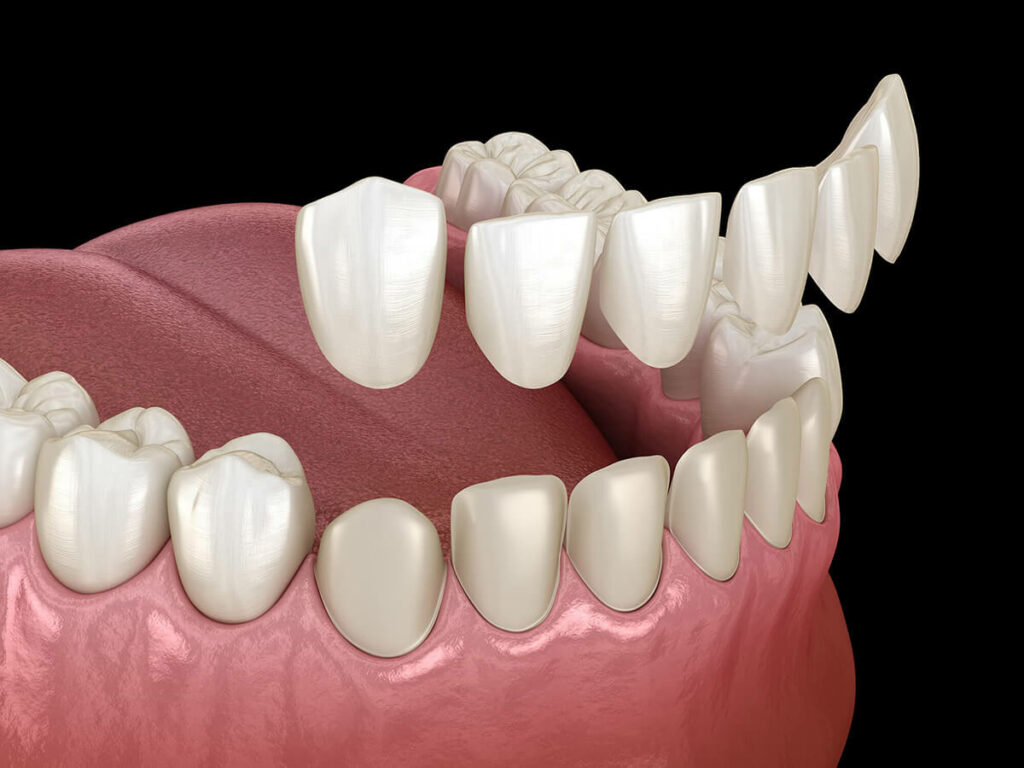
In the simplest clinical terms, Veneers are ultra-thin shells custom-crafted from porcelain or composite materials designed to cover the facial (front) surface of a tooth. Think of them as a protective and aesthetic “façade” that masks the natural tooth underneath. Dental veneers are primarily used to correct aesthetic concerns that traditional whitening or orthodontics might not fully address, such as:
- Intrinsic Staining: Discoloration caused by tetracycline use or excessive fluoride that cannot be bleached.
- Microdontia: Teeth that are unusually small, creating unwanted gaps.
- Enamel Erosion: Wear and tear that leaves teeth looking dull or translucent at the edges.
- Minor Misalignment: Often referred to as “instant orthodontics” for teeth that are slightly rotated or crowded.
When we discuss laminate teeth veneers, we are referring to the sophisticated layering process used to mimic the light-reflecting properties of natural human enamel. The goal of modern veneers in dental practices is no longer to create a “picket fence” of bright white teeth, but rather to create a harmonious, lifelike smile that complements the patient’s age and skin tone.
Are Veneers Permanent?
One of the most frequent questions we encounter at Darya Dental is whether veneers are a reversible procedure. The short answer is: in most cases, yes, they are considered permanent.
To ensure a veneers sits flush with the rest of your smile and doesn’t look “bulky,” a dentist must usually remove a small amount of enamel typically between 0.3mm to 0.7mm. Enamel does not grow back. Therefore, once a tooth has been prepared for veneer’s teeth, it will always require a restoration of some kind to protect the underlying dentin.
However, there are “no-prep” options available, which we will explore later, that require little to no removal of the natural tooth structure. Even so, the commitment to dental veneers is a long-term clinical relationship. You are choosing to upgrade your natural structure with a superior, more resilient material. According to the American Dental Association (ADA), the preparation of the tooth is a critical step in ensuring the bonding agent creates a biological and mechanical seal that prevents decay.
How Long Do Veneers Last?
The longevity of your new smile depends heavily on the material chosen and your post-operative care. While veneers are remarkably durable, they are not invincible. On average, you can expect the following lifespans:
- Porcelain/E-max Veneers: 10 to 15 years, and often up to 20 years with meticulous care.
- Composite Veneers: 5 to 7 years, as the resin is more prone to staining and chipping over time.
The lifespan of turkey veneers a popular choice for international patients seeking high-quality care at a lower veneers cost is identical to those placed anywhere else in the world, provided the clinical standards are met. Factors that can shorten the life of your veneers include:
Premium Dental Care in Turkey
Expert treatments with high-end technology. Get your personalized quote today via WhatsApp.
- Bruxism: Grinding your teeth at night can crack even the strongest tooth porcelain veneers.
- Oral Hygiene: While the veneer itself cannot decay, the tooth underneath can. Gum recession can also expose the margins of the restoration.
- Trauma: Using your teeth as tools (opening bottles or tearing plastic) is the leading cause of premature failure.
At Darya Dental, we emphasize that the “success” of veneers is measured not just by how they look on the day of placement, but by how they function a decade later. This is why choosing the right type of material for your specific bite and lifestyle is paramount.
5 Types of Dental Veneers
When exploring the different types of tooth veneers, it is easy to get overwhelmed by the branding and technical jargon. However, most options fall into five distinct categories, each with its own set of indications, pros, and cons.

Want trusted dental advice in your Google AI answers?
Add Darya Dental Turkey as a Preferred Source on Google to make our dental guides easier to find in your search results and AI Overviews.
Porcelain Veneers
Tooth porcelain veneers remain the gold standard in cosmetic dentistry for a reason. Porcelain is a glass-like ceramic that shares a very similar refractive index to natural enamel. This means that light doesn’t just bounce off the surface; it penetrates the material and reflects from the layer underneath, giving the teeth a “soul” and depth that cheaper materials lack.
Within this category, e-max veneers (made from lithium disilicate) are the most popular. They are incredibly thin yet significantly stronger than traditional feldspathic porcelain. This strength allows for less tooth reduction while providing a restoration that can withstand the rigors of daily chewing. If you are looking for the most durable and aesthetically pleasing veneers, porcelain is almost always the recommended choice.
Composite Resin
Composite veneers are crafted from a tooth-colored resin the same material used for dental fillings. Unlike porcelain, which must be fabricated in a laboratory, composite can often be applied directly to the tooth in a single visit.
The primary advantage here is the veneers cost. Composite is significantly more affordable than porcelain. It is also more “repairable”; if a porcelain veneer chips, the entire unit usually needs replacement, whereas composite can often be patched. However, the trade-off is aesthetics and durability. Composite resin is porous, meaning it will eventually stain from coffee, tea, or tobacco, and it lacks the translucent “glow” of high-end ceramics.
No-Prep Veneers
For patients who are hesitant about enamel removal, no-prep veneers (such as Lumineers) offer a compelling alternative. These are ultra-thin (about the thickness of a contact lens) and are bonded directly onto the existing enamel.
While they are excellent for closing small gaps or slightly widening a smile, they aren’t suitable for everyone. Because no tooth structure is removed, “no-prep” options can sometimes look slightly “thick” if not planned perfectly by an expert clinician. They are best suited for patients with small teeth or those looking for a very subtle enhancement.
Same Day Veneers
In the era of instant gratification, “Same Day” veneers have gained significant traction. This process utilizes CAD/CAM (Computer-Aided Design and Manufacturing) technology, often referred to as CEREC Crown. Instead of taking physical impressions and sending them to an external laboratory, the dentist uses a 3D intraoral scanner to capture a digital map of your teeth.
The veneers is then milled right in the office from a solid block of ceramic. While this eliminates the need for temporary restorations and a second appointment, there is a minor trade-off. Lab-made veneers teeth are often handcrafted by master ceramists who layer different shades of porcelain to mimic the natural gradient of a tooth. Same-day versions, being milled from a single block, can sometimes lack that hyper-realistic internal characterization. However, for those with a busy schedule, they remain a high-quality, efficient option.
Palatal Veneers
Most people associate veneers with the front of the smile, but palatal veneers serve a functional, restorative purpose. These are applied to the lingual (tongue-side) surface of the upper teeth. They are typically prescribed for patients suffering from severe enamel erosion caused by chronic acid reflux or bulimia.
By reinforcing the back of the tooth with a thin layer of gold, composite, or porcelain, the dentist can restore the tooth’s structural integrity and prevent further thinning. While not a “cosmetic” procedure in the traditional sense, they are a vital component of veneers in dental restorative work, often preventing the need for full-coverage crowns.
What is the Best Type of Veneer?
Determining the “best” type of veneer is a subjective process that depends entirely on your clinical needs, your budget, and your aesthetic desires. There is no singular “perfect” material, but rather a perfect material for you.
To help you navigate the different types of tooth veneers, we have compiled a comparative analysis based on the most critical factors patients consider:
| Feature | Porcelain (E-max) | Composite Resin | No-Prep Veneers |
| Durability | Extremely High (10-20 years) | Moderate (5-7 years) | High (10+ years) |
| Aesthetics | Superior Translucency | Good (can look “flat”) | Excellent (but can be bulky) |
| Stain Resistance | High (Non-porous) | Low (Porous) | High |
| Reversibility | No | Yes (usually) | Yes |
| Veneers Cost | Higher Initial Investment | Lower Initial Investment | Higher |
| Best For | Total smile makeover | Minor chips/budget-conscious | Small teeth/Gap closure |
When we evaluate a patient at Darya Dental Clinic, we look at the “occlusion” or the way your teeth meet. If you have a heavy “bite” or grind your teeth, tooth porcelain veneers are almost always the superior choice because composite resin would simply fracture under the pressure.
Which Veneers Look Most Natural?
The hallmark of a high-end cosmetic result is that no one can tell you’ve had work done. When patients ask which veneers look most natural, the answer almost always points toward e-max veneers.
The secret lies in “translucency.” Natural teeth are not opaque; they allow light to pass through the enamel and reflect off the dentin underneath. e-max veneers made from high-strength lithium disilicate are prized for their ability to replicate this light behavior. Furthermore, because they are so strong, they can be made thinner than traditional porcelain, meaning they don’t look “picket-fence” thick.
Another factor in natural aesthetics is the skill of the lab technician. In the case of Turkey veneers, international patients often benefit from clinics that have in-house master ceramists. These experts hand-paint the “mamelons” (the natural ridges on the biting edge of teeth) and add subtle color variations so that your laminate teeth veneers match the surrounding natural teeth perfectly.
What are Alternatives to Veneers?
While veneers are a powerful tool, they aren’t the only way to achieve a radiant smile. Depending on your goals, your dentist might suggest:
- Dental Bonding: This uses the same material as composite veneers but is used to fix localized issues like a single chipped tooth rather than a full set of teeth. It is the most conservative and affordable option.
- Orthodontics (Invisalign): If your primary concern is “crooked” teeth rather than the shape or color, clear aligners are often the better biological choice. It is always better to move natural teeth than to cut them, if possible.
- Professional Whitening: Sometimes, the simplest solution is the best. If your teeth are structurally sound and well-aligned, high-grade professional whitening can provide the “refresh” you are looking for without the need for dental veneers.
- Dental Crowns: If a tooth has lost more than 50% of its natural structure due to decay or a large filling, a veneer won’t provide enough support. In these cases, a full-coverage crown is necessary to protect the tooth.
Understanding these alternatives is crucial because veneer teeth are an elective cosmetic enhancement. A reputable clinician will always present these options to ensure you aren’t over-treating a simple problem. According to research from the Oral Health Foundation, preserving natural tooth structure should always be the priority in any treatment plan.
The Veneer Procedure: What to Expect
Embarking on a journey to a new smile is an exciting process that usually unfolds over two to three appointments. Whether you are opting for E-max veneers or traditional tooth porcelain veneers, the clinical precision required remains the same.
- The Consultation & Digital Design: This is the most critical phase. At Darya Dental, we use digital smile design to show you a “mock-up” of your future smile. We analyze your facial features to ensure the veneers harmonize with your natural appearance.
- Tooth Preparation: To ensure the veneer adheres perfectly, a microscopic layer of enamel is removed. Local anesthesia is used to ensure the process is completely painless.
- The Impression: A digital or physical mold is taken and sent to the laboratory. If you are getting Turkey veneers, this is where the local master ceramists begin their work, hand-crafting each unit.
- Temporary Veneers: While your permanent veneers teeth are being fabricated, you will wear temporary ones to protect your prepared teeth and give you a “test drive” of your new look.
- Final Bonding: Once the permanent restorations arrive, the dentist will check the fit and color. If everything is perfect, they are bonded using a light-sensitive resin that creates a permanent, high-strength seal.
Understanding Veneers Cost and Value
One cannot discuss different types of tooth veneers without addressing the financial aspect. The veneers cost is often the deciding factor for many patients, and it can vary wildly depending on the material, the complexity of the case, and most importantly the geographical location of the clinic.
In Western countries like the US and UK, the price of a full set of dental veneers is often seen as a luxury beyond reach. However, Istanbul has emerged as the global capital for “affordable luxury” in dentistry. By choosing Turkey veneers, patients are no longer forced to choose between quality and cost. At Darya Dental Clinic, we offer European-standard treatments at a fraction of the cost found in London or New York, typically saving our patients 40% to 70% on their total treatment plan.
Global Cost Comparison (Per Tooth)
To give you a clearer perspective on why international patients flock to Istanbul, here is a breakdown of the average veneers cost in 2026:
| Veneer Type | Istanbul | United Kingdom (UK) | United States (USA) |
| Composite Veneers | $150 – $250 | $400 – $800 | $900 – $1,500 |
| Porcelain Veneers | $250 – $450 | $800 – $1,400 | $1,200 – $2,500 |
| E-max Veneers | $300 – $550 | $900 – $1,600 | $1,500 – $3,000 |
| Full Set (20 Teeth) | $5,500 – $8,500 | $18,000 – $30,000 | $25,000 – $50,000+ |
Why Choose Darya Dental Clinic in Istanbul?
While the lower prices are attractive, the true value at Darya Dental Clinic lies in our “quality-first” approach. The significant savings (often exceeding 50% compared to the UK) are not a result of lower quality, but rather lower operational and labor costs in Turkey.
When you choose us for your veneers teeth transformation, you benefit from:
- Premium Materials: We use only top-tier German and Swiss ceramics, ensuring your E-max veneers have the same (or better) durability as those placed in expensive Harley Street or Beverly Hills clinics.
- Expert Surgeons: Our clinical team consists of internationally trained specialists who focus on “One Patient at a Time,” ensuring meticulous attention to detail.
- Transparent Pricing: No hidden fees. Our quotes include consultations and the highest grade of Laminate teeth veneers.
- Advanced Technology: We utilize CAD/CAM digital smile design to ensure your veneers fit your facial symmetry perfectly before we even begin the procedure.
Investing in high-quality tooth porcelain veneers at Darya Dental saves you from the future costs of repairs and replacements that often come with the budget-grade materials used in high-volume “teeth factories.” Here, you get world-class aesthetics at an Istanbul price point.
Making Your Choice
Choosing between the different types of tooth veneers is a decision that impacts your appearance, your oral health, and your self-esteem for years to come. Whether you choose the unparalleled beauty of E-max veneers, the versatility of Composite veneers, or the conservative nature of no-prep options, the goal is the same: a smile that makes you feel like the best version of yourself.
At Darya Dental Clinic, we specialize in creating bespoke smiles that blend scientific precision with artistic vision. Veneers in dental care are more than just a cosmetic fix; they are a long-term investment in your quality of life. According to the National Institutes of Health (NIH), the psychological benefits of a confident smile are linked to improved social interactions and professional success.
If you are ready to explore how veneers can transform your life, the next step is a professional evaluation. By understanding your unique anatomy and goals, we can help you choose the material and technique that will ensure your smile stays bright, healthy, and natural for decades.
Frequently Asked Questions About Veneers
Does the Procedure For Getting Veneers Hurt?
The preparation of the teeth is performed under local anesthesia, so you should feel no pain. Some patients experience “bonding sensitivity” for a few days after the final placement a mild reaction to the adhesive but this typically subsides quickly.
Can I Eat Normally With Veneers?
Yes. Once your veneers are bonded, you can eat most foods. However, we recommend avoiding biting into very hard objects (like ice or hard candy) with your front teeth, as this can chip the porcelain.
Do Veneers Stain Like Natural Teeth?
High-quality tooth porcelain veneers and e-max veneers are non-porous and highly resistant to staining. Unlike natural enamel or composite veneers, they will not darken from coffee or red wine. However, the surrounding natural teeth can still stain, so regular cleanings are essential.
Can I Get My Veneers Whitened?
No. veneer material does not respond to chemical whitening agents. If you plan to whiten your natural teeth, it is best to do so before your veneers are made, so the dentist can match the porcelain to your new, brighter shade.
What happens if a Veneer comes off?
While rare, a veneer can occasionally de-bond. If this happens, keep the veneer safe and contact your dentist immediately. In many cases, if the porcelain is intact, it can be re-bonded to the tooth.
